Genusaurus
JEN-yoo-SORE-us
"knee lizard"
Type species Genusaurus sisteronis
- Lived
- 110 to 106 million years ago, Early Cretaceous
- Diet
- Carnivore
- Group
- Theropods, Abelisauridae
- Found in
- France
- Named by
- Accarie et al. 1995
Where its fossils were found
The evidence
Today

110 million years ago
Habitat
It probably lived in warm, humid woodland near the coast. Fern spores and conifer pollen occur in the marine rocks that buried its bones.
Field notes
About Genusaurus
What it was like
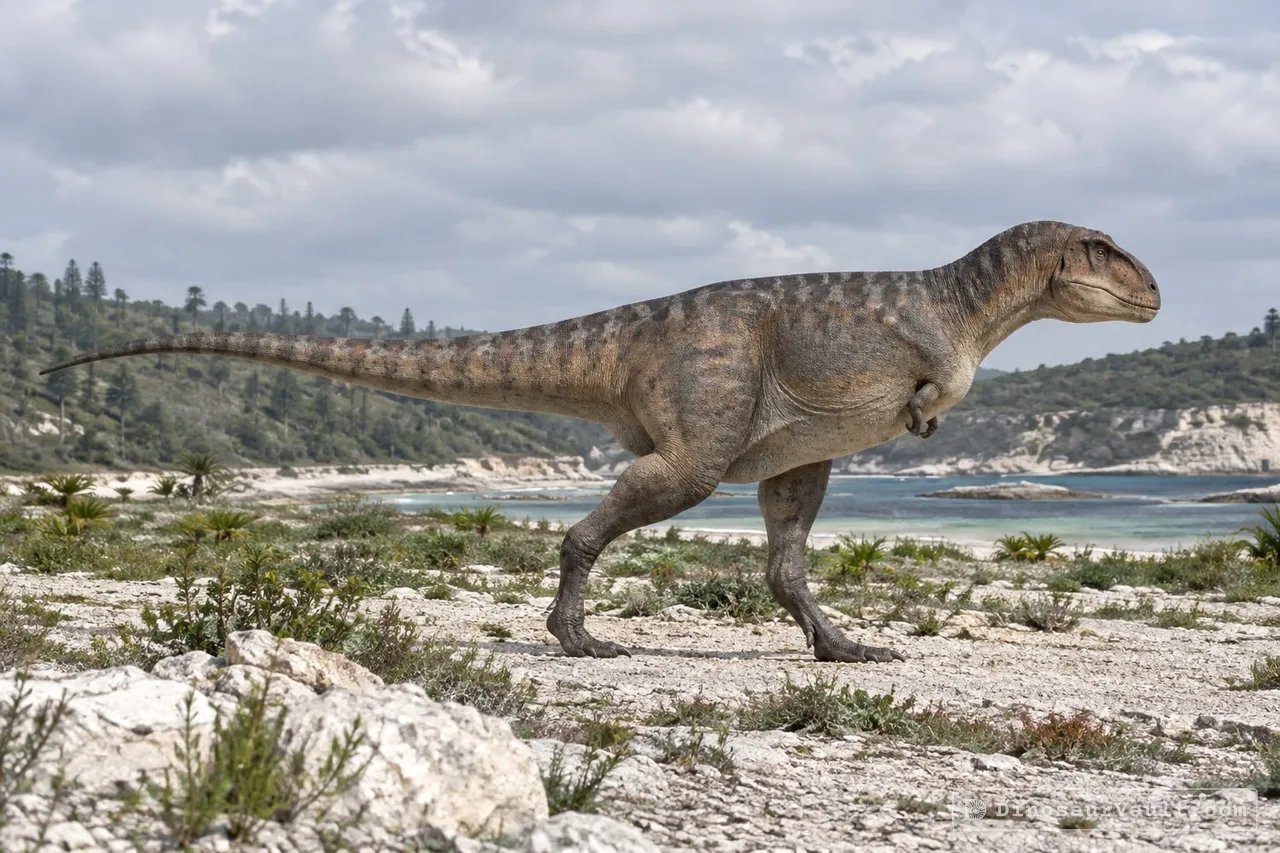
Genusaurus was a medium-sized two-legged predator related to the abelisaurids. It is known from parts of the hips, legs and backbone. Its name refers to a large ridge on its shin bone near the knee.
Its world
It lived in the Early Cretaceous in what is now France. Its bones come from the Marnes bleues, rocks laid down in the sea.
How it was found
Accarie and colleagues named it in 1995 from one find. The type species is Genusaurus sisteronis.
Field gallery
More views of Genusaurus
Scenes reconstructed from the available fossil evidence.
The evidence
The science behind Genusaurus
Which parts of the picture come from its own bones, and which come from its relatives.
From its own fossils
- A partial skeleton preserves hip bones, a thighbone, parts of the lower leg and ankle, and backbone pieces.
- The shin bone has a large ridge near the knee for the attachment of tendons.
Borrowed from relatives
- Abelisaurids such as Majungasaurus provide comparisons for restoring the missing head and front of the body.
Still unknown
- The shape of its skull and the length of its arms.
- Its skin covering and color.
- Its closest relatives within the abelisaurid family.
Discovery timeline
- 1995Named itAccarie et al.
- 2008Family treeCarrano & Sampson
- 2014Family treeTortosa et al.
Key papers
The research behind what we know of Genusaurus
Named it
Named a predator from hip and hindlimb bones buried in marine sediments, with pollen and spores indicating nearby woodland.
Découverte d'un Dinosaure théropode nouveau (Genusaurus sisteronis n. g., n. sp.) dans l'Albien marin de Sisteron (Alpes de Haute-Provence, France) et extension au Crétacé inférieur de la lignée cératosaurienne [Discovery of a new theropod dinosaur (Genusaurus sisteronis n. g., n. sp.) in the marine Albian of Sisteron (Alpes de Haute-Provence, France) and extension of the ceratosaur lineage into the Lower Cretaceous]. Comptes Rendus de l'Académie des Sciences à Paris, série IIa 320: 327-344
No link available
Family tree
Reviewed the fragmentary skeleton and provisionally accepted Genusaurus as a distinct ceratosaur while questioning its original diagnosis.
The Phylogeny of Ceratosauria (Dinosauria: Theropoda). Journal of Systematic Palaeontology 6: 183-236
Read the paper : The Phylogeny of Ceratosauria (Dinosauria: Theropoda) (opens in a new tab)Family tree
Described Arcovenator and identified Genusaurus and Tarascosaurus as early-branching abelisaurids in a revised family tree.
A new abelisaurid dinosaur from the Late Cretaceous of southern France: Palaeobiogeographical implications. Annales de Paléontologie 100: 63-86
Read the paper : A new abelisaurid dinosaur from the Late Cretaceous of southern France: Palaeobiogeographical implications (opens in a new tab)
Close relatives
Other members of Abelisauridae


Sources: Wikidata