Eotrachodon
"dawn Trachodon"
- Lived
- 86 to 84 million years ago, Late Cretaceous
- Diet
- Herbivore
- Group
- Ornithopods, Hadrosauridae
- Found in
- United States
- Named by
- Prieto-Márquez et al. 2016
Where its fossils were found
The evidence
Today

80 million years ago
Habitat
It lived near the coast of Appalachia, separated from western North America by the Western Interior Seaway. Lophorhothon is another plant eater recorded from the Mooreville Chalk.
Field notes
About Eotrachodon
What it was like
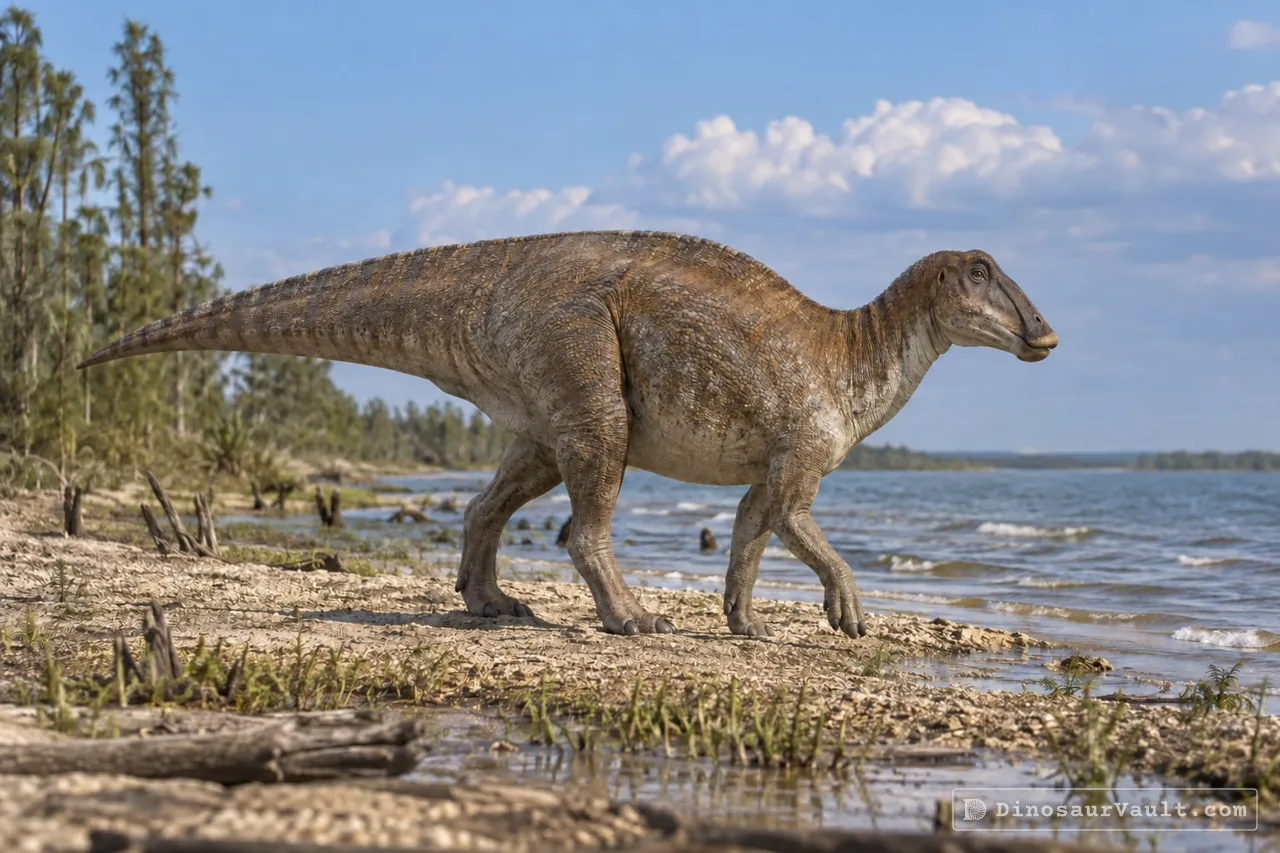
Eotrachodon was an early duckbill, a plant eater with a broad beak and many grinding teeth. It had a large bump on its snout. Its skull and skeleton are fairly complete.
Its world
It lived about 86 to 84 million years ago, in the Late Cretaceous, in what is now Alabama. At the time, eastern North America was a separate land called Appalachia, split from the west by a sea. It shared that land with the duckbill Lophorhothon.
How it was found
Prieto-Márquez and colleagues named Eotrachodon in 2016. It suggests that duckbills first appeared in Appalachia.
Field gallery
More views of Eotrachodon
Scenes reconstructed from the available fossil evidence.
1 of 3
Lived alongside
Found in the same rock formations

A rock formation can hold fossils laid down millions of years apart, so not every animal here met Eotrachodon.
The evidence
The science behind Eotrachodon
Which parts of the picture come from its own bones, and which come from its relatives.
From its own fossils
- A well-preserved skull and partial skeleton reveal its beak, tooth rows and much of its body shape.
- Depressions around the nostril are divided into separate pockets, a distinctive feature of its snout.
- A slice through its shinbone shows rapidly forming bone, so the known animal was still growing.
Borrowed from relatives
- Missing parts of the limbs and tail are restored from other duck-billed dinosaurs such as Edmontosaurus.
- The skull is preserved well enough to guide the head directly, rather than copying a later duckbill's crest.
Still unknown
- Its fully grown size.
- Its skin texture and color.
- How its snout changed as it grew.
Discovery timeline
- 2016Named itPrieto-Marquez, Erickson & Ebersole
- 2016Full descriptionPrieto-Márquez, Erickson & Ebersole
- 2021Family treeKobayashi et al.
Key papers
The research behind what we know of Eotrachodon
Named it
Named an early duckbill with a distinctive snout and used it to explore how duck-billed dinosaurs arose.
A primitive hadrosaurid from southeastern North America and the origin and early evolution of ‘duck-billed’ dinosaurs. Journal of Vertebrate Paleontology 36
Read the paper : A primitive hadrosaurid from southeastern North America and the origin and early evolution of ‘duck-billed’ dinosaurs (opens in a new tab)Full description
Described the skull and skeleton in detail and showed from shinbone tissue that the animal was still growing.
Anatomy and osteohistology of the basal hadrosaurid dinosaurEotrachodonfrom the uppermost Santonian (Cretaceous) of southern Appalachia. PeerJ 4: e1872
Read the paper : Anatomy and osteohistology of the basal hadrosaurid dinosaurEotrachodonfrom the uppermost Santonian (Cretaceous) of southern Appalachia (opens in a new tab)Family tree
Compared Yamatosaurus with Eotrachodon and other early duckbills, testing their relationships and the family's spread between continents.
A new basal hadrosaurid (Dinosauria: Ornithischia) from the latest Cretaceous Kita-ama Formation in Japan implies the origin of hadrosaurids. Scientific Reports 11
Read the paper : A new basal hadrosaurid (Dinosauria: Ornithischia) from the latest Cretaceous Kita-ama Formation in Japan implies the origin of hadrosaurids (opens in a new tab)
Close relatives
Other members of Hadrosauridae


Sources: Wikidata