Lophorhothon
"crested nose"
Type species Lophorhothon atopus
- Lived
- 86 to 72 million years ago, Late Cretaceous
- Diet
- Herbivore
- Length
- about 4.5 m (15 ft)
- Group
- Ornithopods
- Found in
- United States
- Named by
- Langston 1960
Size comparison
To scale


Scale in metersOutline: typical ornithopod shape
Where its fossils were found
The evidence
Today

80 million years ago
Habitat
It lived on the landmass of Appalachia, near the coast of what is now Alabama. Its bones were buried in marine deposits of the Mooreville Chalk, which also contains Eotrachodon.
Field notes
About Lophorhothon
What it was like
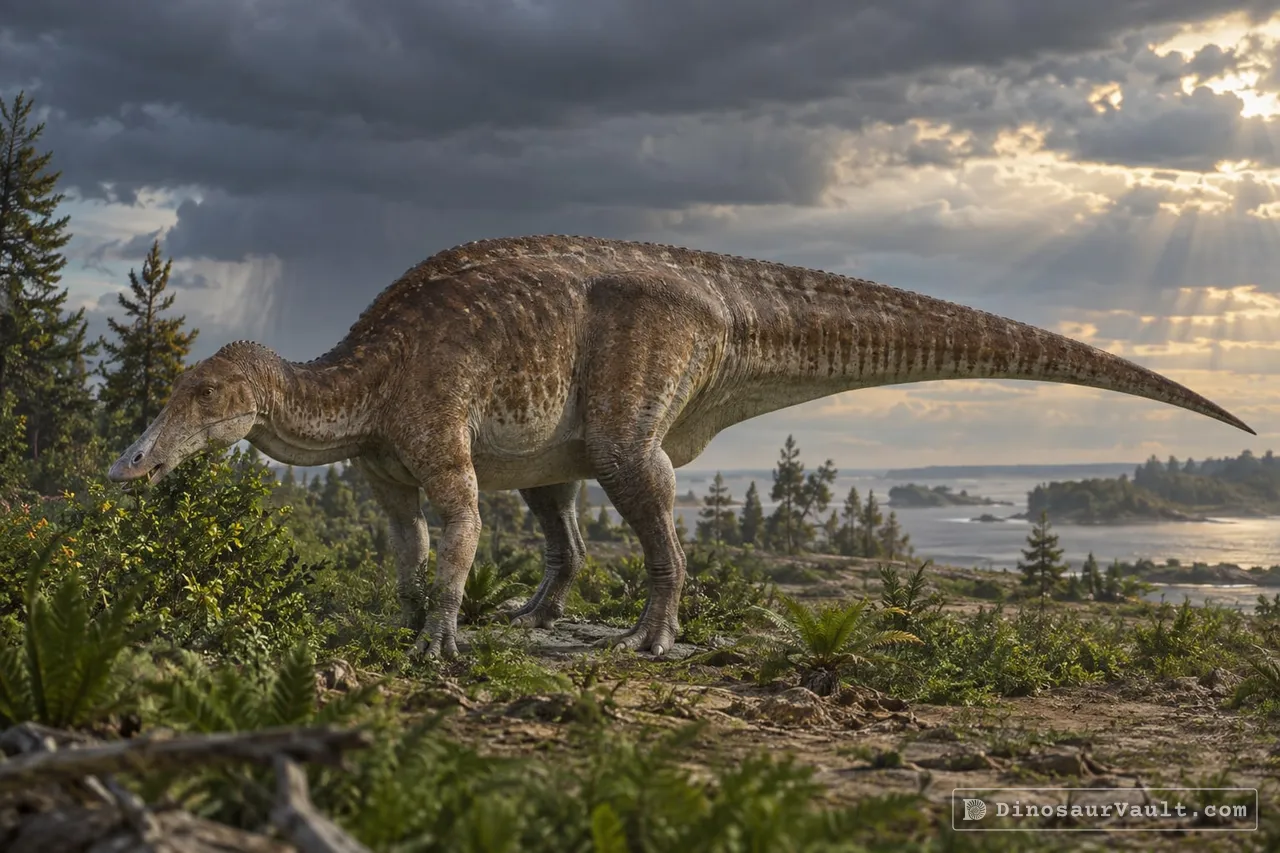
Lophorhothon was a plant eater about 4.5 meters (15 feet) long, an early relative of the duckbills. It had a small crest or bump on its snout. The known skeleton may be from a young animal.
Its world
It lived in the Late Cretaceous, in what is now Alabama. At the time, eastern North America was a separate land called Appalachia. It comes from the Mooreville Chalk, which formed in the sea, and it lived alongside the early duckbill Eotrachodon.
How it was found
Langston named Lophorhothon in 1960. The type species is Lophorhothon atopus.
Field gallery
More views of Lophorhothon
Scenes reconstructed from the available fossil evidence.
Lived alongside
Found in the same rock formations

A rock formation can hold fossils laid down millions of years apart, so not every animal here met Lophorhothon.
The evidence
The science behind Lophorhothon
Which parts of the picture come from its own bones, and which come from its relatives.
From its own fossils
- Behind the nostril opening, the nasal bones rise into a solid, ramp-like crest on an otherwise fairly flat skull roof.
- The type specimen includes much of the skull and the hind legs. A second skeleton referred to it adds the shoulder, arms and part of the upper beak, so together they preserve nearly the whole skeleton.
- A toe bone from the type specimen ends in a hoof-like tip.
Borrowed from relatives
- Most of its skeleton comes from its own fossils. Gobihadros, an early duckbill relative from Mongolia, guides the incomplete front of the beak, the neck, the tail and the ends of the feet.
Still unknown
- The full shape of its snout and beak, which are only partly preserved.
- Why the crest differs between the two skeletons. The difference may reflect individual variation, males and females, damage during preparation, or two separate kinds of animal.
- Whether its hand had a thumb, which none of the known hand bones settles.
Discovery timeline
- 1960Named itLangston & Chicago Natural History Museum.
- 2011Growing upPRIETO‐MÁRQUEZ
- 2016Same rocksPrieto-Márquez, Erickson & Ebersole
- 2019Close relativeTsogtbaatar et al.
- 2021RedescriptionGates & Lamb
Key papers
The research behind what we know of Lophorhothon
Named it
Named a crested plant eater from a partial skull and skeleton found in Alabama.
The vertebrate fauna of the Selma Formation of Alabama. Part VI, The dinosaurs. Fieldiana
Read the paper : The vertebrate fauna of the Selma Formation of Alabama. Part VI, The dinosaurs (opens in a new tab)Growing up
Studied growth in Bactrosaurus and identified the known Lophorhothon specimens as subadults in its comparison of early duckbill relatives.
Cranial and appendicular ontogeny ofBactrosaurus johnsoni, a hadrosauroid dinosaur from the Late Cretaceous of northern China. Palaeontology 54: 773-792
Read the paper : Cranial and appendicular ontogeny ofBactrosaurus johnsoni, a hadrosauroid dinosaur from the Late Cretaceous of northern China (opens in a new tab)Same rocks
Described Eotrachodon from the same formation and explained how its crestless skull differs from Lophorhothon.
Anatomy and osteohistology of the basal hadrosaurid dinosaurEotrachodonfrom the uppermost Santonian (Cretaceous) of southern Appalachia. PeerJ 4: e1872
Read the paper : Anatomy and osteohistology of the basal hadrosaurid dinosaurEotrachodonfrom the uppermost Santonian (Cretaceous) of southern Appalachia (opens in a new tab)Close relative
Described Gobihadros, an early duckbill relative from Mongolia, from bones that include its beak, neck, tail, hands and feet.
A new hadrosauroid (Dinosauria: Ornithopoda) from the Late Cretaceous Baynshire Formation of the Gobi Desert (Mongolia). PLOS ONE 14: e0208480
Read the paper : A new hadrosauroid (Dinosauria: Ornithopoda) from the Late Cretaceous Baynshire Formation of the Gobi Desert (Mongolia) (opens in a new tab)Redescription
Combined old and new specimens to describe the solid nasal crest and place Lophorhothon just outside the duckbill family.
A redescription of Lophorhothon atopus (Ornithopoda: Dinosauria) from the Late Cretaceous of Alabama based on new material1. Canadian Journal of Earth Sciences 58: 918-935
Read the paper : A redescription of Lophorhothon atopus (Ornithopoda: Dinosauria) from the Late Cretaceous of Alabama based on new material1 (opens in a new tab)
Sources: Wikidata