Dongyangopelta
"Dongyang shield"
- Lived
- 113 to 94 million years ago, Early Cretaceous to Late Cretaceous
- Diet
- Herbivore
- Group
- Ankylosaurs, Nodosauridae
- Found in
- China
- Named by
- Chen et al. 2013
Where its fossils were found
The evidence
Today

105 million years ago
Habitat
It lived in eastern China. Zhejiangosaurus and duck-billed dinosaurs are also known from the Chaochuan Formation.
Field notes
About Dongyangopelta
What it was like
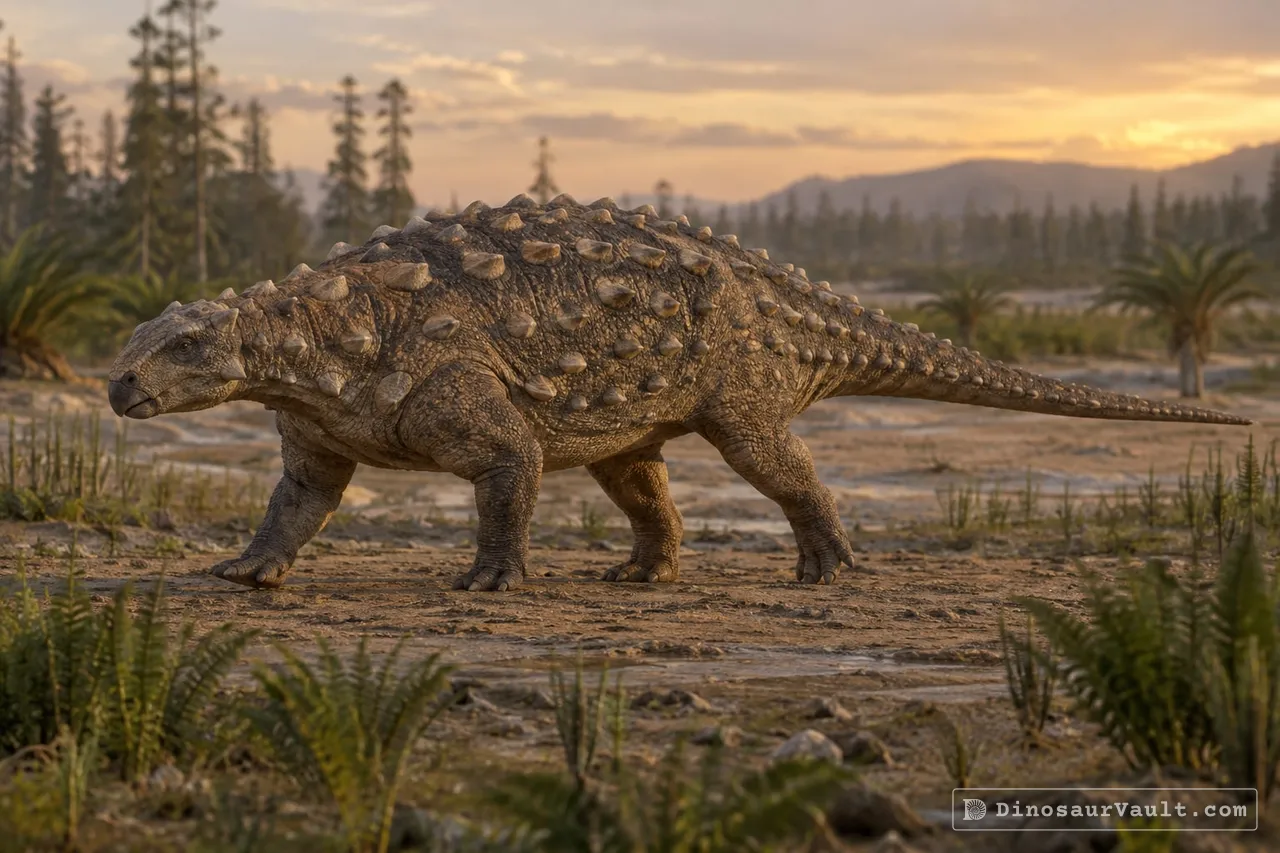
Dongyangopelta was a nodosaur, an armored plant eater, known from part of the hips, some ribs and pieces of armor. Its hips were covered by a shield of fused armor plates.
Its world
It lived in the Cretaceous in what is now eastern China. Its bones come from the Chaochuan Formation.
How it was found
Chen and colleagues named Dongyangopelta in 2013, from a single find.
Field gallery
More views of Dongyangopelta
Scenes reconstructed from the available fossil evidence.
The evidence
The science behind Dongyangopelta
Which parts of the picture come from its own bones, and which come from its relatives.
From its own fossils
- A partial skeleton preserves parts of the hips, ribs, a vertebra and a thigh bone, along with bony armor. The hip bone has a double-curved upper edge, and the lower end of the thigh bone is wide from side to side.
- Fused armor over the hips carries large pebble-shaped bosses surrounded by smaller bumps.
- Many armor plates have rough surfaces and grooves or notches around their edges. One plate is domed, with three arms.
Borrowed from relatives
- Its hip shield is compared with the shields of Europelta and Vectipelta, armored dinosaurs from Europe.
Still unknown
- The shape of its skull.
- Whether it is a different animal from the other armored dinosaur named from the same formation. One study suggested the two might be the same, while a later study treated them separately but left the question open.
- The complete arrangement of its armor.
Discovery timeline
- 2011Close relativesArbour, Burns & Currie
- 2013Named itChen et al.
- 2013Close relativeKirkland et al.
- 2018Family treeZheng et al.
Key papers
The research behind what we know of Dongyangopelta
Close relatives
Compared hip armor across armored dinosaurs and distinguished fused shields from tightly interlocking plates, providing a framework for interpreting Dongyangopelta's shield.
A review of pelvic shield morphology in ankylosaurs (Dinosauria: Ornithischia). Journal of Paleontology 85: 298-302
Read the paper : A review of pelvic shield morphology in ankylosaurs (Dinosauria: Ornithischia) (opens in a new tab)Named it
Described a new armored dinosaur with a fused shield over its hips and distinctive features of its thigh bone and pelvis.
A new nodosaurid ankylosaur from the Chaochuan Formation of Dongyang, Zhejiang Province, China. Acta Geologica Sinica (English Edition) 87: 658-671
No link available
Close relative
Named Europelta and argued that the few bones shared by Dongyangopelta and a second armored dinosaur from the same rocks are too limited to show they are different animals.
The Basal Nodosaurid Ankylosaur Europelta carbonensis n. gen., n. sp. from the Lower Cretaceous (Lower Albian) Escucha Formation of Northeastern Spain. PLoS ONE 8: e80405
Read the paper : The Basal Nodosaurid Ankylosaur Europelta carbonensis n. gen., n. sp. from the Lower Cretaceous (Lower Albian) Escucha Formation of Northeastern Spain (opens in a new tab)Family tree
Compared Chinese armored dinosaurs and recovered Dongyangopelta among nodosaurs in an expanded family tree.
The most basal ankylosaurine dinosaur from the Albian–Cenomanian of China, with implications for the evolution of the tail club. Scientific Reports 8
Read the paper : The most basal ankylosaurine dinosaur from the Albian–Cenomanian of China, with implications for the evolution of the tail club (opens in a new tab)
Close relatives
Other members of Nodosauridae


Sources: Wikidata