Caletodraco
"dragon of the Caux"
Type species Caletodraco cottardi
- Lived
- 101 to 94 million years ago, Late Cretaceous
- Diet
- Carnivore
- Group
- Theropods, Abelisauridae
- Found in
- France
- Named by
- Buffetaut et al. 2024
Where its fossils were found
The evidence
Today

95 million years ago
Habitat
It lived on land near a sea covering much of what is now northern France. Its remains were buried in marine chalk after its carcass probably drifted out to sea.
Field notes
About Caletodraco
What it was like
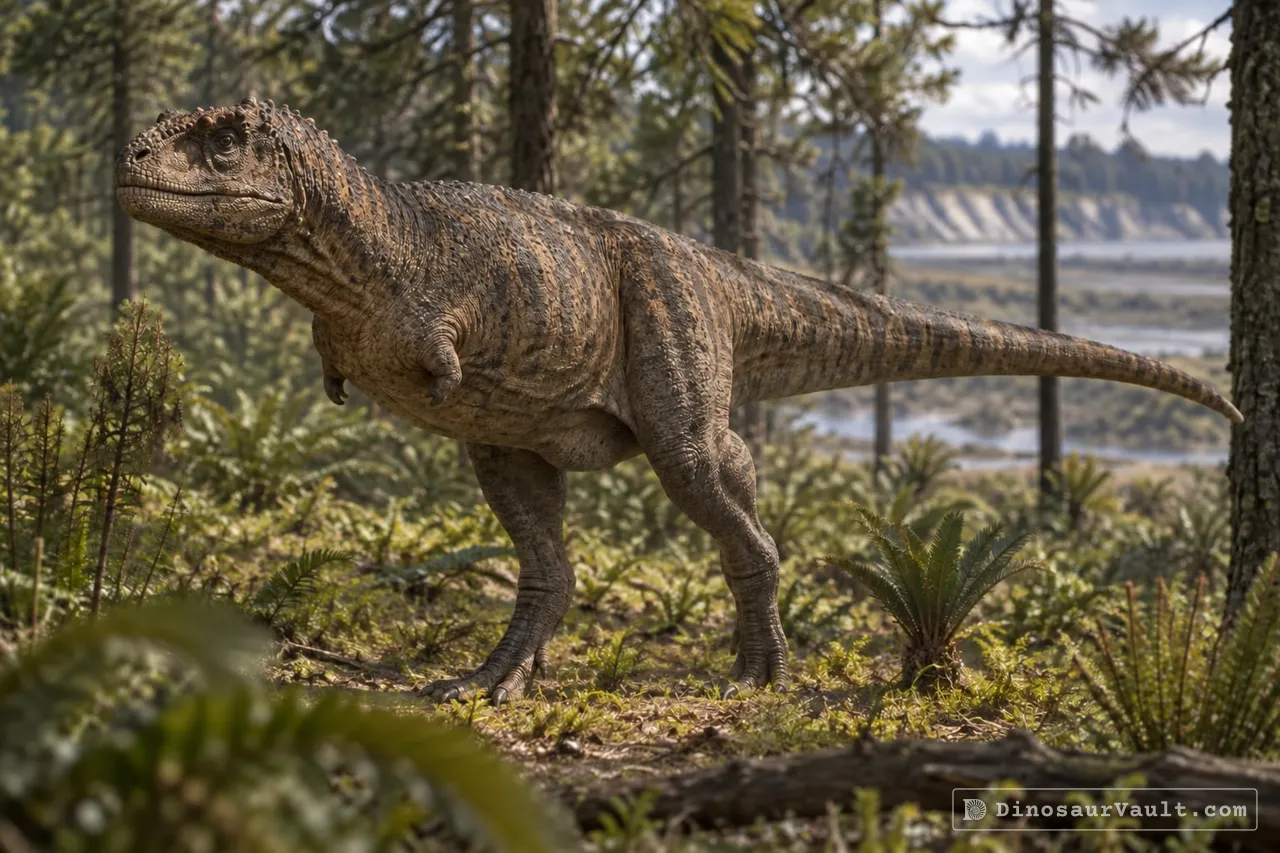
Caletodraco was an abelisaur, a two-legged hunter with a short head and tiny arms, known from part of the backbone, hips and a thigh bone. It was a close relative of Carnotaurus and Aucasaurus from South America.
Its world
It lived in the Late Cretaceous in what is now northern France. Its bones were found in chalk, rock that formed at the bottom of a sea, so its body must have washed out from land.
How it was found
Buffetaut and colleagues named Caletodraco in 2024. The bones were found at the foot of seaside cliffs. It was the first member of its branch of abelisaurs named from outside South America.
Field gallery
More views of Caletodraco
Scenes reconstructed from the available fossil evidence.
1 of 3
The evidence
The science behind Caletodraco
Which parts of the picture come from its own bones, and which come from its relatives.
From its own fossils
- The preserved skeleton includes fused vertebrae above the hips, parts of the hip bones and a vertebra from the base of the tail.
- The tail vertebra has a broad, fan-shaped side projection that helps distinguish it from other abelisaurs.
Borrowed from relatives
- Its missing head and arms are restored from abelisaurs such as Carnotaurus and Aucasaurus, which had short skulls and very small arms.
- Scaly skin is a reasonable restoration based on the preserved skin of Carnotaurus.
Still unknown
- The shape of its skull and any horns or other head ornaments.
- Its skin pattern and color.
- Where on the nearby land it lived and which animals it hunted.
Discovery timeline
- 2021Close relativeHendrickx & Bell
- 2024Named itBuffetaut et al.
- 2026Fossil sitesBuffetaut
Key papers
The research behind what we know of Caletodraco
Close relative
Found large scales scattered among smaller scales in Carnotaurus, providing a comparison for the skin of related abelisaurs.
The scaly skin of the abelisaurid Carnotaurus sastrei (Theropoda: Ceratosauria) from the Upper Cretaceous of Patagonia. Cretaceous Research 128: 104994
Read the paper : The scaly skin of the abelisaurid Carnotaurus sastrei (Theropoda: Ceratosauria) from the Upper Cretaceous of Patagonia (opens in a new tab)Named it
Named an abelisaur from marine chalk, identifying a distinctive tail vertebra and a branch previously known from South America.
Caletodraco cottardi: A New Furileusaurian Abelisaurid (Dinosauria: Theropoda) from the Cenomanian Chalk of Normandy (North-Western France). Fossil Studies 2: 177-195
Read the paper : Caletodraco cottardi: A New Furileusaurian Abelisaurid (Dinosauria: Theropoda) from the Cenomanian Chalk of Normandy (North-Western France) (opens in a new tab)Fossil sites
Reviewed Caletodraco's discovery, the age of its chalk beds and its place among European abelisaurs.
The Cretaceous Dinosaur Record from Normandy (NW France): A Review. Fossil Studies 4: 5
Read the paper : The Cretaceous Dinosaur Record from Normandy (NW France): A Review (opens in a new tab)
Close relatives
Other members of Abelisauridae


Sources: Wikidata