Bravoceratops
- Lived
- 72 to 66 million years ago, Late Cretaceous
- Diet
- Herbivore
- Group
- Ceratopsians, Ceratopsidae
- Found in
- United States
- Named by
- Wick and Lehman 2013
Where its fossils were found
The evidence
Today

70 million years ago
Habitat
Rivers and lakes spread across an inland floodplain in what is now Texas. Other dinosaurs from the Javelina Formation include Alamosaurus and Kritosaurus.
Field notes
About Bravoceratops
What it was like
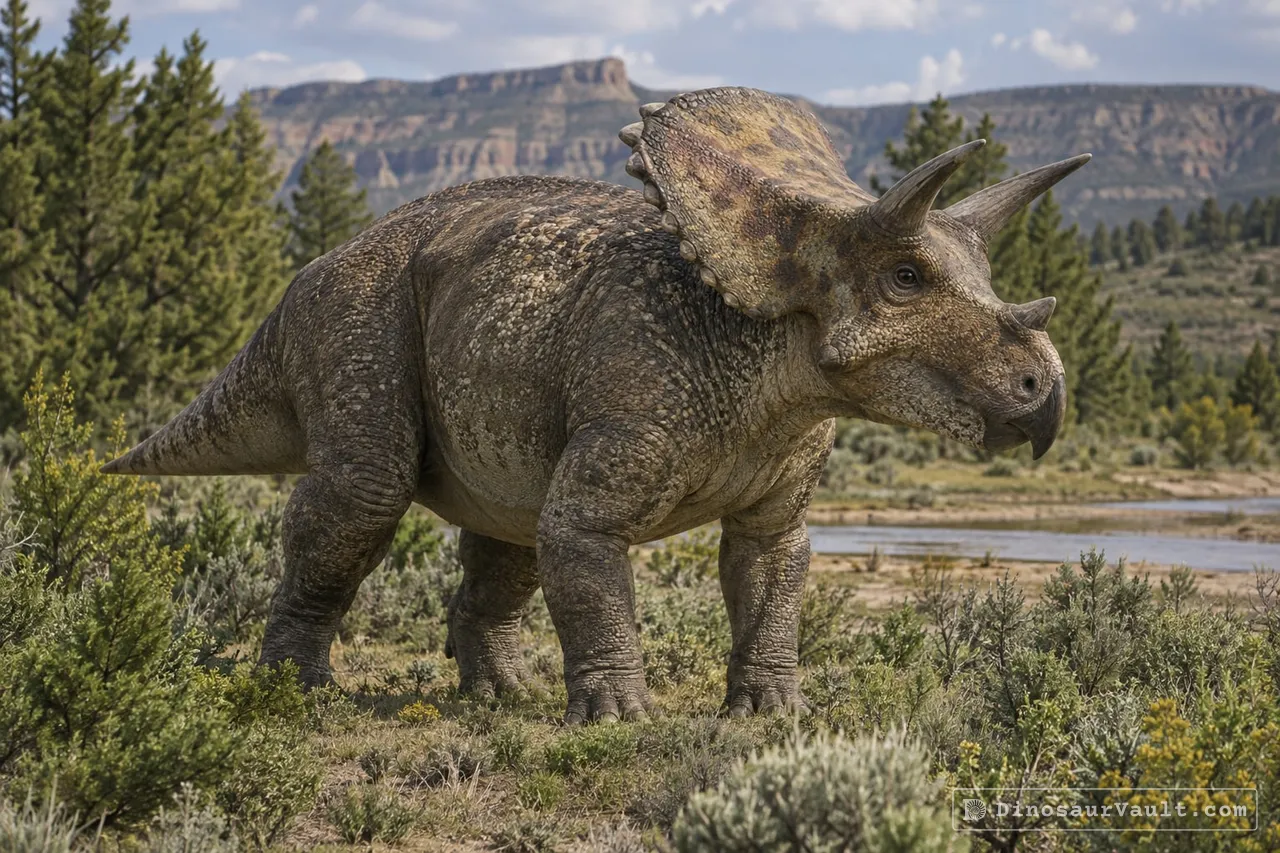
Bravoceratops was a large horned plant eater from the chasmosaurine group, relatives of Chasmosaurus and Triceratops. It is known from pieces of the skull, including part of a long frill.
Its world
It lived about 72 to 66 million years ago, at the end of the Late Cretaceous, in what is now Texas. Its bones come from the Javelina Formation, where it shared the land with the giant titanosaur Alamosaurus and the duckbill Kritosaurus.
How it was found
Wick and Lehman named it in 2013 from one find. Its name refers to a river in the region.
Field gallery
More views of Bravoceratops
Scenes reconstructed from the available fossil evidence.
Lived alongside
Found in the same rock formations


A rock formation can hold fossils laid down millions of years apart, so not every animal here met Bravoceratops.
The evidence
The science behind Bravoceratops
Which parts of the picture come from its own bones, and which come from its relatives.
From its own fossils
- Pieces of a large skull preserve a narrow snout and parts of a long frill.
- The frill had large openings through the bone.
Borrowed from relatives
- The missing body is restored from better-known horned dinosaurs such as Chasmosaurus and Triceratops.
- Comparisons with Coahuilaceratops and Sierraceratops help place its skull among southern chasmosaurines.
Still unknown
- The correct arrangement of the broken frill bones.
- Whether its skull features distinguish it from other named horned dinosaurs.
- Its skin color and markings.
Discovery timeline
- 2013Named itWick & Lehman
- 2020Family treeFowler & Freedman Fowler
- 2022Close relativeDalman et al.
Key papers
The research behind what we know of Bravoceratops
Named it
Named Bravoceratops from a partial skull with a narrow snout and long frill, and suggested a close relationship with Coahuilaceratops.
A new ceratopsian dinosaur from the Javelina Formation (Maastrichtian) of West Texas and implications for chasmosaurine phylogeny. Naturwissenschaften 100: 667-682
Read the paper : A new ceratopsian dinosaur from the Javelina Formation (Maastrichtian) of West Texas and implications for chasmosaurine phylogeny (opens in a new tab)Family tree
Reinterpreted a central frill fragment and questioned whether Bravoceratops has features that distinguish it as a separate genus.
Transitional evolutionary forms in chasmosaurine ceratopsid dinosaurs: evidence from the Campanian of New Mexico. PeerJ 8: e9251
Read the paper : Transitional evolutionary forms in chasmosaurine ceratopsid dinosaurs: evidence from the Campanian of New Mexico (opens in a new tab)Close relative
Grouped Sierraceratops with Bravoceratops and Coahuilaceratops in a southern branch of the horned dinosaur family.
Sierraceratops turneri, a new chasmosaurine ceratopsid from the Hall Lake Formation (Upper Cretaceous) of south-central New Mexico. Cretaceous Research 130: 105034
Read the paper : Sierraceratops turneri, a new chasmosaurine ceratopsid from the Hall Lake Formation (Upper Cretaceous) of south-central New Mexico (opens in a new tab)
Close relatives
Other members of Ceratopsidae


Sources: Wikidata