Asylosaurus
"sanctuary lizard"
- Lived
- 206 to 201 million years ago, Late Triassic
- Found in
- United Kingdom
- Named by
- Galton 2007
Where its fossils were found
The evidence
Today

200 million years ago
Habitat
A small limestone island in a warm island chain, with caves and cracks that trapped bones. Thecodontosaurus inhabited these islands, and Pantydraco comes from the wider island region.
Field notes
About Asylosaurus
What it was like
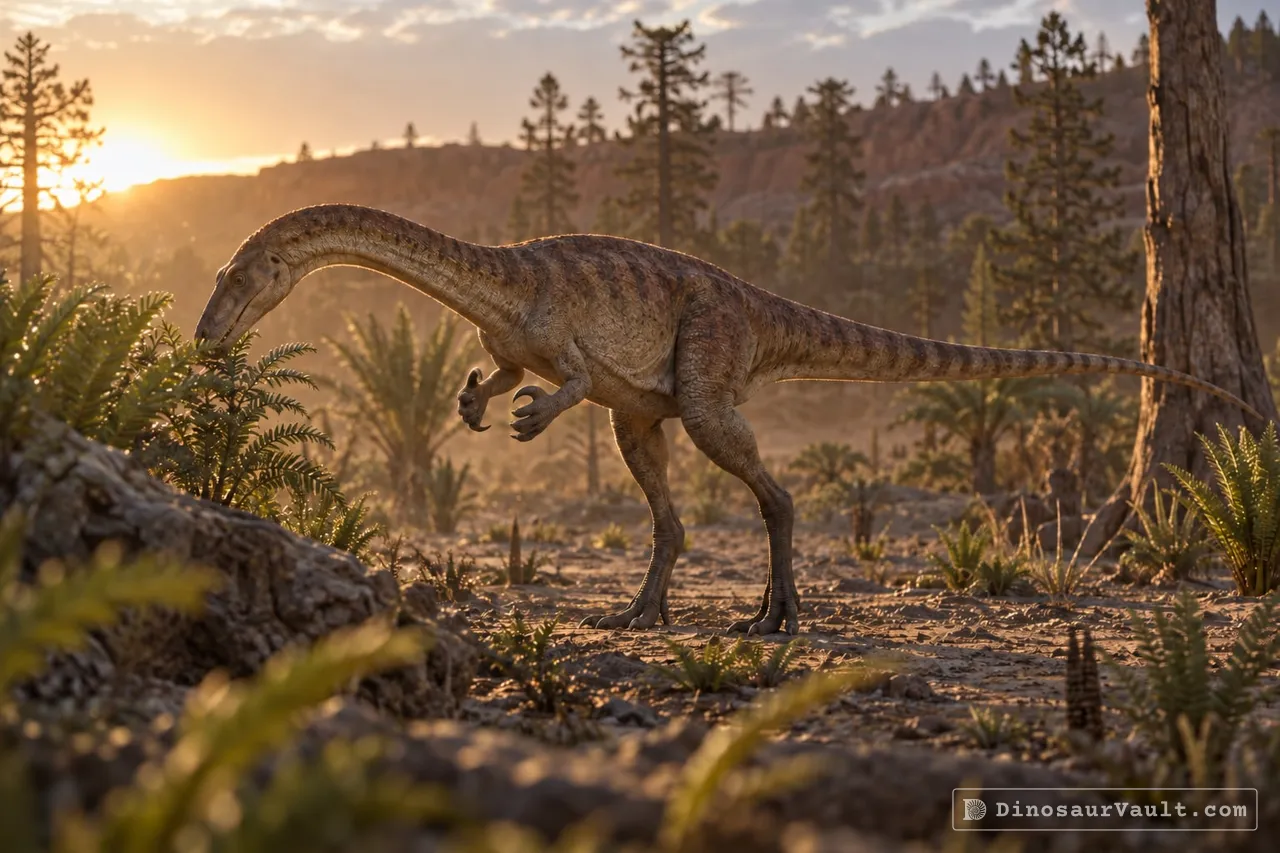
Asylosaurus was a small, early sauropodomorph, a plant eater related to Thecodontosaurus. It is known from part of a skeleton.
Its world
It lived in the Late Triassic, in what is now England. It comes from cave fillings where Thecodontosaurus has also been found.
How it was found
Galton named Asylosaurus in 2007. Its name means unharmed: the bones escaped the bombing that destroyed other fossils from the same site during a war.
Field gallery
More views of Asylosaurus
Scenes reconstructed from the available fossil evidence.
Lived alongside
Found in the same rock formations

A rock formation can hold fossils laid down millions of years apart, so not every animal here met Asylosaurus.
The evidence
The science behind Asylosaurus
Which parts of the picture come from its own bones, and which come from its relatives.
From its own fossils
- An associated partial skeleton preserves back vertebrae, ribs, belly ribs, shoulder bones and parts of the arms and hand.
- The upper arm has a low, rounded muscle attachment crest.
- The associated hand has slender long bones and a very short fourth finger ending in a small, rounded tip.
Borrowed from relatives
- The missing head and parts of the body are restored by comparison with Thecodontosaurus.
Still unknown
- Experts disagree over whether its distinguishing features mark a separate genus or variation within Thecodontosaurus; the value of its upper-arm crest has been questioned.
- The exact shape of its head.
- Its skin covering and color.
Discovery timeline
- 2007Named itGalton
- 2014Same rocksFoffa et al.
- 2020Family treeBallell, Rayfield & Benton
Key papers
The research behind what we know of Asylosaurus
Named it
Restudied the historical fossil collection and named Asylosaurus from a partial skeleton previously assigned to Thecodontosaurus.
Notes on the remains of archosaurian reptiles, mostly basal sauropodomorph dinosaurs, from the 1834 fissure fill (Rhaetian, Upper Triassic) at Clifton in Bristol, southwest England. Revue de Paléobiologie 26: 505-591
No link available
Same rocks
Studied small vertebrates from the original fossil-bearing rocks and described the animal community of the limestone island.
Vertebrates from the Late Triassic Thecodontosaurus-bearing rocks of Durdham Down, Clifton (Bristol, UK). Proceedings of the Geologists' Association 125: 317-328
Read the paper : Vertebrates from the Late Triassic Thecodontosaurus-bearing rocks of Durdham Down, Clifton (Bristol, UK) (opens in a new tab)Family tree
New Thecodontosaurus bones weakened the anatomical case for treating Asylosaurus as a separate genus.
Osteological redescription of the Late Triassic sauropodomorph dinosaur Thecodontosaurus antiquus based on new material from Tytherington, southwestern England. Journal of Vertebrate Paleontology 40: e1770774
Read the paper : Osteological redescription of the Late Triassic sauropodomorph dinosaur Thecodontosaurus antiquus based on new material from Tytherington, southwestern England (opens in a new tab)
Close relatives
Other members of Sauropodomorpha


Sources: Wikidata