Arenysaurus
"Arén lizard"
- Lived
- 72 to 66 million years ago, Late Cretaceous
- Diet
- Herbivore
- Group
- Ornithopods, Hadrosauridae
- Found in
- Spain
- Named by
- Pereda-Suberbiola et al. 2009
Where its fossils were found
The evidence
Today

70 million years ago
Habitat
It lived near shallow coastal lagoons and estuaries on an island in what is now Spain. Pararhabdodon and Blasisaurus were other duck-billed dinosaurs of the region.
Field notes
About Arenysaurus
What it was like
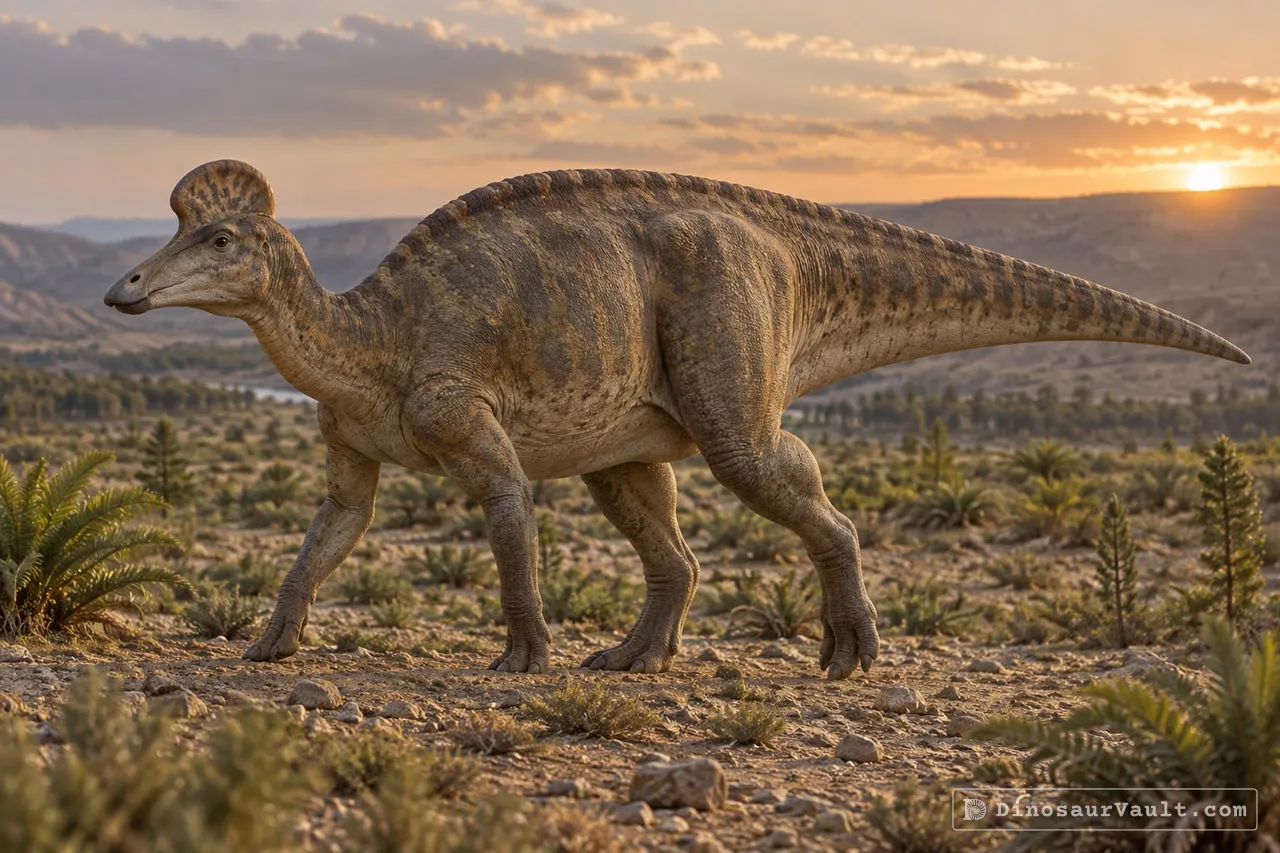
Arenysaurus was a crested duck-billed dinosaur known from a partial skull and skeleton. Its crest was low, rounded and hollow.
It was a relative of other crested hadrosaurs from Europe and North Africa, such as Ajnabia.
Its world
It lived about 72 to 66 million years ago, at the very end of the Late Cretaceous, in what is now northeastern Spain. Its bones come from the La Posa Formation, where it shared the land with the plant eater Pararhabdodon. It was one of the last dinosaurs in Europe before the extinction.
How it was found
Pereda-Suberbiola and colleagues named Arenysaurus in 2009, from a single find.
Field gallery
More views of Arenysaurus
Scenes reconstructed from the available fossil evidence.
Lived alongside
Found in the same rock formations

A rock formation can hold fossils laid down millions of years apart, so not every animal here met Arenysaurus.
The evidence
The science behind Arenysaurus
Which parts of the picture come from its own bones, and which come from its relatives.
From its own fossils
- A partial skull and skeleton preserve the braincase, jaws, backbone, shoulder and limb bones.
- The skull roof has a prominent dome of bone above the braincase.
- Holes and grooves in some limb bones were probably made by insects feeding on the carcass.
Borrowed from relatives
- Corythosaurus and Lambeosaurus provide comparisons for the hollow crest and missing parts of the skull.
- The missing feet and tail tip follow the general body plan of other duck-billed dinosaurs.
Still unknown
- The complete outline of its crest.
- Its skin color.
- Whether island life had reduced its adult size.
Discovery timeline
- 2009Named itPereda-Suberbiola et al.
- 2015SkullCruzado-Caballero et al.
- 2021Fossil sitesCruzado‐Caballero et al.
Key papers
The research behind what we know of Arenysaurus
Named it
Named a crested duckbill from a partial skull and skeleton, with a distinctive dome on the skull roof.
The last hadrosaurid dinosaurs of Europe: A new lambeosaurine from the Uppermost Cretaceous of Aren (Huesca, Spain). Comptes Rendus Palevol 8: 559-572
Read the paper : The last hadrosaurid dinosaurs of Europe: A new lambeosaurine from the Uppermost Cretaceous of Aren (Huesca, Spain) (opens in a new tab)Skull
Used scans to reconstruct the brain cavity and inner ear, and suggested that the animal may have been an island dwarf.
Paleoneuroanatomy of the European lambeosaurine dinosaur Arenysaurus ardevoli. PeerJ 3: e802
Read the paper : Paleoneuroanatomy of the European lambeosaurine dinosaur Arenysaurus ardevoli (opens in a new tab)Fossil sites
Found tunnels, holes and notches in limb bones that were probably made by insects feeding on the dead animal.
Bioerosion and palaeoecological association of osteophagous insects in the Maastrichtian dinosaur Arenysaurus ardevoli. Lethaia 54: 957-968
Read the paper : Bioerosion and palaeoecological association of osteophagous insects in the Maastrichtian dinosaur Arenysaurus ardevoli (opens in a new tab)
Close relatives
Other members of Hadrosauridae


Sources: Wikidata