Anoplosaurus
"unarmed lizard"
- Lived
- 101 to 94 million years ago, Late Cretaceous
- Diet
- Herbivore
- Group
- Ankylosaurs, Nodosauridae
- Found in
- United Kingdom
- Named by
- Seeley 1879
Where its fossils were found
The evidence
Today

95 million years ago
Habitat
It lived on land in what is now England, beside seas that deposited the rocks containing its bones. Those deposits also preserve other dinosaurs and pterosaurs.
Field notes
About Anoplosaurus
What it was like
Anoplosaurus was probably a nodosaur, an armored plant eater. It is known from a few bones of a young animal. No armor was found with it, which gave it its name.
Its world
It lived in the Cretaceous in what is now England. Its bones come from rocks laid down in the sea.
How it was found
Seeley named Anoplosaurus in 1879.
Field gallery
More views of Anoplosaurus
Scenes reconstructed from the available fossil evidence.
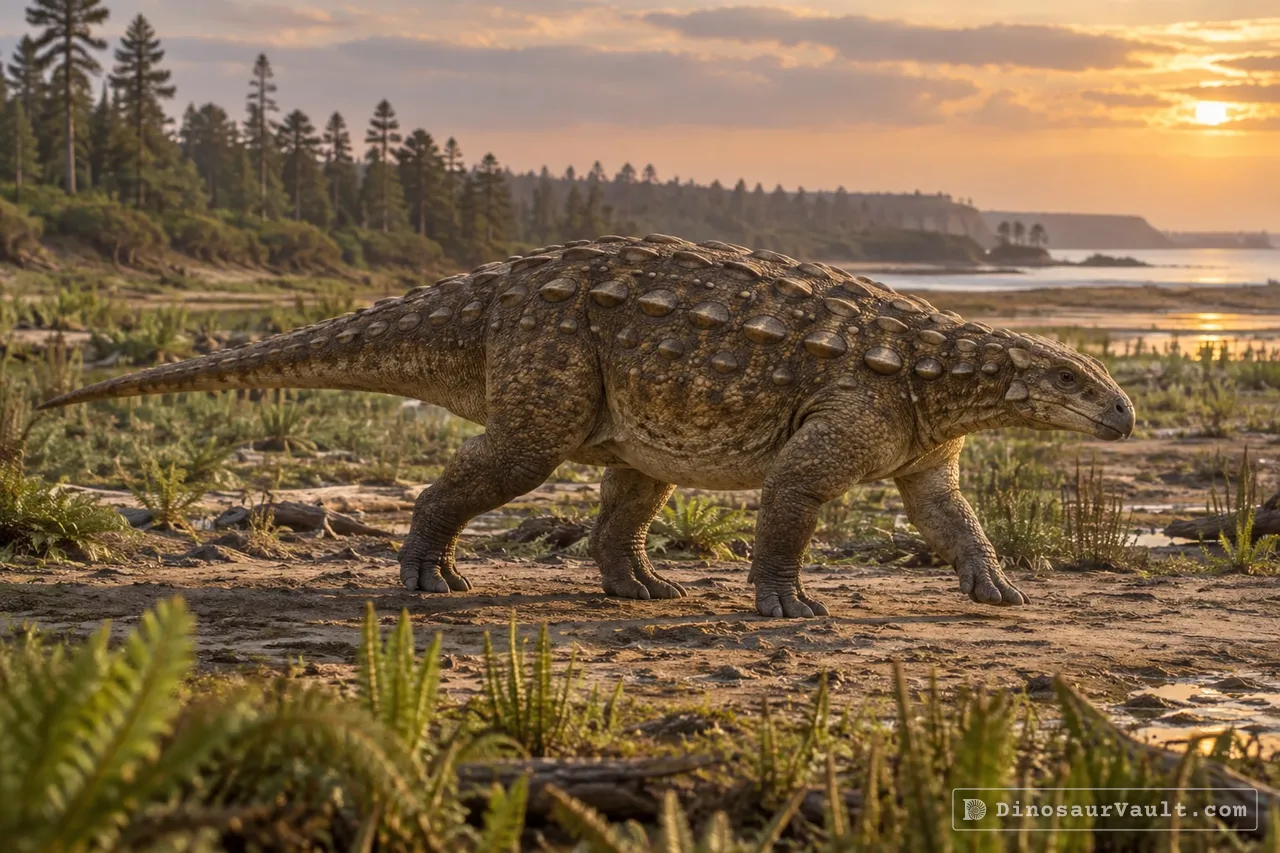
1 of 3
The evidence
The science behind Anoplosaurus
Which parts of the picture come from its own bones, and which come from its relatives.
From its own fossils
- The type material includes a partial lower jaw, vertebrae and parts of the shoulders, hips and limbs.
- A review diagnosed it from features of the shoulder girdle and the thigh bone, and kept it provisionally among the early nodosaurs.
- The partial lower jaw preserves no teeth.
Borrowed from relatives
- Sauropelta provides broader comparisons for the body, feet and possible armor.
- Gargoyleosaurus provides a broader comparison for the missing upper skull.
Still unknown
- The arrangement of its armor.
- Its adult size and complete skull shape.
- Its color and exact place in the armored dinosaur family tree.
Discovery timeline
- 1879Named itSeeley
- 2008Family treeNAISH & MARTILL
- 2014Same rocksBlows
Key papers
The research behind what we know of Anoplosaurus
Named it
Named Anoplosaurus from a partial skeleton among dinosaur remains collected from marine rocks in England.
On the Dinosauria of the Cambridge Greensand. Quarterly Journal of the Geological Society of London 35: 591-636
Read the paper : On the Dinosauria of the Cambridge Greensand (opens in a new tab)Family tree
Reviewed British plant-eating dinosaurs and supported Anoplosaurus as an early nodosaur known from a young skeleton.
Dinosaurs of Great Britain and the role of the Geological Society of London in their discovery: Ornithischia. Journal of the Geological Society 165: 613-623
Read the paper : Dinosaurs of Great Britain and the role of the Geological Society of London in their discovery: Ornithischia (opens in a new tab)Same rocks
Described nodosaur neck armor from the same deposits and discussed armor development in young nodosaurs.
Notice of nodosaur (Dinosauria, Ankylosauria) remains from the mid-Cretaceous of Cambridge, England, with comments on cervical half-ring armour. Proceedings of the Geologists' Association 125: 56-62
Read the paper : Notice of nodosaur (Dinosauria, Ankylosauria) remains from the mid-Cretaceous of Cambridge, England, with comments on cervical half-ring armour (opens in a new tab)
Close relatives
Other members of Nodosauridae


Sources: Wikidata