Acantholipan
"thorn without fat"
Type species Acantholipan gonzalezi
- Lived
- 84 to 72 million years ago, Late Cretaceous
- Diet
- Herbivore
- Group
- Ankylosaurs, Nodosauridae
- Found in
- Mexico
- Named by
- Rivera-Sylva et al. 2018
Where its fossils were found
The evidence
Today

80 million years ago
Habitat
It probably lived on coastal land in what is now Mexico. Its bones were buried in sediments laid down in shallow seawater.
Field notes
About Acantholipan
What it was like
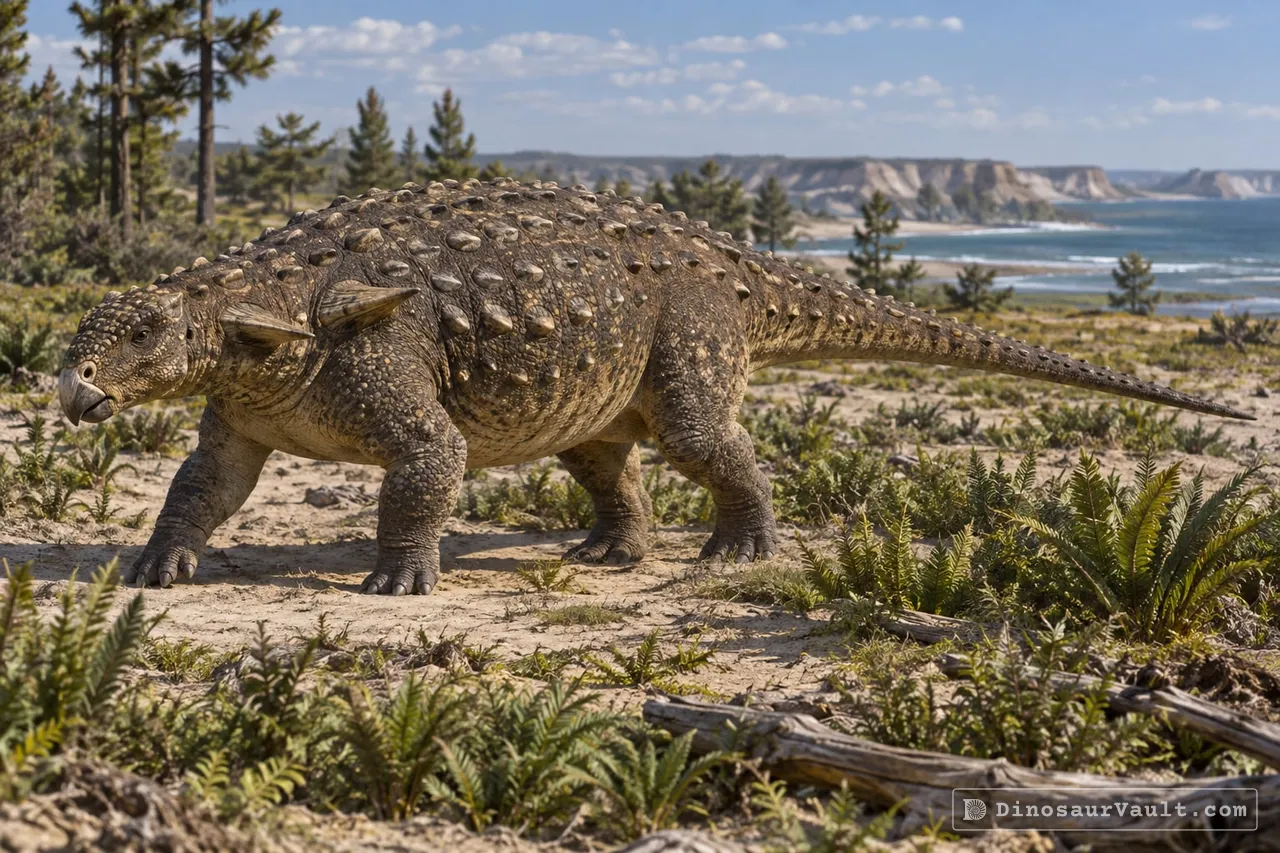
Acantholipan was a nodosaur, an armored plant eater without a tail club. It is known from a few bones and armor pieces.
Its world
It lived in the Late Cretaceous, in what is now Mexico. Its fossils come from rocks laid down in the sea.
How it was found
Rivera-Sylva and colleagues named Acantholipan in 2018. The type species is Acantholipan gonzalezi. It is the first nodosaur named from Mexico.
Field gallery
More views of Acantholipan
Scenes reconstructed from the available fossil evidence.
1 of 2
The evidence
The science behind Acantholipan
Which parts of the picture come from its own bones, and which come from its relatives.
From its own fossils
- A few bones preserve parts of the back, tail, rib, arm and thigh, together with an armor spine.
- The forearm bone has a prominent triangular projection.
- Its armor spine is long and cone-shaped, with a slight backward curve.
Borrowed from relatives
- Nodosaurus and Edmontonia provide comparisons for the broad armored body and a tail without a club.
Still unknown
- The shape of its skull.
- The full arrangement of its armor.
- Its adult size and color.
Discovery timeline
- 2018Named itRivera-Sylva et al.
- 2021Family treeMadzia et al.
- 2025Fossil sitesRivera-Sylva et al.
Key papers
The research behind what we know of Acantholipan
Named it
Named an armored dinosaur from sparse bones and a distinctive cone-shaped spine, the first named ankylosaur from Mexico.
Paleodiversity of Late Cretaceous Ankylosauria from Mexico and their phylogenetic significance. Swiss Journal of Palaeontology 137: 83-93
Read the paper : Paleodiversity of Late Cretaceous Ankylosauria from Mexico and their phylogenetic significance (opens in a new tab)Family tree
Defined named branches of the plant-eating dinosaur family tree, including the nodosaur group containing Acantholipan and Nodosaurus.
The phylogenetic nomenclature of ornithischian dinosaurs. PeerJ 9: e12362
Read the paper : The phylogenetic nomenclature of ornithischian dinosaurs (opens in a new tab)Fossil sites
Reviewed armored dinosaur finds from Mexico and identified the known Acantholipan specimen as a juvenile from coastal deposits.
Ankylosaurians from Coahuila, Mexico. Paleontología Mexicana 14: 13-27
Read the paper : Ankylosaurians from Coahuila, Mexico (opens in a new tab)
Close relatives
Other members of Nodosauridae


Sources: Wikidata