Yongjinglong
- Lived
- 126 to 113 million years ago, Early Cretaceous
- Diet
- Herbivore
- Group
- Sauropods, Euhelopodidae
- Found in
- China
- Named by
- Li et al. 2014
Where its fossils were found
The evidence
Fossil record
Hekou Group, Gansu, China
Early Cretaceous
The naming paper places the skeleton in the Hekou Group. A numbered subdivision is not a formation name.
Today

120 million years ago
Habitat
It lived in a basin in China, where sand and mud buried its bones. Other large plant eaters in the same rocks included Daxiatitan and Huanghetitan.
Field notes
About Yongjinglong
What it was like
Yongjinglong was a large sauropod, a long-necked plant eater related to Euhelopus. It is known from teeth, back bones, ribs and a shoulder blade.
Its world
It lived in the Early Cretaceous, in what is now China. The armored plant eater Taohelong is also known from the same regional rocks.
How it was found
Li and colleagues named Yongjinglong in 2014.
Field gallery
More views of Yongjinglong
Scenes reconstructed from the available fossil evidence.
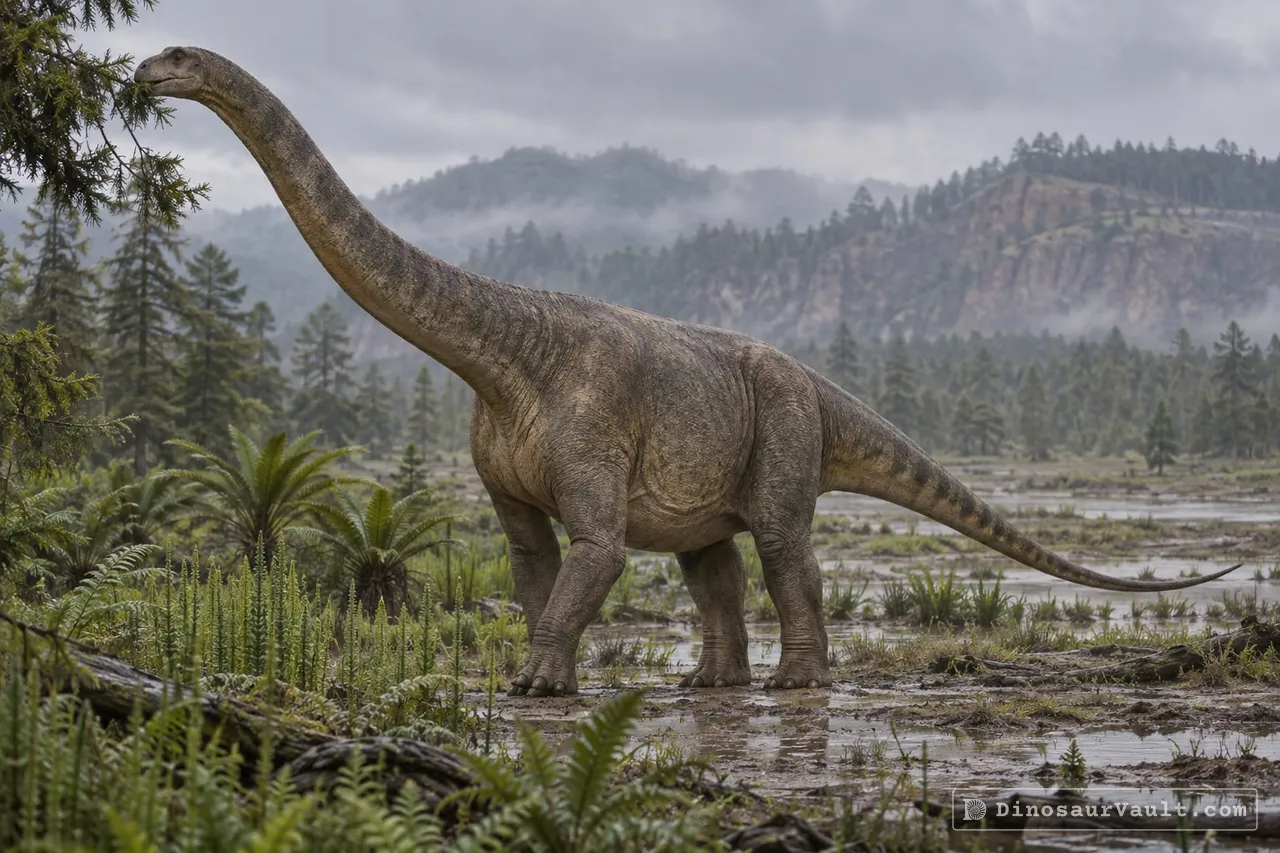
The evidence
The science behind Yongjinglong
Which parts of the picture come from its own bones, and which come from its relatives.
From its own fossils
- A partial skeleton preserves spoon-shaped teeth, neck and back bones, a rib fragment, the left shoulder girdle and the right forearm bones. The teeth are the only parts of the head.
- The neck and front back bones have deep openings for air sacs, and the shoulder blade is unusually long and narrow, with straight edges.
- In the forearm, a sturdy ulna wraps around the top of the radius. The radius is fairly straight and less stout than the ulna, and both narrow between widened ends.
Borrowed from relatives
- The missing skull is restored by comparison with Euhelopus, and the neck, body, hind legs, feet and tail with Mnyamawamtuka.
- The missing wrist and hand follow the more distant Camarasaurus and Apatosaurus.
Still unknown
- The shape of its skull and the full length of its neck.
- How its shoulder girdle sat on the body. Its describers considered more than one position.
- Its fully grown size.
Discovery timeline
- 2013Close relativePoropat & Kear
- 2014Named itLi et al.
- 2019Family treeMannion et al.
- 2025Close relativeShan
Key papers
The research behind what we know of Yongjinglong
Close relative
Photographed and digitally rebuilt the type skull of Euhelopus and described further skull bones.
Photographic Atlas and Three-Dimensional Reconstruction of the Holotype Skull of Euhelopus zdanskyi with Description of Additional Cranial Elements. PLoS ONE 8: e79932
Read the paper : Photographic Atlas and Three-Dimensional Reconstruction of the Holotype Skull of Euhelopus zdanskyi with Description of Additional Cranial Elements (opens in a new tab)Named it
Described a subadult sauropod with spoon-shaped teeth, deeply hollowed backbones, an unusually long shoulder blade and sturdy forearm bones.
A New Titanosaurian Sauropod from the Hekou Group (Lower Cretaceous) of the Lanzhou-Minhe Basin, Gansu Province, China. PLoS ONE 9: e85979
Read the paper : A New Titanosaurian Sauropod from the Hekou Group (Lower Cretaceous) of the Lanzhou-Minhe Basin, Gansu Province, China (opens in a new tab)Family tree
Placed Yongjinglong among relatives of Euhelopus rather than within the titanosaurs.
New information on the Cretaceous sauropod dinosaurs of Zhejiang Province, China: impact on Laurasian titanosauriform phylogeny and biogeography. Royal Society Open Science 6: 191057
Read the paper : New information on the Cretaceous sauropod dinosaurs of Zhejiang Province, China: impact on Laurasian titanosauriform phylogeny and biogeography (opens in a new tab)Close relative
Reexamined Liaoningotitan and recovered it as the closest relative of Yongjinglong in a family-tree analysis.
The re-description of Liaoningotitan sinensis Zhou et al., 2018. PeerJ 13: e19154
Read the paper : The re-description of Liaoningotitan sinensis Zhou et al., 2018 (opens in a new tab)
Close relatives
Other members of Euhelopodidae


Sources: Wikidata