Yanbeilong
- Lived
- 113 to 101 million years ago, Early Cretaceous
- Diet
- Herbivore
- Group
- Stegosaurs, Stegosauridae
- Found in
- China
- Named by
- Jia et al. 2024
Where its fossils were found
The evidence
Today

105 million years ago
Habitat
It lived in the Early Cretaceous landscape preserved in the Zuoyun Formation of China.
Field notes
About Yanbeilong
What it was like
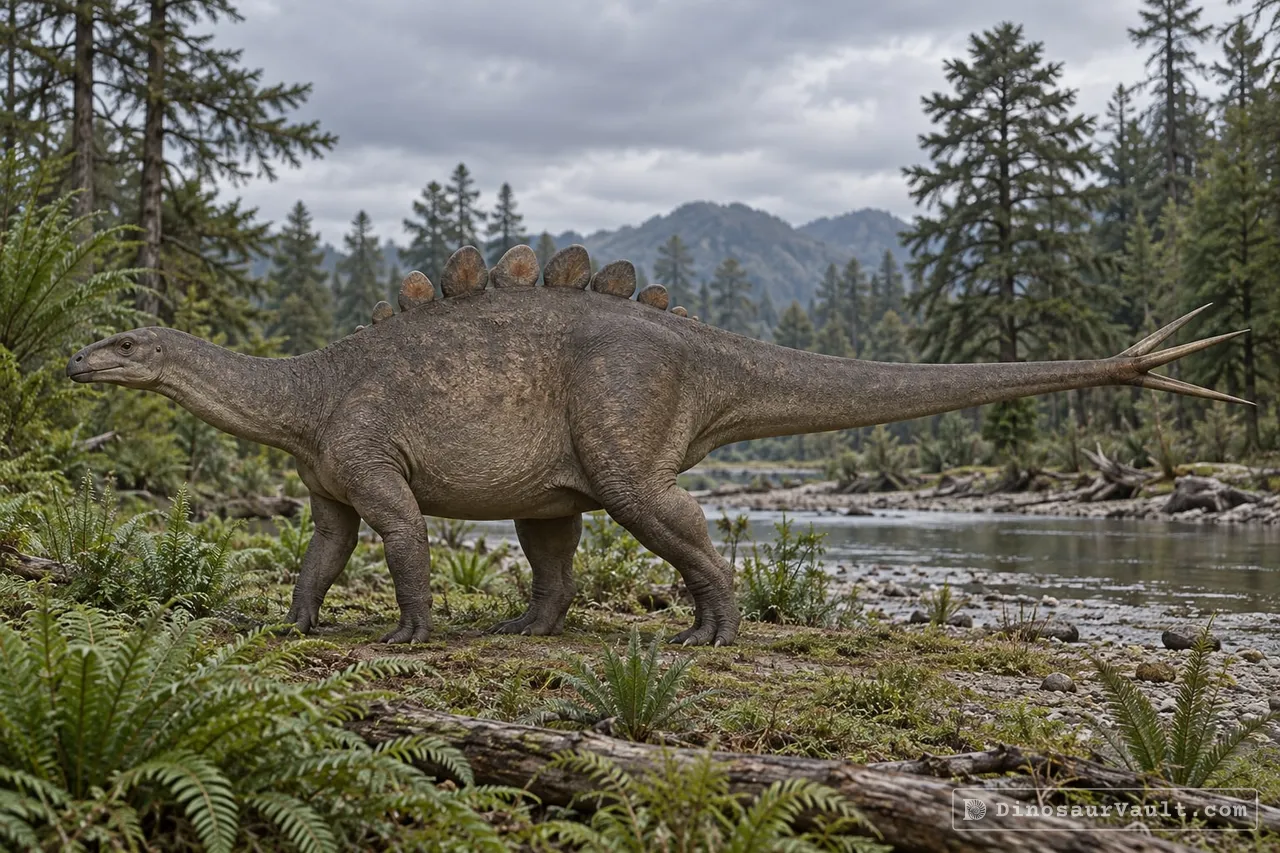
Yanbeilong was a stegosaur, a plated plant eater related to Stegosaurus. It is known from part of the backbone and the hips.
Its world
It lived in the Early Cretaceous in what is now China. Its bones come from the Zuoyun Formation. Most stegosaurs had died out by then, which makes Yanbeilong one of the youngest known.
How it was found
Jia and colleagues named it in 2024 from one find. Its species name, ultimus, refers to its place among the last stegosaurs.
Field gallery
More views of Yanbeilong
Scenes reconstructed from the available fossil evidence.
1 of 3
The evidence
The science behind Yanbeilong
Which parts of the picture come from its own bones, and which come from its relatives.
From its own fossils
- The partial skeleton preserves back vertebrae, a vertebra from the front of the tail and much of the hip region.
- The fused backbone above the hips and the surrounding pelvic bones help distinguish it from other stegosaurs.
Borrowed from relatives
- Stegosaurus supplies a model for the missing small head, beak and limbs.
- Its back plates and tail spikes are restored by comparison with Stegosaurus.
- Stegosaur forefeet had compact columns of palm bones rather than widely spread fingers.
Still unknown
- The shapes and arrangement of its plates and tail spikes.
- Its full size and limb proportions.
- Its skin texture and color.
Often drawn wrong
- A stegosaur's hind claws were blunt and hoof-like rather than long, sharp predator talons.
Discovery timeline
- 2010PostureSenter
- 2015Close relativeMaidment, Brassey & Barrett
- 2024Named itJia et al.
Key papers
The research behind what we know of Yanbeilong
Posture
Showed that stegosaur palm bones fitted into an upright, compact arrangement that supported the forefoot.
Evidence for a Sauropod-Like Metacarpal Configuration in Stegosaurian Dinosaurs. Acta Palaeontologica Polonica 55: 427-432
Read the paper : Evidence for a Sauropod-Like Metacarpal Configuration in Stegosaurian Dinosaurs (opens in a new tab)Close relative
Described a nearly complete Stegosaurus skeleton, including blunt hind claws and back armor, useful comparisons for the missing parts of Yanbeilong.
The Postcranial Skeleton of an Exceptionally Complete Individual of the Plated Dinosaur Stegosaurus stenops (Dinosauria: Thyreophora) from the Upper Jurassic Morrison Formation of Wyoming, U.S.A. PLOS ONE 10: e0138352
Read the paper : The Postcranial Skeleton of an Exceptionally Complete Individual of the Plated Dinosaur Stegosaurus stenops (Dinosauria: Thyreophora) from the Upper Jurassic Morrison Formation of Wyoming, U.S.A. (opens in a new tab)Named it
Named a late-surviving stegosaur from its backbone and hips, extending the record of the group in China.
A new stegosaur from the late Early Cretaceous of Zuoyun, Shanxi Province, China. Historical Biology 37: 420-429
Read the paper : A new stegosaur from the late Early Cretaceous of Zuoyun, Shanxi Province, China (opens in a new tab)
Close relatives
Other members of Stegosauridae


Sources: Wikidata