Yamatosaurus
"Yamato lizard"
Type species Yamatosaurus izanagii
- Lived
- 72 to 66 million years ago, Late Cretaceous
- Diet
- Herbivore
- Group
- Ornithopods, Hadrosauridae
- Found in
- Japan
- Named by
- Kobayashi et al. 2021
Where its fossils were found
The evidence
Today

70 million years ago
Habitat
It probably lived on coastal land beside the sea. Fossil plants include plane trees, elms and cycads; marine turtles, mosasaurs and diving birds occur in the same rocks.
Field notes
About Yamatosaurus
What it was like
Yamatosaurus was a duck-billed plant eater, known from part of the jaw, teeth and some other bones. It was an early member of the hadrosaur family.
Its world
It lived about 72 to 66 million years ago, at the end of the Late Cretaceous, in what is now Japan. Its bones come from the Kita-ama Formation, rocks laid down in the sea, on an island.
How it was found
Kobayashi and colleagues named Yamatosaurus in 2021, from a single find. Its name refers to an old name for Japan.
Field gallery
More views of Yamatosaurus
Scenes reconstructed from the available fossil evidence.
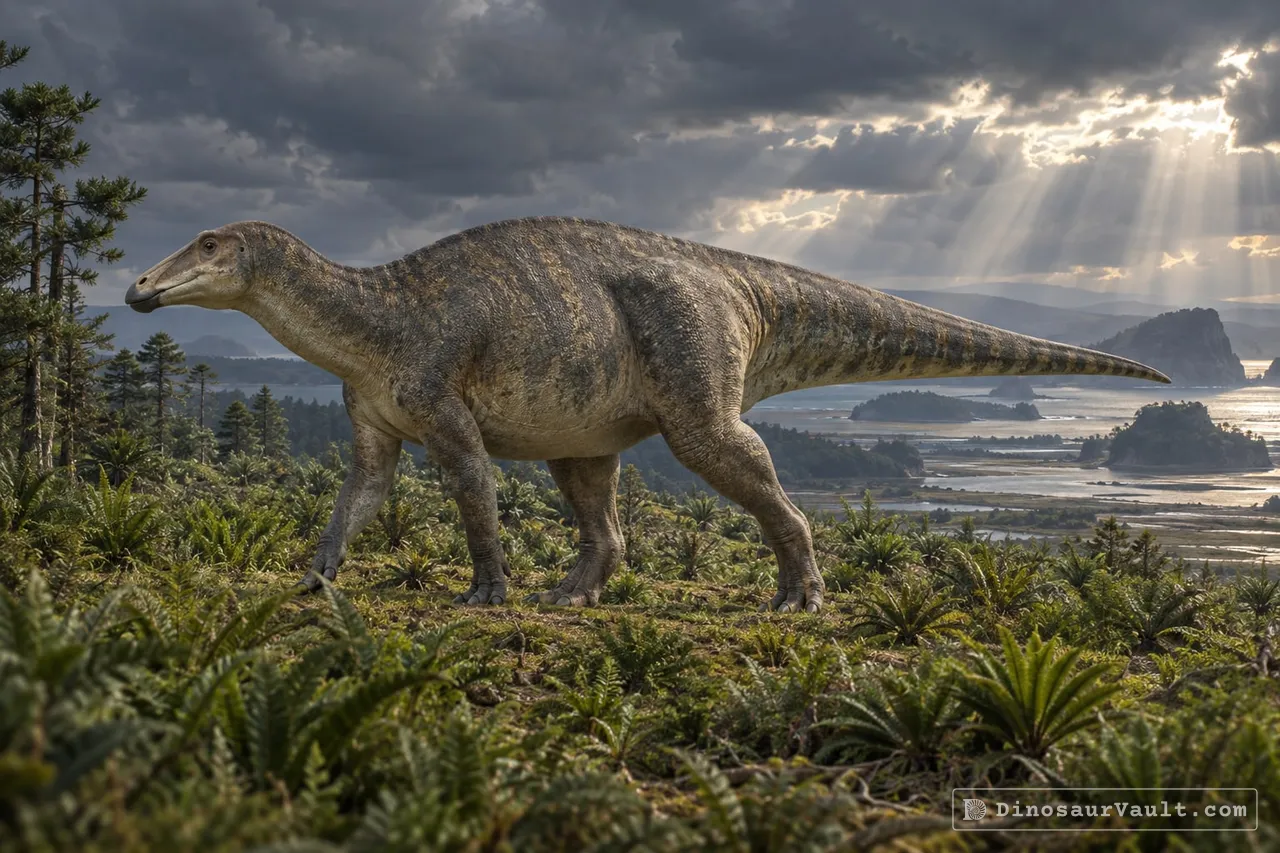
1 of 3
The evidence
The science behind Yamatosaurus
Which parts of the picture come from its own bones, and which come from its relatives.
From its own fossils
- The find includes lower jaw bones, teeth, neck vertebrae, a tail vertebra, neck ribs and a shoulder bone.
- Some positions in its tooth battery have only a single tooth in use.
- Its shoulder bone lacks the prominent biceps attachment found in more specialized duckbills.
Borrowed from relatives
- The missing limbs and most of the body are restored by comparison with other duckbills, such as Hadrosaurus and Kamuysaurus.
Still unknown
- The shape of the top of its skull.
- Its skin covering and color.
- How much time it spent walking on two legs or on all fours.
Discovery timeline
- 2019Close relativeKobayashi et al.
- 2021Named itKobayashi et al.
- 2024Fossil sitesHayashi et al.
Key papers
The research behind what we know of Yamatosaurus
Close relative
Described Kamuysaurus from a nearly complete skeleton, documenting another Japanese duckbill whose remains were buried at sea.
A New Hadrosaurine (Dinosauria: Hadrosauridae) from the Marine Deposits of the Late Cretaceous Hakobuchi Formation, Yezo Group, Japan. Scientific Reports 9
Read the paper : A New Hadrosaurine (Dinosauria: Hadrosauridae) from the Marine Deposits of the Late Cretaceous Hakobuchi Formation, Yezo Group, Japan (opens in a new tab)Named it
Described its unusual tooth battery and shoulder bone, placing Yamatosaurus on an early branch of the duckbill family tree.
A new basal hadrosaurid (Dinosauria: Ornithischia) from the latest Cretaceous Kita-ama Formation in Japan implies the origin of hadrosaurids. Scientific Reports 11
Read the paper : A new basal hadrosaurid (Dinosauria: Ornithischia) from the latest Cretaceous Kita-ama Formation in Japan implies the origin of hadrosaurids (opens in a new tab)Fossil sites
Identified a duckbill relative from an isolated back vertebra, extending the Japanese record of these plant eaters in marine rocks.
A Hadrosauroid Vertebra from the Upper Cretaceous Izumi Group, Kagawa Prefecture, Japan. Paleontological Research 28
Read the paper : A Hadrosauroid Vertebra from the Upper Cretaceous Izumi Group, Kagawa Prefecture, Japan (opens in a new tab)
Close relatives
Other members of Hadrosauridae


Sources: Wikidata