Xunmenglong
"swift fierce dragon"
Type species Xunmenglong yingliangis
- Lived
- 133 to 126 million years ago, Early Cretaceous
- Diet
- Carnivore
- Group
- Theropods, Compsognathidae
- Found in
- China
- Named by
- Xing et al. 2020
Where its fossils were found
The evidence
Today

130 million years ago
Habitat
Its fossil came from lake deposits mixed with volcanic ash in the Huajiying Formation. The same formation preserves Jinfengopteryx. Protopteryx, an early bird, also lived in this lake region.
Field notes
About Xunmenglong
What it was like
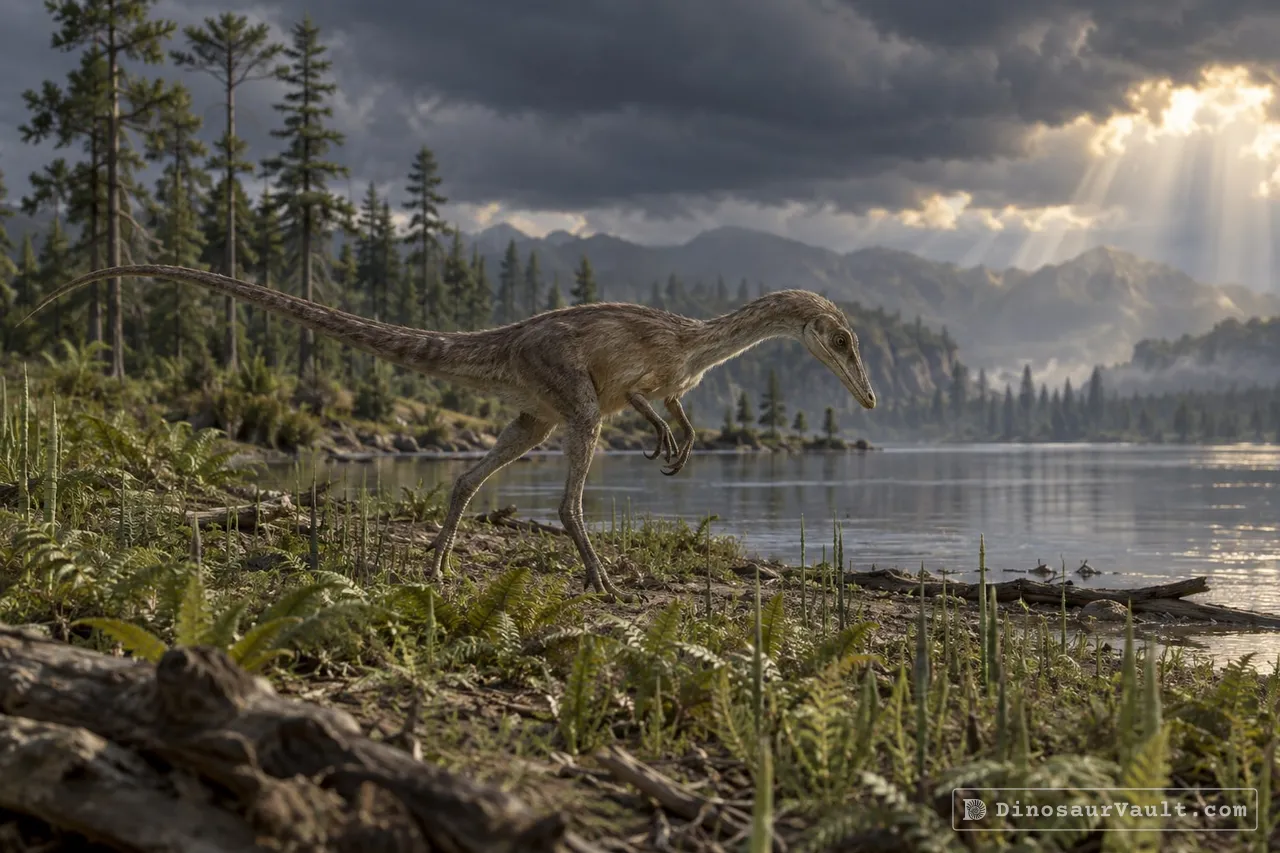
Xunmenglong was a small compsognathid, a light, two-legged hunter. It is known from the back half of a skeleton, from a young animal.
Its world
It lived in the Early Cretaceous, in what is now China. It comes from the Huajiying Formation, where it lived beside the small troodontid Jinfengopteryx.
How it was found
Xing and colleagues named Xunmenglong in 2020. The type species is Xunmenglong yingliangis.
Field gallery
More views of Xunmenglong
Scenes reconstructed from the available fossil evidence.
1 of 2
Lived alongside
Found in the same rock formations

A rock formation can hold fossils laid down millions of years apart, so not every animal here met Xunmenglong.
The evidence
The science behind Xunmenglong
Which parts of the picture come from its own bones, and which come from its relatives.
From its own fossils
- The type skeleton preserves the hips, the base of the tail and the hind legs.
- Its lower legs were unusually long compared with those of other small theropods.
- An outer toe has a longer bone near its tip than the bone immediately behind it, a feature used to identify the genus.
Borrowed from relatives
- The missing head and neck can be compared with Huaxiagnathus, another small theropod.
Still unknown
- Its adult size and proportions.
- Its skin covering and color.
- Its place in the theropod family tree, which changes when young animals are compared differently.
Discovery timeline
- 2004SkullHwang et al.
- 2020Named itXing et al.
- 2020Its worldYang et al.
Key papers
The research behind what we know of Xunmenglong
Skull
Described the skull of Huaxiagnathus, a small theropod used as a comparison for the missing head of Xunmenglong.
A large Compsognathid from the early cretaceous Yixian formation of China. Journal of Systematic Palaeontology 2: 13-30
Read the paper : A large Compsognathid from the early cretaceous Yixian formation of China (opens in a new tab)Named it
Named a small theropod from a partial skeleton with unusually long lower legs and a distinctive outer toe.
A new compsognathid theropod dinosaur from the oldest assemblage of the Jehol Biota in the Lower Cretaceous Huajiying Formation, northeastern China. Cretaceous Research 107: 104285
Read the paper : A new compsognathid theropod dinosaur from the oldest assemblage of the Jehol Biota in the Lower Cretaceous Huajiying Formation, northeastern China (opens in a new tab)Its world
Dated volcanic layers in the Huajiying Formation to establish the timing of its early bird-rich fossil communities.
The appearance and duration of the Jehol Biota: Constraint from SIMS U-Pb zircon dating for the Huajiying Formation in northern China. Proceedings of the National Academy of Sciences 117: 14299-14305
Read the paper : The appearance and duration of the Jehol Biota: Constraint from SIMS U-Pb zircon dating for the Huajiying Formation in northern China (opens in a new tab)
Close relatives
Other members of Compsognathidae


Sources: Wikidata