Scipionyx
SHIP-ee-oh-NIX
- Lived
- 113 to 110 million years ago, Early Cretaceous
- Diet
- Carnivore
- Group
- Theropods, Compsognathidae
- Found in
- Italy
- Named by
- Dal Sasso and Signore 1996
Where its fossils were found
The evidence
Today

110 million years ago
Habitat
It probably lived on an island near a coastal lagoon in what is now Italy.
Field notes
About Scipionyx
What it was like
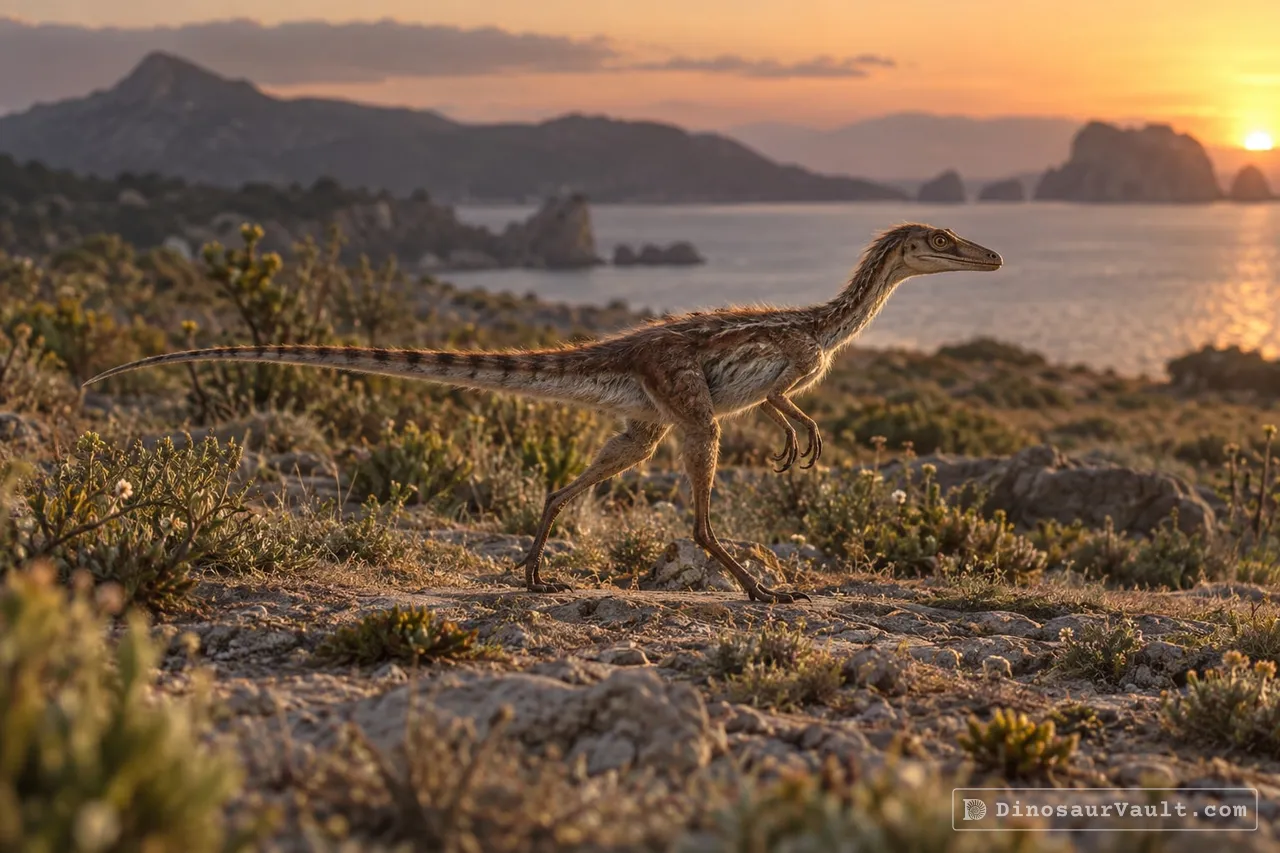
Scipionyx is known from a single fossil, a young juvenile with an extraordinary level of preservation. Traces of its muscles, intestines, and other soft tissue survived alongside the bones, letting scientists study internal anatomy that is almost never preserved in dinosaurs. It was a small, bipedal predator with a long tail for balance. Half-digested remains in its gut show that it had recently eaten lizards and fish. Because such tissue rarely survives fossilization, the specimen is considered one of the most important dinosaur fossils ever found.
Its world
Scipionyx lived from about 113 to 110 million years ago, during the Early Cretaceous, in what is now Italy. It was the first dinosaur ever found in the country, and remains one of the few known from there. No other dinosaurs are confirmed from the same rocks, so little is known yet about the animals it may have lived alongside.
How it was found
Dal Sasso and Signore named Scipionyx in 1996. Because the only known fossil is a very young juvenile, its adult size and appearance are unknown, and its exact classification is still debated. Most paleontologists place it among the compsognathids, a family of small, lightly built theropods, though not all agree.
Field gallery
More views of Scipionyx
Scenes reconstructed from the available fossil evidence.
1 of 7
The evidence
The science behind Scipionyx
Which parts of the picture come from its own bones, and which come from its relatives.
From its own fossils
- The only known skeleton belongs to a hatchling with a large head, short arms and a long tail.
- Muscles and intestines survive alongside the bones, preserving details of its internal anatomy.
- Half-digested fish and lizard remains lie inside its gut.
Borrowed from relatives
- The hatchling's body shape comes largely from its own skeleton.
- Lips covering the teeth are inferred from comparisons with other theropods, including Tyrannosaurus.
Still unknown
- Its adult size and body proportions.
- Whether its skin carried scales, feathers or both, and what color it was.
- Its exact place in the theropod family tree.
Discovery timeline
- 1996Named itSasso & Signore
- 1999Full descriptionRuben et al.
- 2023Close relativeCullen et al.
Key papers
The research behind what we know of Scipionyx
Named it
Described a tiny theropod from Italy whose fossil preserved internal organs and muscles alongside the skeleton.
Exceptional soft-tissue preservation in a theropod dinosaur from Italy. Nature 392: 383-387
No link available
Full description
Interpreted the preserved organs of Scipionyx as support for diaphragm-assisted breathing, an interpretation later challenged by other studies.
Pulmonary Function and Metabolic Physiology of Theropod Dinosaurs. Science 283: 514-516
Read the paper : Pulmonary Function and Metabolic Physiology of Theropod Dinosaurs (opens in a new tab)Close relative
Comparisons of theropod teeth and living reptiles support lips covering the teeth when the mouth closed, informing the likely appearance of Scipionyx.
Theropod dinosaur facial reconstruction and the importance of soft tissues in paleobiology. Science 379: 1348-1352
Read the paper : Theropod dinosaur facial reconstruction and the importance of soft tissues in paleobiology (opens in a new tab)
Close relatives
Other members of Compsognathidae


Sources: Wikidata