Jinfengopteryx
"golden phoenix feather"
Type species Jinfengopteryx elegans
- Lived
- 126 to 121 million years ago, Early Cretaceous
- Diet
- Omnivore
- Group
- Theropods, Troodontidae
- Found in
- China
- Named by
- Ji et al. 2005
Where its fossils were found
The evidence
Today

125 million years ago
Habitat
Lakes and rivers lay in a landscape shaped by volcanoes in what is now China, recorded by the Huajiying Formation. Xunmenglong was another small theropod from these rocks.
Field notes
About Jinfengopteryx
What it was like
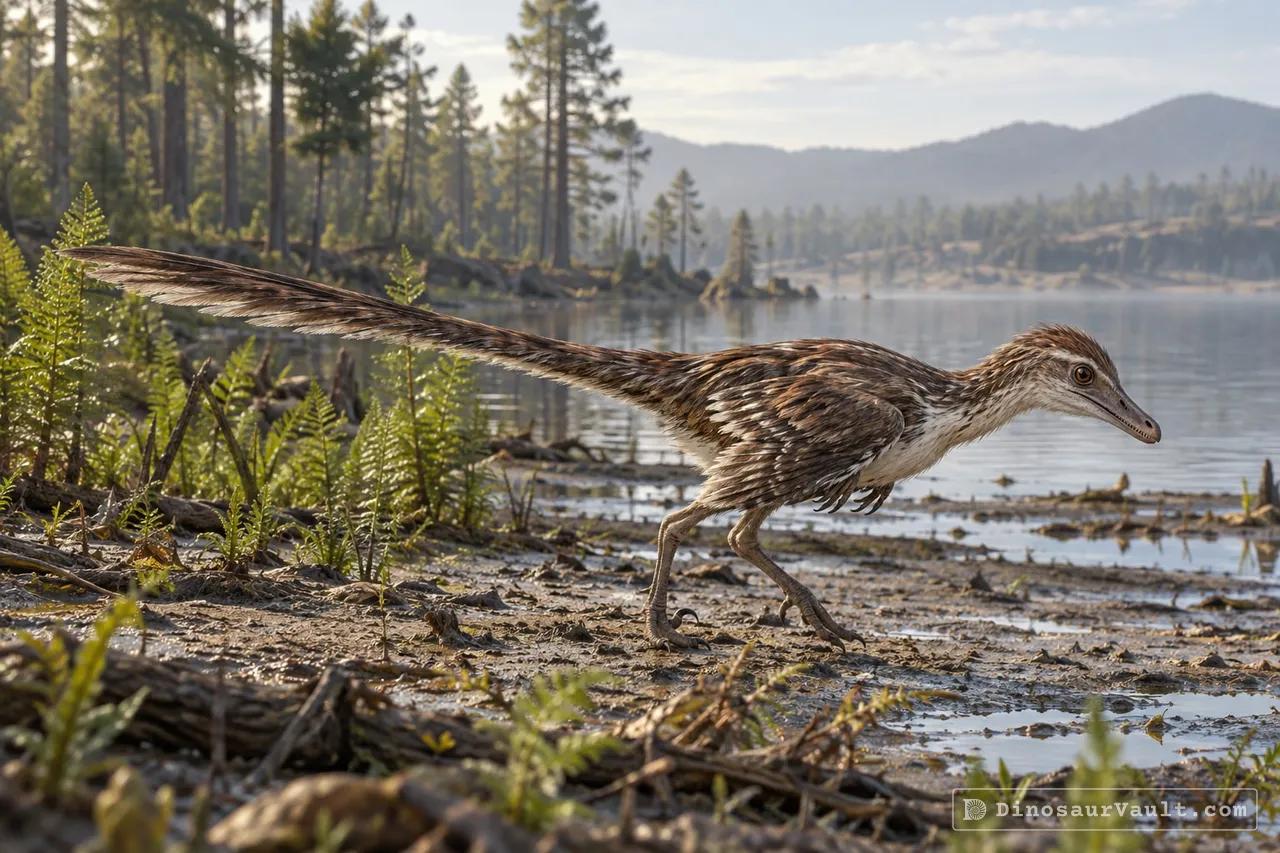
Jinfengopteryx was a small feathered troodontid about the size of a crow. Its skeleton preserves feathers over its body and tail. Seeds found with it may have been part of its diet.
Its world
It lived in the Early Cretaceous, in what is now China. It comes from the Huajiying Formation.
How it was found
Ji and colleagues named Jinfengopteryx in 2005. The type species is Jinfengopteryx elegans. It was first described as an early bird, but later work showed it to be a troodontid.
Field gallery
More views of Jinfengopteryx
Scenes reconstructed from the available fossil evidence.
1 of 3
Lived alongside
Found in the same rock formations

A rock formation can hold fossils laid down millions of years apart, so not every animal here met Jinfengopteryx.
The evidence
The science behind Jinfengopteryx
Which parts of the picture come from its own bones, and which come from its relatives.
From its own fossils
- A nearly complete skeleton preserves feathers around the body, with vaned feathers along most of its long, bony tail.
- Its skull has a short, high snout and a large eye socket, and its jaws have many closely packed teeth.
- Its arms are short compared with its hind legs.
Borrowed from relatives
- Most of the skeleton and much of the feather covering come from its own fossil.
- The skull roof, neck and body follow Jianianhualong, and the hands, feet and end of the tail follow Sinornithoides, both troodontids.
Still unknown
- Whether the small oval objects preserved with it are seeds it ate.
- Whether it could fly or used its feathered arms in other ways.
- Its feather colors.
Discovery timeline
- 2005Named itJi et al.
- 2006Family treeXu & Norell
- 2007SkullJi & Ji
- 2019Family treeHartman et al.
- 2020PosturePei et al.
Key papers
The research behind what we know of Jinfengopteryx
Named it
Named Jinfengopteryx from a feathered skeleton and initially interpreted it as an early bird.
First avialan bird from China. Geological Bulletin of China 24: 197-210
No link available
Family tree
Reviewed non-bird dinosaurs of the Jehol Group and treated Jinfengopteryx as a troodontid on the evidence of its body plan and teeth.
Non‐avian dinosaur fossils from the Lower Cretaceous Jehol Group of western Liaoning, China. Geological Journal 41: 419-437
Read the paper : Non‐avian dinosaur fossils from the Lower Cretaceous Jehol Group of western Liaoning, China (opens in a new tab)Skull
Compared the skeleton with Archaeopteryx and pointed to its short, high snout, closely packed teeth, short arms and long tail feathers.
Jinfengopteryx Compared to Archaeopteryx, with Comments on the Mosaic Evolution of Long‐tailed Avialan Birds. Acta Geologica Sinica - English Edition 81: 337-343
Read the paper : Jinfengopteryx Compared to Archaeopteryx, with Comments on the Mosaic Evolution of Long‐tailed Avialan Birds (opens in a new tab)Family tree
Compared bird relatives and found that Jinfengopteryx could occupy different branches within the troodontid family tree.
A new paravian dinosaur from the Late Jurassic of North America supports a late acquisition of avian flight. PeerJ 7: e7247
Read the paper : A new paravian dinosaur from the Late Jurassic of North America supports a late acquisition of avian flight (opens in a new tab)Posture
Estimated flight potential in bird relatives; Jinfengopteryx fell just above the wing-loading threshold used for modern flying birds.
Potential for Powered Flight Neared by Most Close Avialan Relatives, but Few Crossed Its Thresholds. Current Biology 30: 4033-4046.e8
Read the paper : Potential for Powered Flight Neared by Most Close Avialan Relatives, but Few Crossed Its Thresholds (opens in a new tab)
Close relatives
Other members of Troodontidae


Sources: Wikidata