Triunfosaurus
"Triunfo lizard"
Type species Triunfosaurus leonardii
- Lived
- 143 to 126 million years ago, Early Cretaceous
- Diet
- Herbivore
- Group
- Sauropods
- Found in
- Brazil
- Named by
- Carvalho et al. 2017
Where its fossils were found
The evidence
Today

135 million years ago
Habitat
It lived in northeastern Brazil, where rivers carried sand and gravel through a probably dry landscape. Its bones were buried in river deposits of the Rio Piranhas Formation.
Field notes
About Triunfosaurus
What it was like
Triunfosaurus was a long-necked, four-legged plant eater, known from part of the hips and tail. It was first described as a very early titanosaur, but later studies place it just outside that group.
Its world
It lived in the Early Cretaceous in what is now northeastern Brazil. Its bones come from the Rio Piranhas Formation.
How it was found
Carvalho and colleagues named Triunfosaurus in 2017, from a single find.
Field gallery
More views of Triunfosaurus
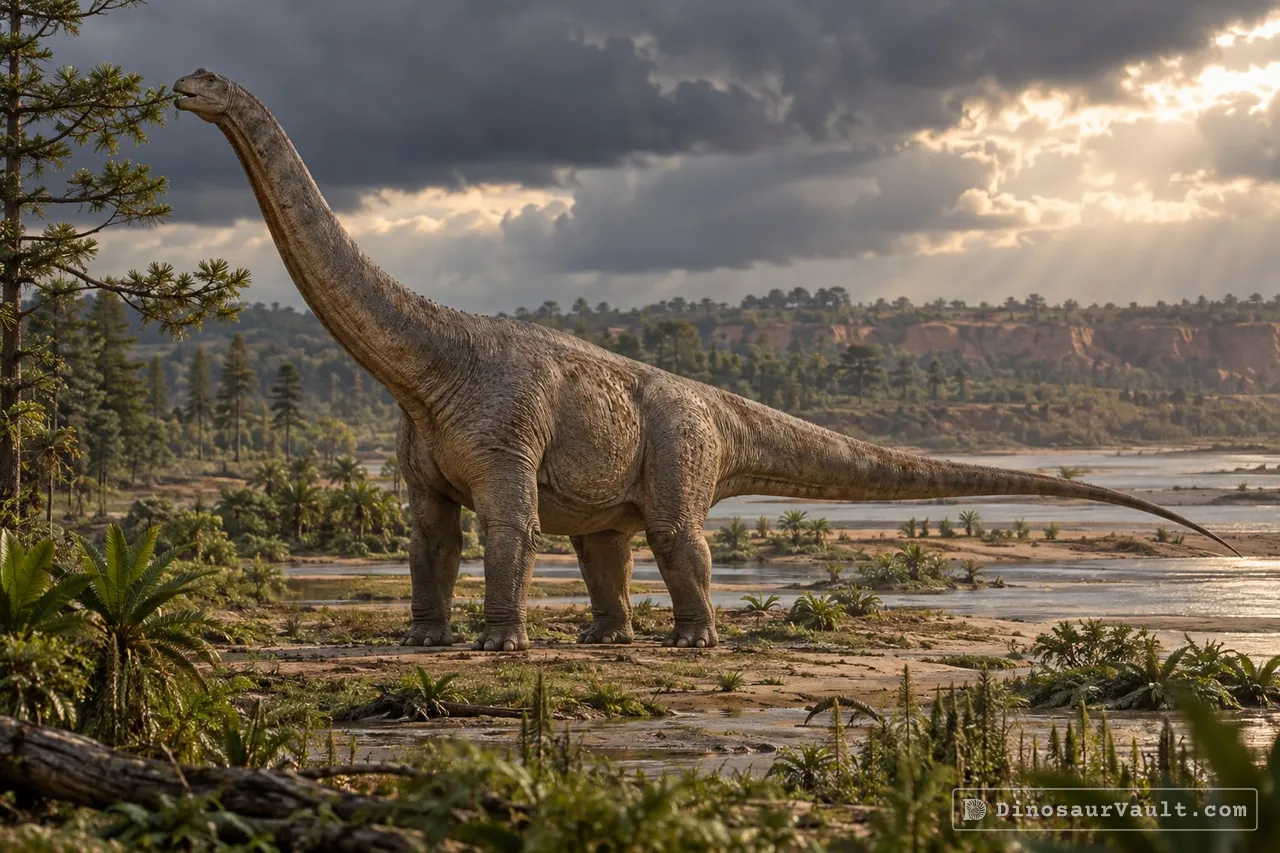
Scenes reconstructed from the available fossil evidence.
The evidence
The science behind Triunfosaurus
Which parts of the picture come from its own bones, and which come from its relatives.
From its own fossils
- The type material includes articulated vertebrae from the front of the tail, separate bony tail projections, bones from beneath the tail and an incomplete hip bone.
- The upright projections on the front tail vertebrae widen strongly from front to back near their tops.
- A later study identified a small bump on the side of a tail-joint projection and ridges on a bone from beneath the tail.
Borrowed from relatives
- The missing head is inferred from broader titanosaur comparisons such as Tapuiasaurus.
- Mnyamawamtuka supplies broader comparisons for the missing neck, chest, shoulders and upper arms.
Still unknown
- Its complete body size, proportions and skin color.
- Exactly where it sits near the base of the titanosaur family tree.
- Whether all of the type bones come from one animal; a later study judged this likely but not certain.
Discovery timeline
- 2011Close relativeMANNION & CALVO
- 2016SkullWilson et al.
- 2017Named itCarvalho et al.
- 2019Full descriptionGorscak & O’Connor
- 2026RedescriptionMannion & Carvalho
Key papers
The research behind what we know of Triunfosaurus
Close relative
Redescribed Andesaurus, whose hip and tail bones help compare Triunfosaurus with early titanosaurs.
Anatomy of the basal titanosaur (Dinosauria, Sauropoda) Andesaurus delgadoi from the mid-Cretaceous (Albian-early Cenomanian) Río Limay Formation, Neuquén Province, Argentina: implications for titanosaur systematics. Zoological Journal of the Linnean Society: no-no
Read the paper : Anatomy of the basal titanosaur (Dinosauria, Sauropoda) Andesaurus delgadoi from the mid-Cretaceous (Albian-early Cenomanian) Río Limay Formation, Neuquén Province, Argentina: implications for titanosaur systematics (opens in a new tab)Skull
Described the skull of Tapuiasaurus, providing a broader titanosaur comparison for the missing head of Triunfosaurus.
The skull of the titanosaurTapuiasaurus macedoi(Dinosauria: Sauropoda), a basal titanosaur from the Lower Cretaceous of Brazil. Zoological Journal of the Linnean Society 178: 611-662
Read the paper : The skull of the titanosaurTapuiasaurus macedoi(Dinosauria: Sauropoda), a basal titanosaur from the Lower Cretaceous of Brazil (opens in a new tab)Named it
Named Triunfosaurus from hip and tail bones and interpreted it as an early titanosaur.
A new basal titanosaur (Dinosauria, Sauropoda) from the Lower Cretaceous of Brazil. Journal of South American Earth Sciences 75: 74-84
Read the paper : A new basal titanosaur (Dinosauria, Sauropoda) from the Lower Cretaceous of Brazil (opens in a new tab)Full description
Described neck, shoulder and upper-arm bones of Mnyamawamtuka, providing broader comparisons for the missing front of Triunfosaurus.
A new African Titanosaurian Sauropod Dinosaur from the middle Cretaceous Galula Formation (Mtuka Member), Rukwa Rift Basin, Southwestern Tanzania. PLOS ONE 14: e0211412
Read the paper : A new African Titanosaurian Sauropod Dinosaur from the middle Cretaceous Galula Formation (Mtuka Member), Rukwa Rift Basin, Southwestern Tanzania (opens in a new tab)Redescription
Reinterpreted its tail anatomy and placed Triunfosaurus near the base of the titanosaur radiation, with the exact position depending on the analysis.
Re-evaluation of the Early Cretaceous titanosauriform sauropod dinosaur Triunfosaurus leonardii from the Triunfo Basin, Brazil: implications for the initial radiations of Somphospondyli and Titanosauria. Zoological Journal of the Linnean Society 207
Read the paper : Re-evaluation of the Early Cretaceous titanosauriform sauropod dinosaur Triunfosaurus leonardii from the Triunfo Basin, Brazil: implications for the initial radiations of Somphospondyli and Titanosauria (opens in a new tab)
Close relatives
Other members of Somphospondyli


Sources: Wikidata