Where its fossils were found
The evidence
No finds with map coordinates are recorded yet.
Habitat
It lived in the Late Cretaceous lowlands of the southwestern United States. Rivers and wetlands supported plant eaters such as Pentaceratops and Parasaurolophus.
Field notes
About Titanoceratops
What it was like
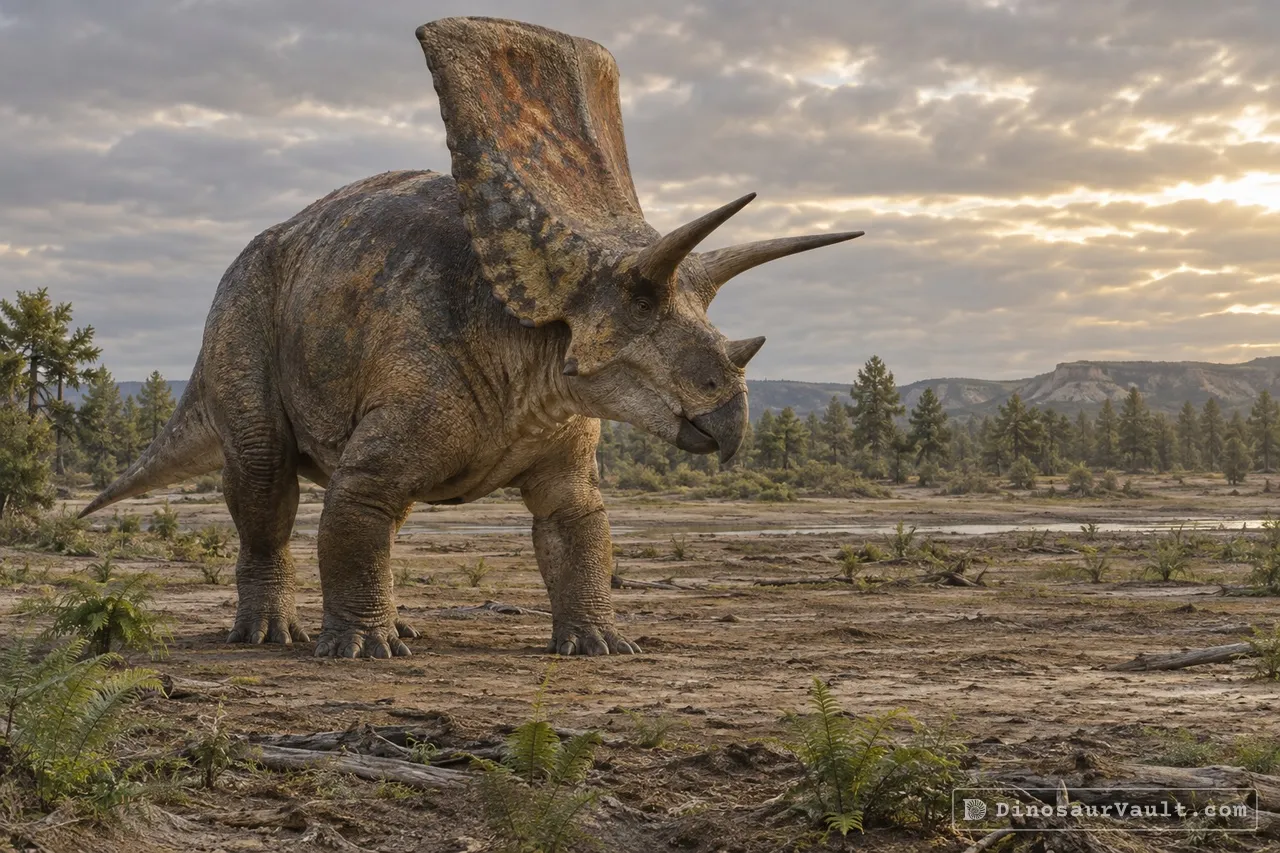
Titanoceratops was a very large horned dinosaur, with a huge skull, a long frill and horns over its eyes. It belonged to the same branch of horned dinosaurs as Triceratops and Torosaurus.
Its world
It lived in the Late Cretaceous in what is now the southwestern United States, where it would have been one of the biggest plant eaters of its day.
How it was found
Longrich named Titanoceratops in 2011 from a big skull and skeleton that had long been filed under Pentaceratops. He argued that details of the skull tied it to Triceratops instead. Other scientists disagree and think the fossil is simply a large, old Pentaceratops, so its status is still debated.
Field gallery
More views of Titanoceratops
Scenes reconstructed from the available fossil evidence.
The evidence
The science behind Titanoceratops
Which parts of the picture come from its own bones, and which come from its relatives.
From its own fossils
- A large skull is associated with much of the skeleton, including bones of the backbone, hips and limbs.
- The skull preserves a long snout and large brow horns.
Borrowed from relatives
- The missing parts of the frill were originally restored using Pentaceratops.
- The naming study compared its skull with Triceratops and Torosaurus to propose a close relationship.
Still unknown
- Whether it is a distinct genus or a large, old Pentaceratops.
- The complete outline of its frill and the exact rock layer of the original find.
- Its color and how its horns changed during growth.
Discovery timeline
- 1998Full descriptionLehman
- 2011Named itLongrich
- 2014Close relativeLongrich
Key papers
The research behind what we know of Titanoceratops
Full description
Described the large skull and associated skeleton before the specimen was given the name Titanoceratops.
A gigantic skull and skeleton of the horned dinosaur Pentaceratops sternbergi from New Mexico. Journal of Paleontology 72: 894-906
Read the paper : A gigantic skull and skeleton of the horned dinosaur Pentaceratops sternbergi from New Mexico (opens in a new tab)Named it
Reidentified a large skeleton previously called Pentaceratops and proposed that its skull placed it near Triceratops and Torosaurus.
Titanoceratops ouranos, a giant horned dinosaur from the late Campanian of New Mexico. Cretaceous Research 32: 264-276
Read the paper : Titanoceratops ouranos, a giant horned dinosaur from the late Campanian of New Mexico (opens in a new tab)Close relative
Compared Pentaceratops fossils across North America, exploring variation and relationships in the horned dinosaur central to the Titanoceratops debate.
The horned dinosaurs Pentaceratops and Kosmoceratops from the upper Campanian of Alberta and implications for dinosaur biogeography. Cretaceous Research 51: 292-308
Read the paper : The horned dinosaurs Pentaceratops and Kosmoceratops from the upper Campanian of Alberta and implications for dinosaur biogeography (opens in a new tab)
Close relatives
Other members of Ceratopsidae


Sources: Wikidata