Tastavinsaurus
"Tastavins lizard"
- Lived
- 121 to 120 million years ago, Early Cretaceous
- Diet
- Herbivore
- Group
- Sauropods
- Found in
- Spain
- Named by
- Canudo et al. 2008
Where its fossils were found
The evidence
Today

120 million years ago
Habitat
Its fossils come from coastal deposits in what is now Spain. The sand and clay of the Forcall Formation record shallow water influenced by tides.
Field notes
About Tastavinsaurus
What it was like
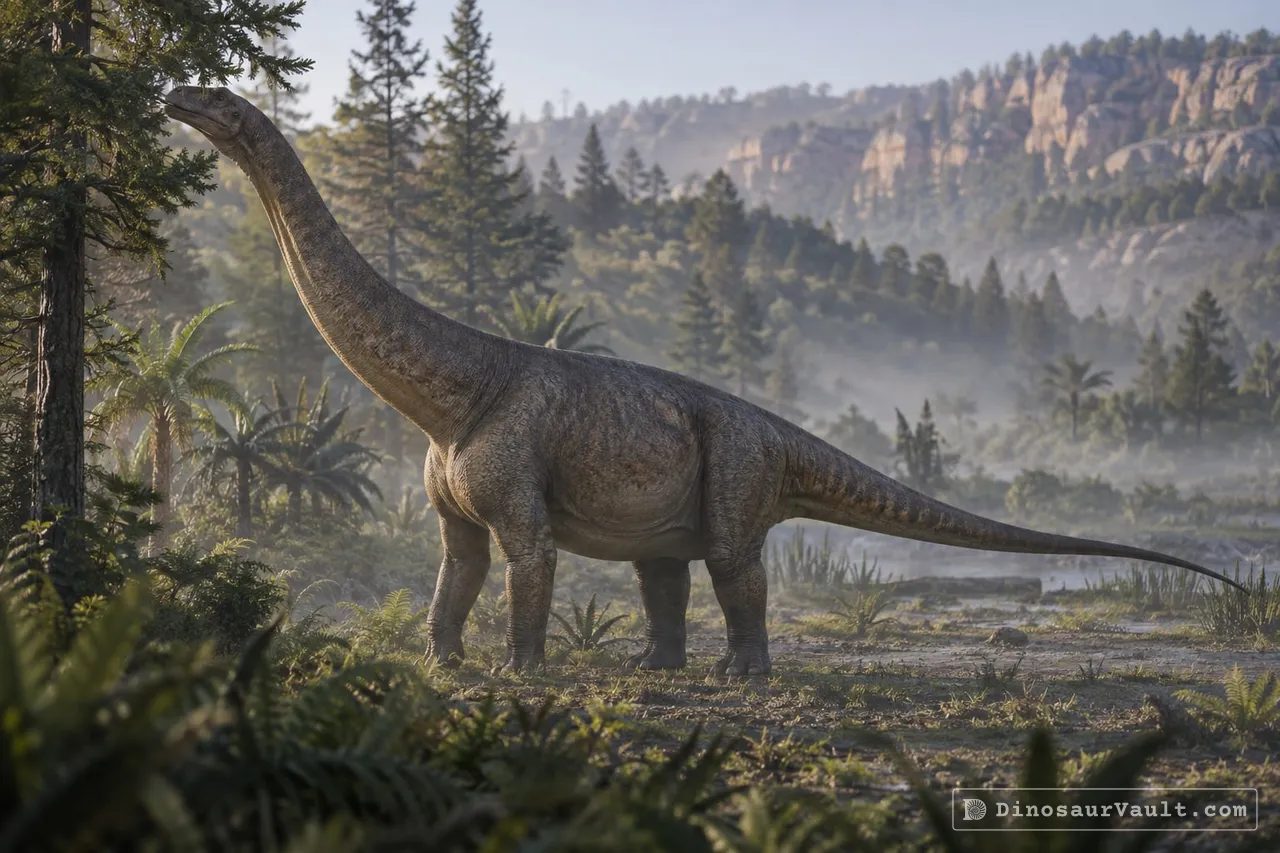
Tastavinsaurus was a long-necked, four-legged plant eater, a relative of the titanosaurs. It is known from a partial skeleton with much of the hips, tail and hind legs.
Its world
It lived in the Early Cretaceous in what is now eastern Spain. Its bones come from the Xert and Forcall formations.
How it was found
Canudo and colleagues named Tastavinsaurus in 2008. Two finds are known.
Field gallery
More views of Tastavinsaurus
Scenes reconstructed from the available fossil evidence.
The evidence
The science behind Tastavinsaurus
Which parts of the picture come from its own bones, and which come from its relatives.
From its own fossils
- The first skeleton preserves rear back vertebrae, ribs, the hips, much of the tail and both hind legs and feet.
- In that skeleton the thigh bone is straight and the shin bone short and nearly straight. The toe claws get smaller from the inner toe outward and are sickle-shaped in side view.
- A second partial skeleton referred to it adds an arm bone, ribs, parts of the hips and a complete hind leg.
Borrowed from relatives
- The missing head and jaws are restored by comparison with Euhelopus.
- The neck, shoulders, upper arms and tail tip follow Mnyamawamtuka, and the wrists and hands follow Camarasaurus and Apatosaurus.
Still unknown
- Its skull shape and neck proportions.
- Its closest relatives. It has been grouped with Venenosaurus and Cedarosaurus, while a later study places it more broadly among titanosauriforms close to, but outside, the titanosaurs.
- How its tail ended, and its skin covering and color.
Discovery timeline
- 2008Named itCanudo, Royo-Torres & Cuenca-Bescós
- 2012New findRoyo-Torres, Alcalá & Cobos
- 2012Family treeD'EMIC
Key papers
The research behind what we know of Tastavinsaurus
Named it
Described a partial adult skeleton preserving much of the hips, tail and hind legs, and compared it with Venenosaurus.
A new sauropod:Tastavinsaurus sanzigen. et sp. nov. from the Early Cretaceous (Aptian) of Spain. Journal of Vertebrate Paleontology 28: 712-731
Read the paper : A new sauropod:Tastavinsaurus sanzigen. et sp. nov. from the Early Cretaceous (Aptian) of Spain (opens in a new tab)New find
Described another partial skeleton from shallow coastal deposits and grouped Tastavinsaurus with Cedarosaurus and Venenosaurus.
A new specimen of the Cretaceous sauropod Tastavinsaurus sanzi from El Castellar (Teruel, Spain), and a phylogenetic analysis of the Laurasiformes. Cretaceous Research 34: 61-83
Read the paper : A new specimen of the Cretaceous sauropod Tastavinsaurus sanzi from El Castellar (Teruel, Spain), and a phylogenetic analysis of the Laurasiformes (opens in a new tab)Family tree
Reassessed early titanosauriform relationships and found no support for the proposed northern group that included Tastavinsaurus.
The early evolution of titanosauriform sauropod dinosaurs. Zoological Journal of the Linnean Society 166: 624-671
Read the paper : The early evolution of titanosauriform sauropod dinosaurs (opens in a new tab)
Close relatives
Other members of Somphospondyli


Sources: Wikidata