Oplosaurus
"armed lizard"
Type species Oplosaurus armatus
- Lived
- 137 to 121 million years ago, Early Cretaceous
- Diet
- Herbivore
- Group
- Sauropods
- Found in
- United Kingdom
- Named by
- Gervais 1852
Where its fossils were found
The evidence
Today

130 million years ago
Habitat
A low floodplain crossed by winding rivers, with lakes and patches of woodland. Other dinosaurs from these rocks include Iguanodon, Hypsilophodon and Neovenator.
Field notes
About Oplosaurus
What it was like
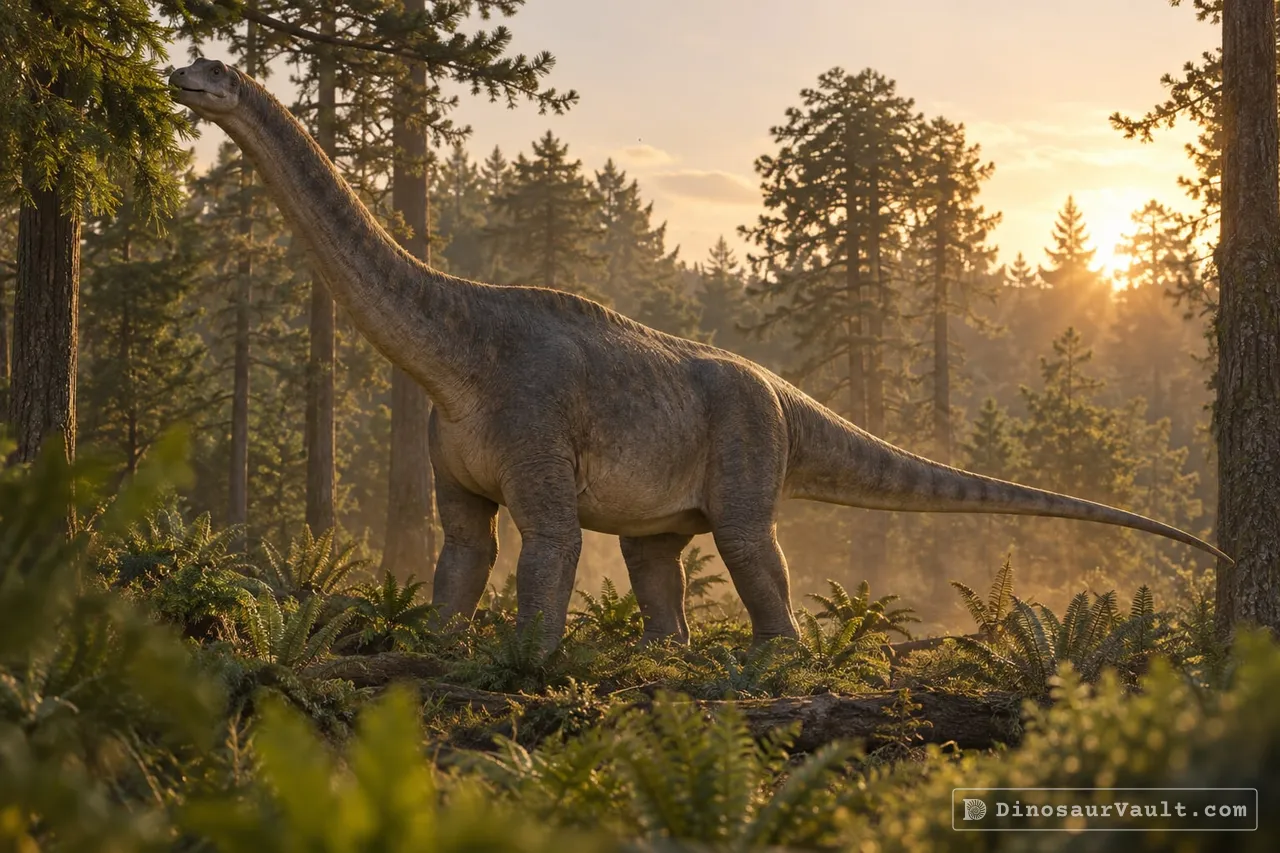
Oplosaurus is known from a single large tooth, which came from a long-necked, four-legged plant eater. The tooth is broad and spoon-shaped.
Its world
It lived in the Early Cretaceous in what is now southern England.
How it was found
Gervais named Oplosaurus in 1852, from a single tooth. An older view treated the name as doubtful, while a later revision kept it as provisionally valid. Its place among sauropods remains unsettled.
Field gallery
More views of Oplosaurus
Scenes reconstructed from the available fossil evidence.
1 of 3
The evidence
The science behind Oplosaurus
Which parts of the picture come from its own bones, and which come from its relatives.
From its own fossils
- A single large, broad tooth is the basis for Oplosaurus.
- Its spoon-shaped crown resembles the teeth of broad-toothed sauropods.
- The inner surface of the tooth crown is concave and lacks a central ridge.
Borrowed from relatives
- The long neck and four-legged stance are inferred from sauropods in general; Camarasaurus provides the comparison for the missing head, neck and shoulders.
Still unknown
- A later revision kept the name as provisionally valid against an older view that it is doubtful, and its sauropod family is unsettled.
- Its body size and proportions.
- Its skin and color.
Discovery timeline
- 1852Named itGervais
- 2007Family treeNaish & Martill
- 2007Family treeSánchez-Hernández, Benton & Naish
- 2010Its worldSweetman & Insole
Key papers
The research behind what we know of Oplosaurus
Named it
Named Oplosaurus from a large tooth found in England.
Zoologie et Paléontologie Françaises (Animaux Vertébrés) ou Nouvelles Recherches sur les Animaux Vivants et Fossiles de la France. 1–3:1-274+.
No link available
Family tree
Reviewed British sauropods and the competing ideas that Oplosaurus belonged near Brachiosaurus or Camarasaurus.
Dinosaurs of Great Britain and the role of the Geological Society of London in their discovery: basal Dinosauria and Saurischia. Journal of the Geological Society 164: 493-510
Read the paper : Dinosaurs of Great Britain and the role of the Geological Society of London in their discovery: basal Dinosauria and Saurischia (opens in a new tab)Family tree
Compared Spanish sauropod teeth with Oplosaurus and found similarities to Camarasaurus and other broad-toothed sauropods.
Dinosaurs and other fossil vertebrates from the Late Jurassic and Early Cretaceous of the Galve area, NE Spain. Palaeogeography, Palaeoclimatology, Palaeoecology 249: 180-215
Read the paper : Dinosaurs and other fossil vertebrates from the Late Jurassic and Early Cretaceous of the Galve area, NE Spain (opens in a new tab)Its world
Explained how floods carried plants and animal remains into deposits on a low river plain.
The plant debris beds of the Early Cretaceous (Barremian) Wessex Formation of the Isle of Wight, southern England: their genesis and palaeontological significance. Palaeogeography, Palaeoclimatology, Palaeoecology 292: 409-424
Read the paper : The plant debris beds of the Early Cretaceous (Barremian) Wessex Formation of the Isle of Wight, southern England: their genesis and palaeontological significance (opens in a new tab)
Close relatives
Other members of Sauropoda


Sources: Wikidata