Isanosaurus
"Isan lizard"
Type species Isanosaurus attavipachi
- Lived
- 193 to 175 million years ago, Early Jurassic
- Diet
- Herbivore
- Group
- Sauropods
- Found in
- Thailand
- Named by
- Buffetaut et al. 2000
Where its fossils were found
The evidence
Today

185 million years ago
Habitat
It lived on river plains in what is now Thailand, where sand and mud became the rocks of the Nam Phong Formation.
Field notes
About Isanosaurus
What it was like
Isanosaurus was an early sauropod, one of the first true long-necked giants. It is known from parts of the backbone, ribs, shoulder and thigh. The bones seem to come from a young animal, so its adult size is uncertain.
Its world
It lived in what is now Thailand. Its bones come from the Nam Phong Formation. The age of these rocks is debated: they were first thought to be from the end of the Triassic, which would make Isanosaurus one of the oldest sauropods, but later studies suggest they may be younger.
How it was found
Buffetaut and colleagues named it in 2000. The type species is Isanosaurus attavipachi. Its name refers to the northeastern region of Thailand where it was found.
Field gallery
More views of Isanosaurus
Scenes reconstructed from the available fossil evidence.
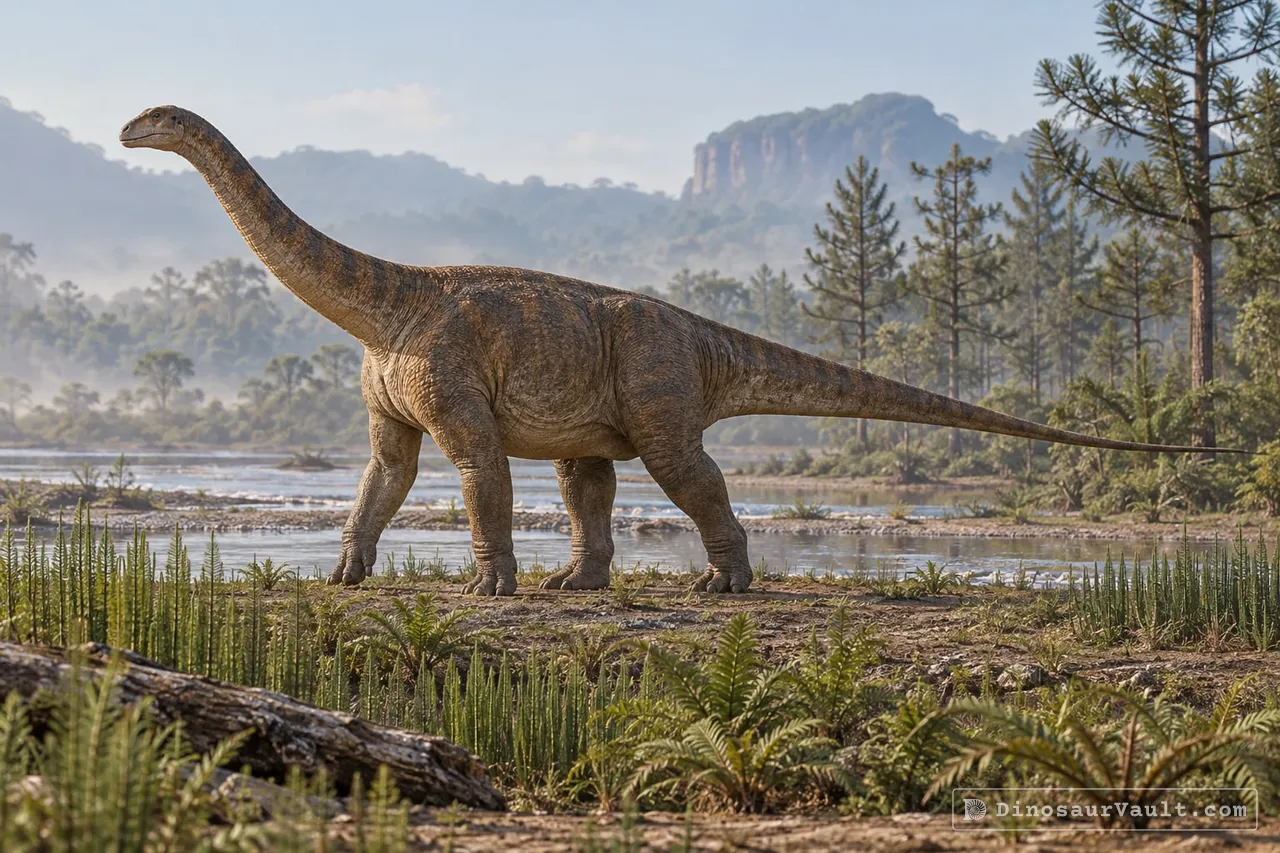
1 of 3
The evidence
The science behind Isanosaurus
Which parts of the picture come from its own bones, and which come from its relatives.
From its own fossils
- Parts of an associated skeleton include neck, back and tail bones, ribs, a shoulder blade and a thigh bone.
- The thigh bone is straight and robust, with a strong, curved ridge where a tail muscle attached.
Borrowed from relatives
- Tazoudasaurus provides a guide to the missing jaws and feet, including a narrow lower jaw and spreading front feet with a large inner claw.
Still unknown
- Its adult size and complete head shape.
- The exact age of the rocks containing its skeleton.
- Its skin, color and full arrangement of toes and claws.
Discovery timeline
- 2000Named itBuffetaut et al.
- 2004Close relativeAllain et al.
- 2023Same rocksHanta et al.
Key papers
The research behind what we know of Isanosaurus
Named it
Described a partial skeleton with a robust thigh bone and identified Isanosaurus as an early sauropod.
The earliest known sauropod dinosaur. Nature 407: 72-74
Read the paper : The earliest known sauropod dinosaur (opens in a new tab)Close relative
Described Tazoudasaurus from skull and body bones, providing a fuller comparison for early sauropods such as Isanosaurus.
A basal sauropod dinosaur from the Early Jurassic of Morocco. Comptes Rendus Palevol 3: 199-208
Read the paper : A basal sauropod dinosaur from the Early Jurassic of Morocco (opens in a new tab)Same rocks
Described hatchling and juvenile sauropod bones from the Nam Phong Formation, assigning them to an unnamed early sauropod rather than Isanosaurus.
Hatchling and Early Juvenile of Early Sauropod from the Early Middle Jurassic Nam Phong Formation, Chaiyaphum Province, Northeastern Thailand. Paleontological Research 28
Read the paper : Hatchling and Early Juvenile of Early Sauropod from the Early Middle Jurassic Nam Phong Formation, Chaiyaphum Province, Northeastern Thailand (opens in a new tab)
Close relatives
Other members of Sauropoda


Sources: Wikidata