Riojavenatrix
"La Rioja huntress"
Type species Riojavenatrix lacustris
- Lived
- 121 to 120 million years ago, Early Cretaceous
- Diet
- Carnivore
- Group
- Theropods, Spinosauridae
- Found in
- Spain
- Named by
- Isasmendi et al. 2024
Where its fossils were found
The evidence
Today

120 million years ago
Habitat
It lived near lakes and rivers in what is now Spain.
Field notes
About Riojavenatrix
What it was like
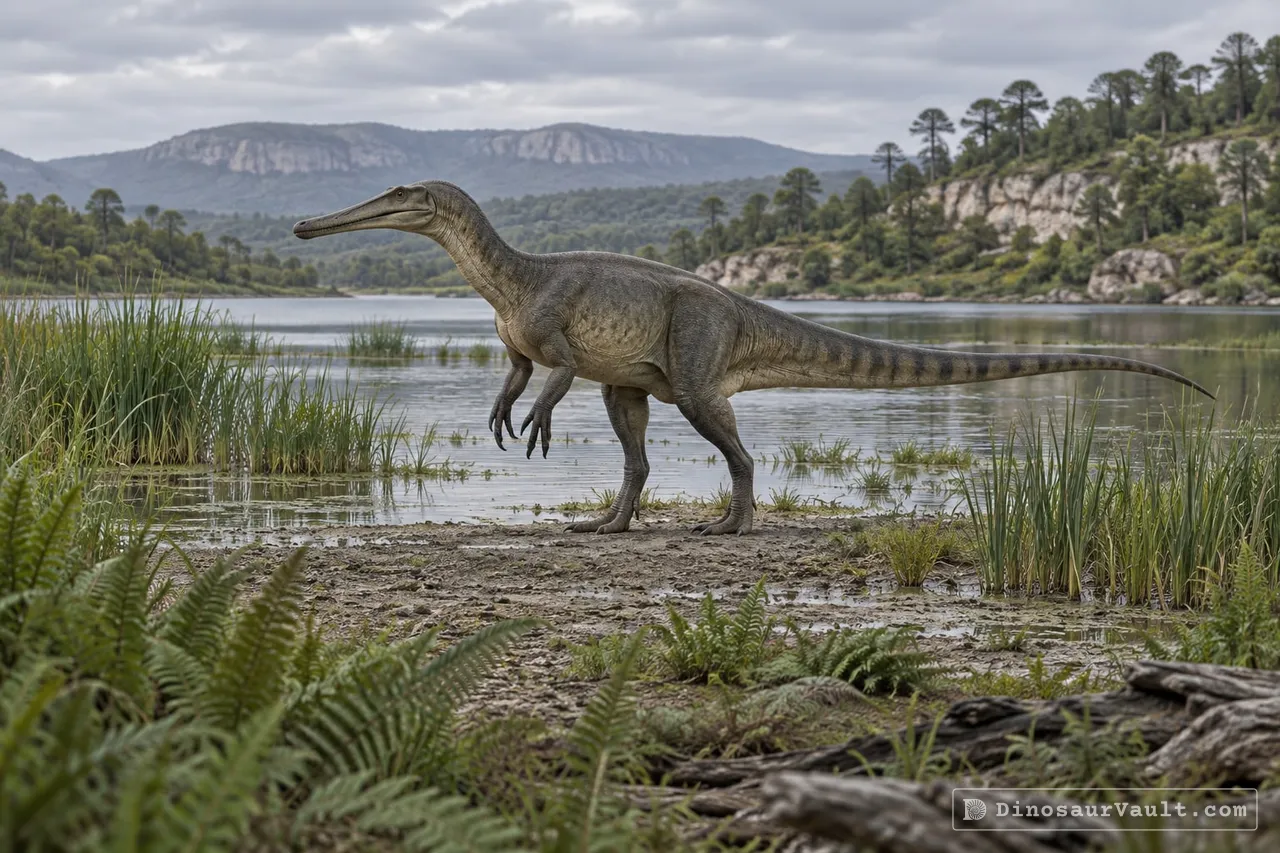
Riojavenatrix was a spinosaur, a two-legged predator with a long, narrow snout, probably suited to catching fish. It is known from parts of the hips and legs.
Its world
It lived about 121 to 120 million years ago, in the Early Cretaceous, in what is now Spain. The rocks where it was found formed near lakes and rivers.
How it was found
Isasmendi and colleagues named it in 2024 from one find. The type species is Riojavenatrix lacustris. It is one of several spinosaurs known from Spain and Portugal.
Field gallery
More views of Riojavenatrix
Scenes reconstructed from the available fossil evidence.
1 of 3
The evidence
The science behind Riojavenatrix
Which parts of the picture come from its own bones, and which come from its relatives.
From its own fossils
- Parts of the backbone, hips and hind legs belong to an associated partial skeleton.
- A small inner toe claw is narrow, pointed and strongly curved.
Borrowed from relatives
- Suchomimus provides a model for the missing long snout, curved neck and strong arms.
- The enlarged thumb claw in restorations follows other spinosaurs such as Suchomimus.
Still unknown
- The shape of its skull and the outline of its back.
- Its exact place within the spinosaur family.
- Its color and the foods it ate.
Often drawn wrong
- A towering sail copied from Spinosaurus has no support in its known bones.
- Its palms should face inward, following other theropods.
Discovery timeline
- 1998Close relativeSereno et al.
- 2021Family treeBarker et al.
- 2024Named itIsasmendi et al.
Key papers
The research behind what we know of Riojavenatrix
Close relative
Described Suchomimus, whose long snout and powerful arms help restore the missing front half of Riojavenatrix.
A Long-Snouted Predatory Dinosaur from Africa and the Evolution of Spinosaurids. Science 282: 1298-1302
Read the paper : A Long-Snouted Predatory Dinosaur from Africa and the Evolution of Spinosaurids (opens in a new tab)Family tree
Named Ceratosuchops and Riparovenator and proposed that the spinosaur family originated in Europe.
New spinosaurids from the Wessex Formation (Early Cretaceous, UK) and the European origins of Spinosauridae. Scientific Reports 11
Read the paper : New spinosaurids from the Wessex Formation (Early Cretaceous, UK) and the European origins of Spinosauridae (opens in a new tab)Named it
Named a new spinosaur from an associated partial skeleton with distinctive hip, thigh and ankle bones.
Increasing the theropod record of Europe: a new basal spinosaurid from the Enciso Group of the Cameros Basin (La Rioja, Spain). Evolutionary implications and palaeobiodiversity. Zoological Journal of the Linnean Society 202
Read the paper : Increasing the theropod record of Europe: a new basal spinosaurid from the Enciso Group of the Cameros Basin (La Rioja, Spain). Evolutionary implications and palaeobiodiversity (opens in a new tab)
Close relatives
Other members of Spinosauridae


Sources: Wikidata