Rhomaleopakhus
"strong forearm"
Type species Rhomaleopakhus turpanensis
- Lived
- 152 to 143 million years ago, Late Jurassic
- Diet
- Herbivore
- Group
- Sauropods, Mamenchisauridae
- Found in
- China
- Named by
- Upchurch et al. 2021
Where its fossils were found
The evidence
Today

150 million years ago
Habitat
The Kalazha Formation contains red sandstone and mudstone deposited on land, probably by rivers. Hudiesaurus also lived in this region of China.
Field notes
About Rhomaleopakhus
What it was like
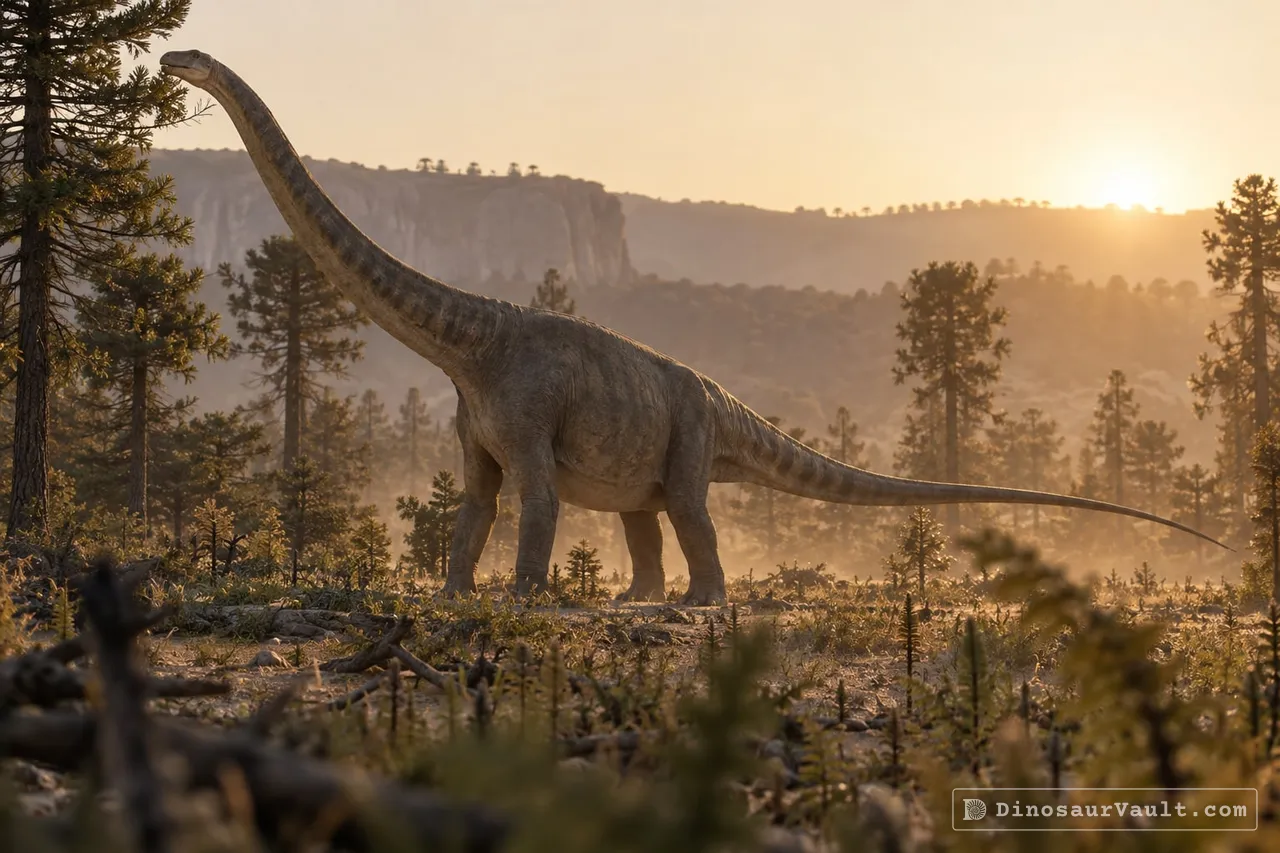
Rhomaleopakhus was a mamenchisaurid, a sauropod with a very long neck, related to Mamenchisaurus. It is known from a front leg and some neck bones.
Its world
It lived in the Late Jurassic, in what is now China. It comes from the Kalazha Formation, where the large sauropod Hudiesaurus has also been found.
How it was found
Upchurch and colleagues named Rhomaleopakhus in 2021. The type species is Rhomaleopakhus turpanensis. Its bones had first been placed in Hudiesaurus.
Field gallery
More views of Rhomaleopakhus
Scenes reconstructed from the available fossil evidence.
Lived alongside
Found in the same rock formations

A rock formation can hold fossils laid down millions of years apart, so not every animal here met Rhomaleopakhus.
The evidence
The science behind Rhomaleopakhus
Which parts of the picture come from its own bones, and which come from its relatives.
From its own fossils
- A nearly complete front leg preserves the upper arm, forearm and hand.
- The forearm bones are unusually thick, with a large bony projection at the elbow for muscle attachment.
Borrowed from relatives
- The head, neck, trunk and tail are restored from mamenchisaurids such as Mamenchisaurus, Chuanjiesaurus and Analong.
Still unknown
- Its full neck length and body proportions.
- Its skin covering and color.
- How its unusually thick forearms affected the way it walked.
Discovery timeline
- 2021Named itUpchurch et al.
- 2021Close relativeRen et al.
- 2023Close relativeMoore et al.
Key papers
The research behind what we know of Rhomaleopakhus
Named it
Separated the thick-boned front leg from Hudiesaurus and named Rhomaleopakhus, linking it with Chuanjiesaurus and Analong.
Re-assessment of the Late Jurassic eusauropod dinosaur Hudiesaurus sinojapanorum Dong, 1997, from the Turpan Basin, China, and the evolution of hyper-robust antebrachia in sauropods. Journal of Vertebrate Paleontology 41
Read the paper : Re-assessment of the Late Jurassic eusauropod dinosaur Hudiesaurus sinojapanorum Dong, 1997, from the Turpan Basin, China, and the evolution of hyper-robust antebrachia in sauropods (opens in a new tab)Close relative
Separated Analong from Chuanjiesaurus, distinguishing close relatives used to reconstruct Rhomaleopakhus.
A revision of the referred specimen of Chuanjiesaurus anaensis Fang et al., 2000: a new early branching mamenchisaurid sauropod from the Middle Jurassic of China. Historical Biology 33: 1872-1887
Read the paper : A revision of the referred specimen of Chuanjiesaurus anaensis Fang et al., 2000: a new early branching mamenchisaurid sauropod from the Middle Jurassic of China (opens in a new tab)Close relative
Showed how air-filled vertebrae and long neck ribs helped support the enormous neck of a mamenchisaurid relative.
Re-assessment of the Late Jurassic eusauropod Mamenchisaurus sinocanadorum Russell and Zheng, 1993, and the evolution of exceptionally long necks in mamenchisaurids. Journal of Systematic Palaeontology 21
Read the paper : Re-assessment of the Late Jurassic eusauropod Mamenchisaurus sinocanadorum Russell and Zheng, 1993, and the evolution of exceptionally long necks in mamenchisaurids (opens in a new tab)
Close relatives
Other members of Mamenchisauridae


Sources: Wikidata