Xinjiangtitan
"Xinjiang titan"
- Lived
- Jurassic
- Diet
- Herbivore
- Group
- Sauropods, Mamenchisauridae
- Found in
- China
- Named by
- Wu et al. 2013
Where its fossils were found
The evidence
Today

Habitat
It probably browsed on land near rivers and lakes in what is now northwestern China.
Field notes
About Xinjiangtitan
What it was like
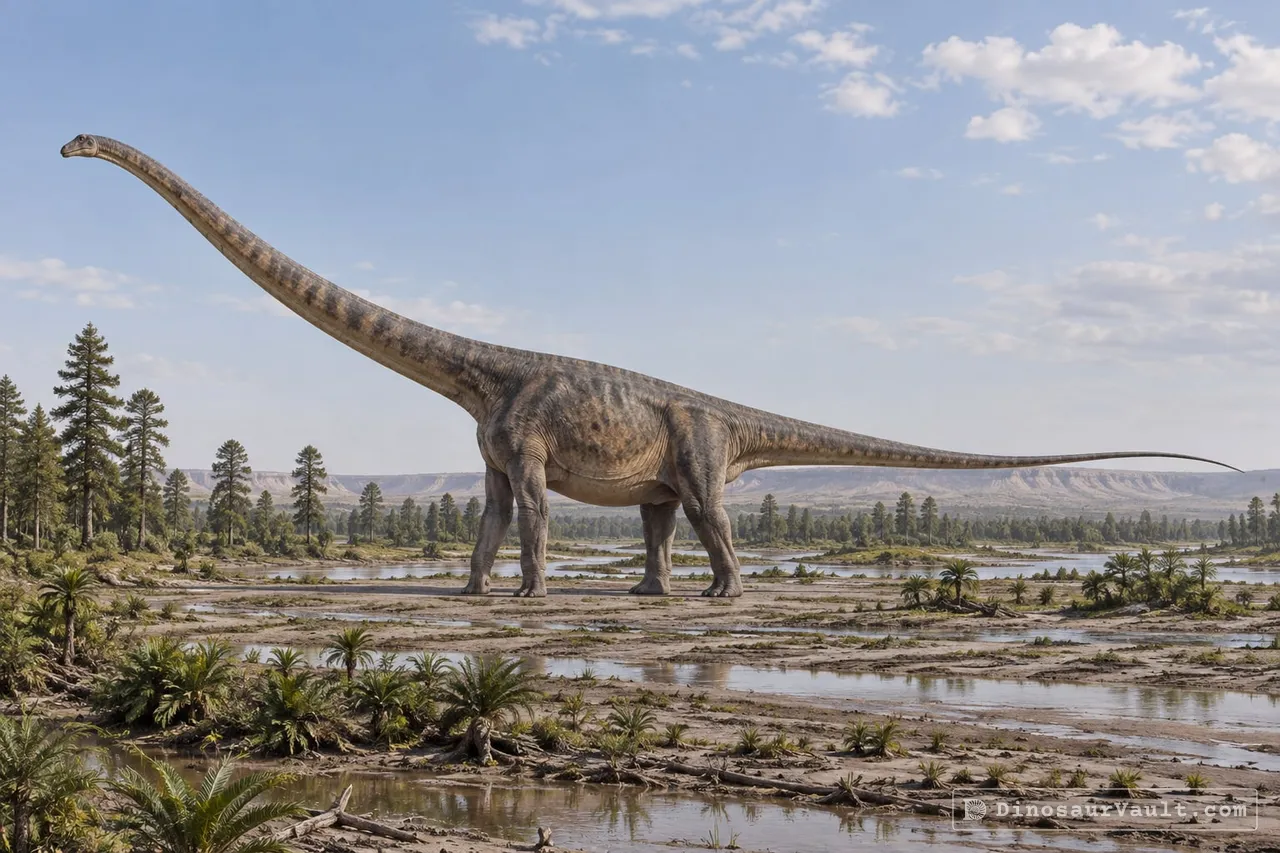
Xinjiangtitan was a huge mamenchisaurid, a sauropod with an extremely long neck. Its skeleton preserves one of the most complete backbones of any sauropod, and its neck may be among the longest of any known animal.
Its world
It lived in the Jurassic in what is now northwestern China. Its bones come from the Qiketai Formation. Its relatives include Mamenchisaurus and Omeisaurus.
How it was found
Wu and colleagues named it in 2013 from one partial skeleton.
Field gallery
More views of Xinjiangtitan
Scenes reconstructed from the available fossil evidence.
The evidence
The science behind Xinjiangtitan
Which parts of the picture come from its own bones, and which come from its relatives.
From its own fossils
- A single skeleton preserves a complete neck and most of the backbone, along with parts of the hips and hind legs.
- Its neck vertebrae are greatly stretched out, with long ribs running beneath them.
- The front and middle back vertebrae have forked spines above the spinal cord.
Borrowed from relatives
- Its missing head and front legs are restored by comparison with related sauropods such as Mamenchisaurus.
Still unknown
- The shape of its skull.
- How high it usually held its neck while feeding.
- Its skin covering and color.
Discovery timeline
- 2013Named itWu et al.
- 2018RedescriptionZhang et al.
- 2022Family treeZhang et al.
Key papers
The research behind what we know of Xinjiangtitan
Named it
Named a giant sauropod from a partial skeleton and linked it to Mamenchisaurus.
A new gigantic sauropod dinosaur from the Middle Jurassic of Shanshan, Xinjiang. Global Geology 32: 437-446
No link available
Redescription
Further excavation revealed the complete neck, allowing a detailed account of its vertebrae and corrections to the original description.
Redescription of the cervical vertebrae of the Mamenchisaurid SauropodXinjiangtitan shanshanesisWu et al. 2013. Historical Biology 32: 803-822
Read the paper : Redescription of the cervical vertebrae of the Mamenchisaurid SauropodXinjiangtitan shanshanesisWu et al. 2013 (opens in a new tab)Family tree
Restudied the back vertebrae and found close similarities to Hudiesaurus and Mamenchisaurus.
Redescription of the dorsal vertebrae of the mamenchisaurid sauropod Xinjiangtitan shanshanesis Wu et al. 2013. Historical Biology 36: 49-75
Read the paper : Redescription of the dorsal vertebrae of the mamenchisaurid sauropod Xinjiangtitan shanshanesis Wu et al. 2013 (opens in a new tab)
Close relatives
Other members of Mamenchisauridae


Sources: Wikidata