Uragasaurus
"serpent lizard"
Type species Uragasaurus kalasinensis
- Lived
- 149 to 137 million years ago, Late Jurassic to Early Cretaceous
- Diet
- Herbivore
- Group
- Sauropods, Mamenchisauridae
- Found in
- Thailand
- Named by
- Nilpanapan et al. 2026
Where its fossils were found
The evidence
Today

145 million years ago
Habitat
Rivers crossed a lowland basin in what is now Thailand, leaving sand, silt and mud. Minimocursor and Mamenchisaurus are also recorded from the Phu Kradung Formation.
Field notes
About Uragasaurus
What it was like
Uragasaurus was a mamenchisaurid, a long-necked plant eater from the family of Mamenchisaurus. It is known from a single back bone.
Its world
It lived in the Late Jurassic or Early Cretaceous in what is now Thailand. Its bone comes from the Phu Kradung Formation, where the small plant eater Minimocursor also lived.
How it was found
Nilpanapan and colleagues named it in 2026. The type species is Uragasaurus kalasinensis. It is the first mamenchisaurid named from Thailand.
Field gallery
More views of Uragasaurus
Scenes reconstructed from the available fossil evidence.
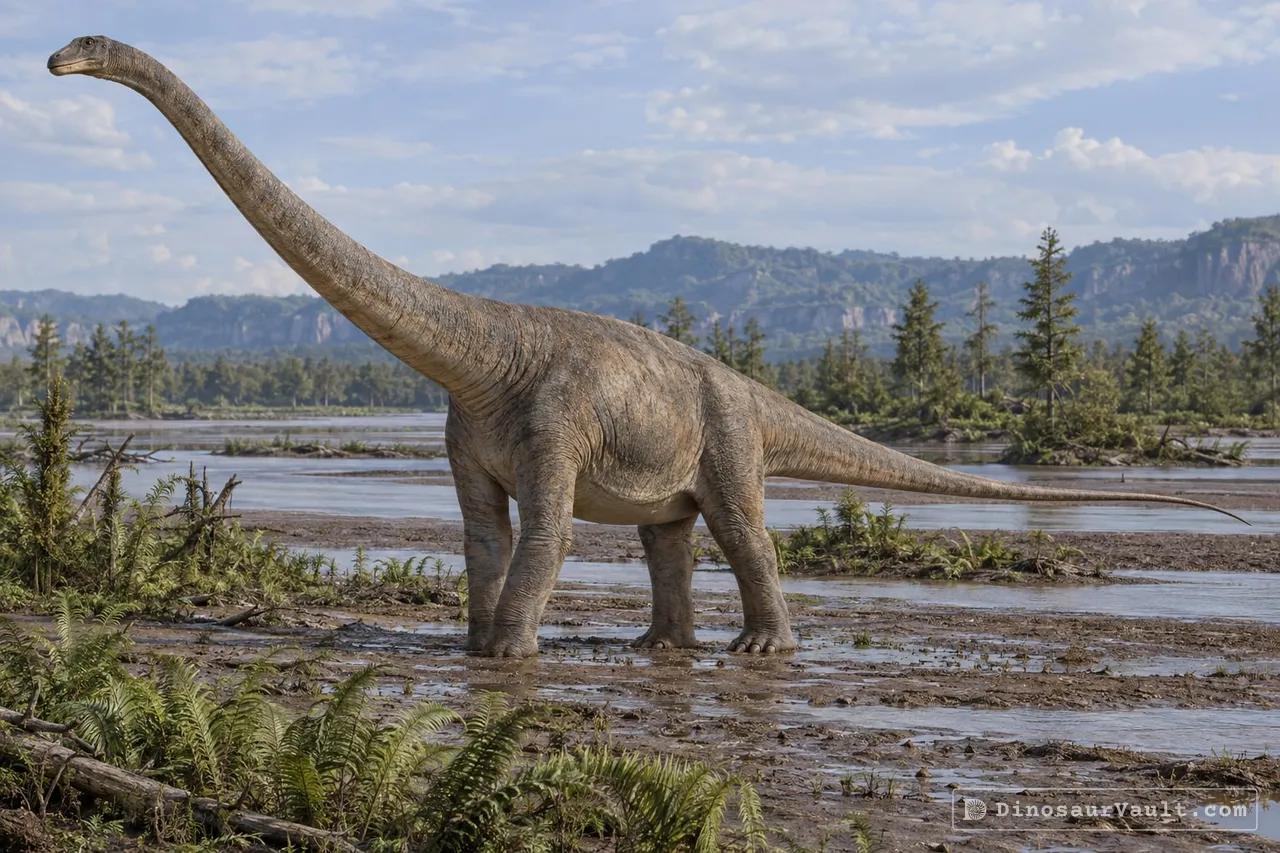
1 of 3
Lived alongside
Found in the same rock formations


A rock formation can hold fossils laid down millions of years apart, so not every animal here met Uragasaurus.
The evidence
The science behind Uragasaurus
Which parts of the picture come from its own bones, and which come from its relatives.
From its own fossils
- The type specimen is a single vertebra from the front of the back, with a split upper spine and small chambers inside the bone.
- Teardrop-shaped hollows and a branching pattern of bony ridges distinguish the vertebra from those of other sauropods.
- Nearby bones, including neck, rib, shoulder, leg and back bones, have not been assigned to Uragasaurus.
Borrowed from relatives
- Mamenchisaurus supplies a model for the missing long neck, trunk and tail.
- Euhelopus guides the missing face, while Apatosaurus and Brachiosaurus provide broader comparisons for compact, weight-bearing front feet.
Still unknown
- Its skull shape, neck length and total body size.
- Its closest relative within the mamenchisaurid family.
- Its skin covering and color.
Discovery timeline
- 2003PostureBonnan
- 2013SkullPoropat & Kear
- 2026Named itNilpanapan et al.
Key papers
The research behind what we know of Uragasaurus
Posture
Explained how sauropod hand bones formed compact supports for bearing weight, a comparison for the missing front feet of Uragasaurus.
The evolution of manus shape in sauropod dinosaurs: implications for functional morphology, forelimb orientation, and phylogeny. Journal of Vertebrate Paleontology 23: 595-613
Read the paper : The evolution of manus shape in sauropod dinosaurs: implications for functional morphology, forelimb orientation, and phylogeny (opens in a new tab)Skull
Documented the Euhelopus skull, providing a broader sauropod comparison for the missing head of Uragasaurus.
Photographic Atlas and Three-Dimensional Reconstruction of the Holotype Skull of Euhelopus zdanskyi with Description of Additional Cranial Elements. PLoS ONE 8: e79932
Read the paper : Photographic Atlas and Three-Dimensional Reconstruction of the Holotype Skull of Euhelopus zdanskyi with Description of Additional Cranial Elements (opens in a new tab)Named it
Named Uragasaurus from a distinctive back vertebra and placed it among early branches of the mamenchisaurid family.
A new mamenchisaurid sauropod from the Lower Phu Kradung Formation, Upper Jurassic of northeastern Thailand. Scientific Reports 16
Read the paper : A new mamenchisaurid sauropod from the Lower Phu Kradung Formation, Upper Jurassic of northeastern Thailand (opens in a new tab)
Close relatives
Other members of Mamenchisauridae


Sources: Wikidata