Hudiesaurus
"butterfly lizard"
Type species Hudiesaurus sinojapanorum
- Lived
- 152 to 143 million years ago, Late Jurassic
- Diet
- Herbivore
- Group
- Sauropods, Mamenchisauridae
- Found in
- China
- Named by
- Dong 1997
Where its fossils were found
The evidence
Today

150 million years ago
Habitat
The Kalazha Formation records an inland landscape in northwestern China, probably crossed by rivers. Rhomaleopakhus is another sauropod from these rocks.
Field notes
About Hudiesaurus
What it was like
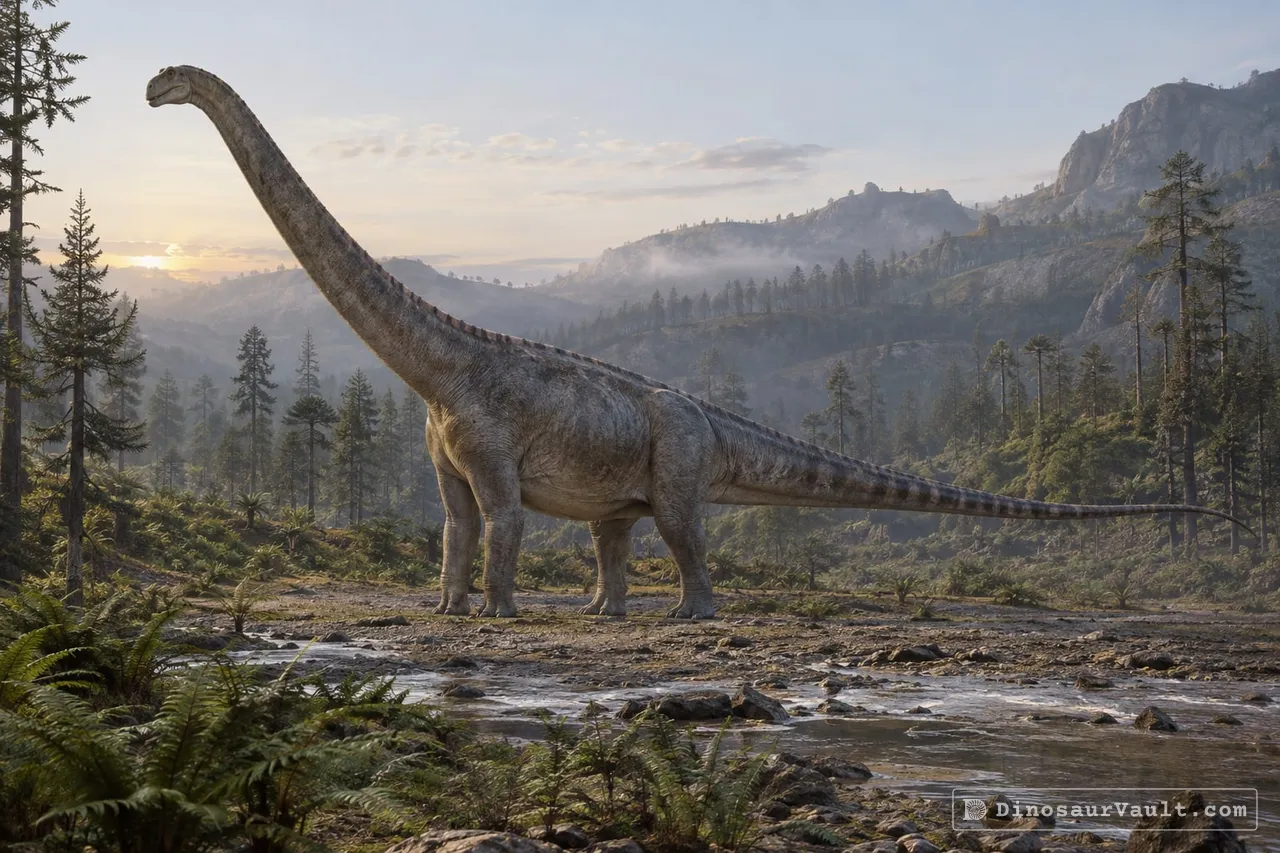
Hudiesaurus was a long-necked, four-legged plant eater, a relative of Mamenchisaurus, known from a single large backbone.
Its world
It lived in the Late Jurassic in what is now northwestern China. Its fossil comes from the Kalazha Formation.
How it was found
Dong named Hudiesaurus in 1997. Other bones first placed in it are now thought to belong to a separate genus, Rhomaleopakhus.
Field gallery
More views of Hudiesaurus
Scenes reconstructed from the available fossil evidence.
1 of 3
Lived alongside
Found in the same rock formations

A rock formation can hold fossils laid down millions of years apart, so not every animal here met Hudiesaurus.
The evidence
The science behind Hudiesaurus
Which parts of the picture come from its own bones, and which come from its relatives.
From its own fossils
- Hudiesaurus is securely known from a single large vertebra, probably from near the back of the neck.
- The vertebra has a split upper spine and deep cavities in its sides.
Borrowed from relatives
- Mamenchisaurus provides a comparison for its missing skull, limbs and the rest of its neck.
Still unknown
- Its full body size and exact neck length.
- The shape of its skull and limbs, and its skin texture and color.
- Its place in the sauropod family tree; a later analysis placed it near Euhelopus rather than among mamenchisaurids.
Discovery timeline
- 1997Named itDong
- 2021RedescriptionUpchurch et al.
- 2023Family treeMoore et al.
- 2025Family treeDai et al.
Key papers
The research behind what we know of Hudiesaurus
Named it
Named Hudiesaurus from a large vertebra and also assigned nearby teeth and a forelimb to it.
A gigantic sauropod (Hudiesaurus sinojapanorum gen. et sp. nov.) from the Turpan Basin, China. Sino-Japanese Silk Road Dinosaur Expedition. China Ocean Press, Beijing.
No link available
Redescription
Restricted Hudiesaurus to a single neck vertebra, excluded the teeth and moved the forelimb to a separate genus, Rhomaleopakhus.
Re-assessment of the Late Jurassic eusauropod dinosaur Hudiesaurus sinojapanorum Dong, 1997, from the Turpan Basin, China, and the evolution of hyper-robust antebrachia in sauropods. Journal of Vertebrate Paleontology 41
Read the paper : Re-assessment of the Late Jurassic eusauropod dinosaur Hudiesaurus sinojapanorum Dong, 1997, from the Turpan Basin, China, and the evolution of hyper-robust antebrachia in sauropods (opens in a new tab)Family tree
Restudied Mamenchisaurus sinocanadorum and showed how air-filled vertebrae helped mamenchisaurids support exceptionally long necks.
Re-assessment of the Late Jurassic eusauropod Mamenchisaurus sinocanadorum Russell and Zheng, 1993, and the evolution of exceptionally long necks in mamenchisaurids. Journal of Systematic Palaeontology 21
Read the paper : Re-assessment of the Late Jurassic eusauropod Mamenchisaurus sinocanadorum Russell and Zheng, 1993, and the evolution of exceptionally long necks in mamenchisaurids (opens in a new tab)Family tree
The main family-tree analysis placed Hudiesaurus near Euhelopus, challenging its earlier placement among mamenchisaurids.
A new mamenchisaurid sauropod dinosaur from the Upper Jurassic of Southwest China reveals new evolutionary evidence from East Asian eusauropods. Scientific Reports 15
Read the paper : A new mamenchisaurid sauropod dinosaur from the Upper Jurassic of Southwest China reveals new evolutionary evidence from East Asian eusauropods (opens in a new tab)
Close relatives
Other members of Mamenchisauridae


Sources: Wikidata