Rhinorex
"nose king"
Type species Rhinorex condrupus
- Lived
- 84 to 72 million years ago, Late Cretaceous
- Diet
- Herbivore
- Group
- Ornithopods, Hadrosauridae
- Found in
- United States
- Named by
- Gates and Scheetz 2014
Where its fossils were found
The evidence
Today

80 million years ago
Habitat
It lived in a swampy estuary in Utah near the Western Interior Seaway. Gryposaurus lived elsewhere in the region.
Field notes
About Rhinorex
What it was like
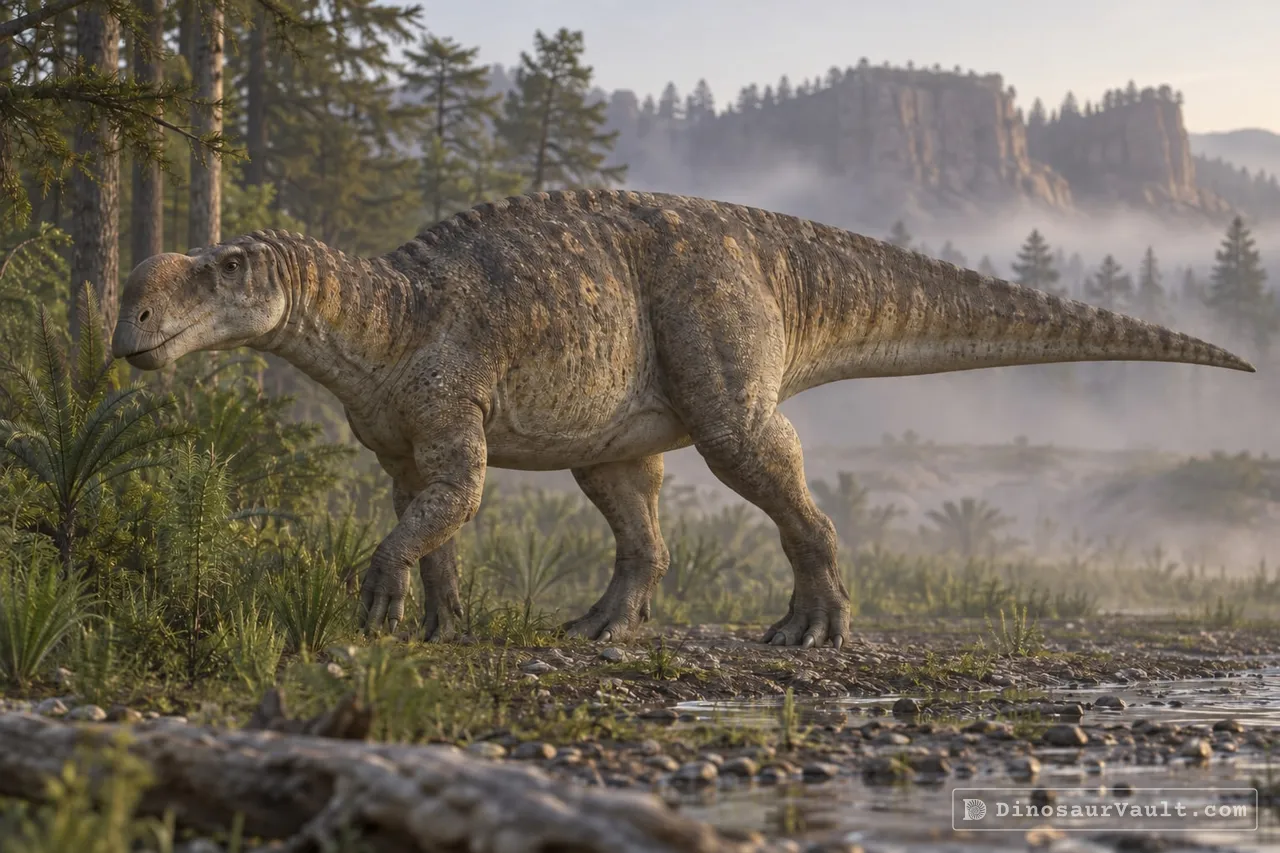
Rhinorex was a duckbill with a large, arched nose, a relative of Gryposaurus and Kritosaurus. It is known from a skull. What the big nose was for is not known: it may have been for display or for making sounds.
Its world
It lived in the Late Cretaceous, in what is now Utah. Its rocks formed in a coastal lowland near the Western Interior Seaway.
How it was found
Gates and Scheetz named Rhinorex in 2014. The type species is Rhinorex condrupus. The skull had been in a museum collection for years before it was studied.
Field gallery
More views of Rhinorex
Scenes reconstructed from the available fossil evidence.
1 of 3
The evidence
The science behind Rhinorex
Which parts of the picture come from its own bones, and which come from its relatives.
From its own fossils
- A nearly complete skull preserves a distinctive nose with a hook-shaped projection on the nasal bone.
- Skin impressions survive with the skeleton.
Borrowed from relatives
- Gryposaurus provides a close comparison for restoring the missing parts of its duckbill body and limbs.
Still unknown
- What its enlarged nose was used for.
- Its color.
- How its nose changed as it grew.
Discovery timeline
- 2007Close relativeGATES & SAMPSON
- 2014Named itGates & Scheetz
- 2016Family treePrieto-Márquez & Gutarra
Key papers
The research behind what we know of Rhinorex
Close relative
Described a robust-skulled species of Gryposaurus from Utah, a useful comparison for the head of Rhinorex.
A new species of Gryposaurus (Dinosauria: Hadrosauridae) from the late Campanian Kaiparowits Formation, southern Utah, USA. Zoological Journal of the Linnean Society 151: 351-376
Read the paper : A new species of Gryposaurus (Dinosauria: Hadrosauridae) from the late Campanian Kaiparowits Formation, southern Utah, USA (opens in a new tab)Named it
Identified Rhinorex from its distinctive skull and placed it close to Gryposaurus in the duckbill family tree.
A new saurolophine hadrosaurid (Dinosauria: Ornithopoda) from the Campanian of Utah, North America. Journal of Systematic Palaeontology 13: 711-725
Read the paper : A new saurolophine hadrosaurid (Dinosauria: Ornithopoda) from the Campanian of Utah, North America (opens in a new tab)Family tree
Compared duckbill bones from a bonebed and placed most of them near Gryposaurus and Rhinorex.
The ‘duck-billed’ dinosaurs of Careless Creek (Upper Cretaceous of Montana, USA), with comments on hadrosaurid ontogeny. Journal of Paleontology 90: 133-146
Read the paper : The ‘duck-billed’ dinosaurs of Careless Creek (Upper Cretaceous of Montana, USA), with comments on hadrosaurid ontogeny (opens in a new tab)
Close relatives
Other members of Hadrosauridae


Sources: Wikidata