Qijianglong
"Qijiang dragon"
Type species Qijianglong guokr
- Lived
- 162 to 143 million years ago, Late Jurassic
- Diet
- Herbivore
- Group
- Sauropods, Mamenchisauridae
- Found in
- China
- Named by
- Xing et al. 2015
Where its fossils were found
The evidence
Today

150 million years ago
Habitat
Its region had rivers and shallow lakes that expanded during floods. Mamenchisaurus, Yangchuanosaurus and Tongnanlong are also known from the Suining Formation.
Field notes
About Qijianglong
What it was like
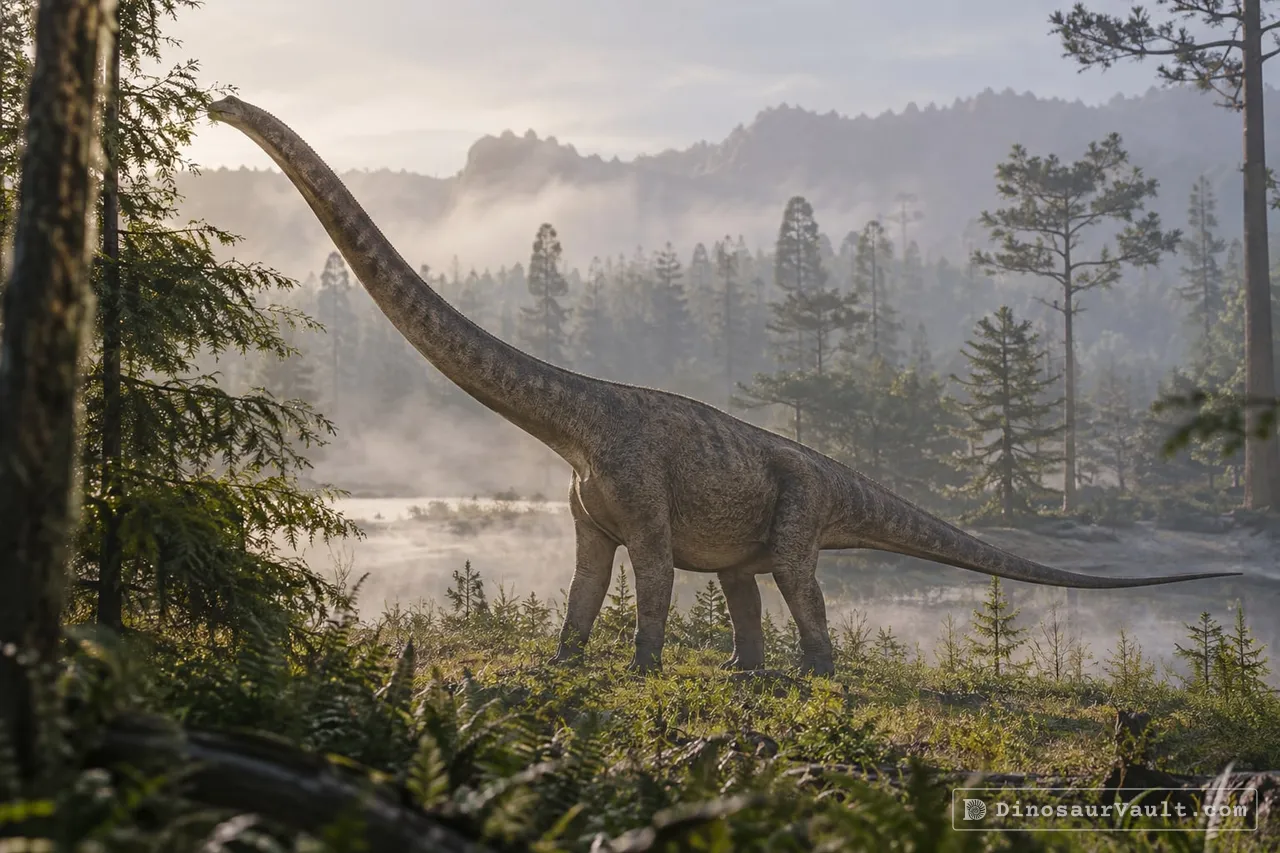
Qijianglong was a long-necked, four-legged plant eater, a relative of Mamenchisaurus. Its neck was very long, about half of its body length, and the bones of its neck fit together in a way that let it move up and down more easily than from side to side.
Its world
It lived in what is now southwestern China. Its bones come from the Suining Formation, whose age is debated, either Late Jurassic or Early Cretaceous.
How it was found
Xing and colleagues named Qijianglong in 2015. It was found by workers on a building site, and its skull and neck were still joined together.
Field gallery
More views of Qijianglong
Scenes reconstructed from the available fossil evidence.
Lived alongside
Found in the same rock formations


A rock formation can hold fossils laid down millions of years apart, so not every animal here met Qijianglong.
The evidence
The science behind Qijianglong
Which parts of the picture come from its own bones, and which come from its relatives.
From its own fossils
- The partial type skeleton preserves a flat skull roof and braincase, the complete neck, much of the tail and scattered body bones.
- Its neck vertebrae contain air-filled chambers and internal finger-like processes.
- Some tail vertebrae are fused together, possibly from an injury or disease.
Borrowed from relatives
- Mamenchisaurus youngi provides comparisons for missing parts of the front of the head, limbs and trunk.
- Camarasaurus and Apatosaurus provide further comparisons for missing wrist and hand support.
Still unknown
- Its skin texture and color.
- Its full adult size.
- The exact age of the rocks where it was found.
Discovery timeline
- 2015Named itXing et al.
- 2020Family treeMoore et al.
- 2023Inside the bonesMoore et al.
Key papers
The research behind what we know of Qijianglong
Named it
Named Qijianglong from a partial skeleton with a well-preserved braincase and a long neck bearing distinctive joint projections.
A new sauropod dinosaur from the Late Jurassic of China and the diversity, distribution, and relationships of mamenchisaurids. Journal of Vertebrate Paleontology 35: e889701
Read the paper : A new sauropod dinosaur from the Late Jurassic of China and the diversity, distribution, and relationships of mamenchisaurids (opens in a new tab)Family tree
Placed Qijianglong, Klamelisaurus and Mamenchisaurus within a radiation of exceptionally long-necked sauropods.
Osteology ofKlamelisaurus gobiensis(Dinosauria, Eusauropoda) and the evolutionary history of Middle–Late Jurassic Chinese sauropods. Journal of Systematic Palaeontology 18: 1299-1393
Read the paper : Osteology ofKlamelisaurus gobiensis(Dinosauria, Eusauropoda) and the evolutionary history of Middle–Late Jurassic Chinese sauropods (opens in a new tab)Inside the bones
Scans of the mamenchisaurid Mamenchisaurus sinocanadorum showed extensive neck air spaces, helping explain how relatives of Qijianglong supported long necks.
Re-assessment of the Late Jurassic eusauropod Mamenchisaurus sinocanadorum Russell and Zheng, 1993, and the evolution of exceptionally long necks in mamenchisaurids. Journal of Systematic Palaeontology 21
Read the paper : Re-assessment of the Late Jurassic eusauropod Mamenchisaurus sinocanadorum Russell and Zheng, 1993, and the evolution of exceptionally long necks in mamenchisaurids (opens in a new tab)
Close relatives
Other members of Mamenchisauridae


Sources: Wikidata