Punatitan
Type species Punatitan coughlini
- Lived
- 84 to 66 million years ago, Late Cretaceous
- Diet
- Herbivore
- Group
- Sauropods
- Found in
- Argentina
- Named by
- Hechenleitner et al. 2020
Where its fossils were found
The evidence
Today

75 million years ago
Habitat
It lived in what is now Argentina, where its bones were buried in sand. The same formation preserves the smaller titanosaur Bravasaurus and extensive titanosaur nesting sites.
Field notes
About Punatitan
What it was like
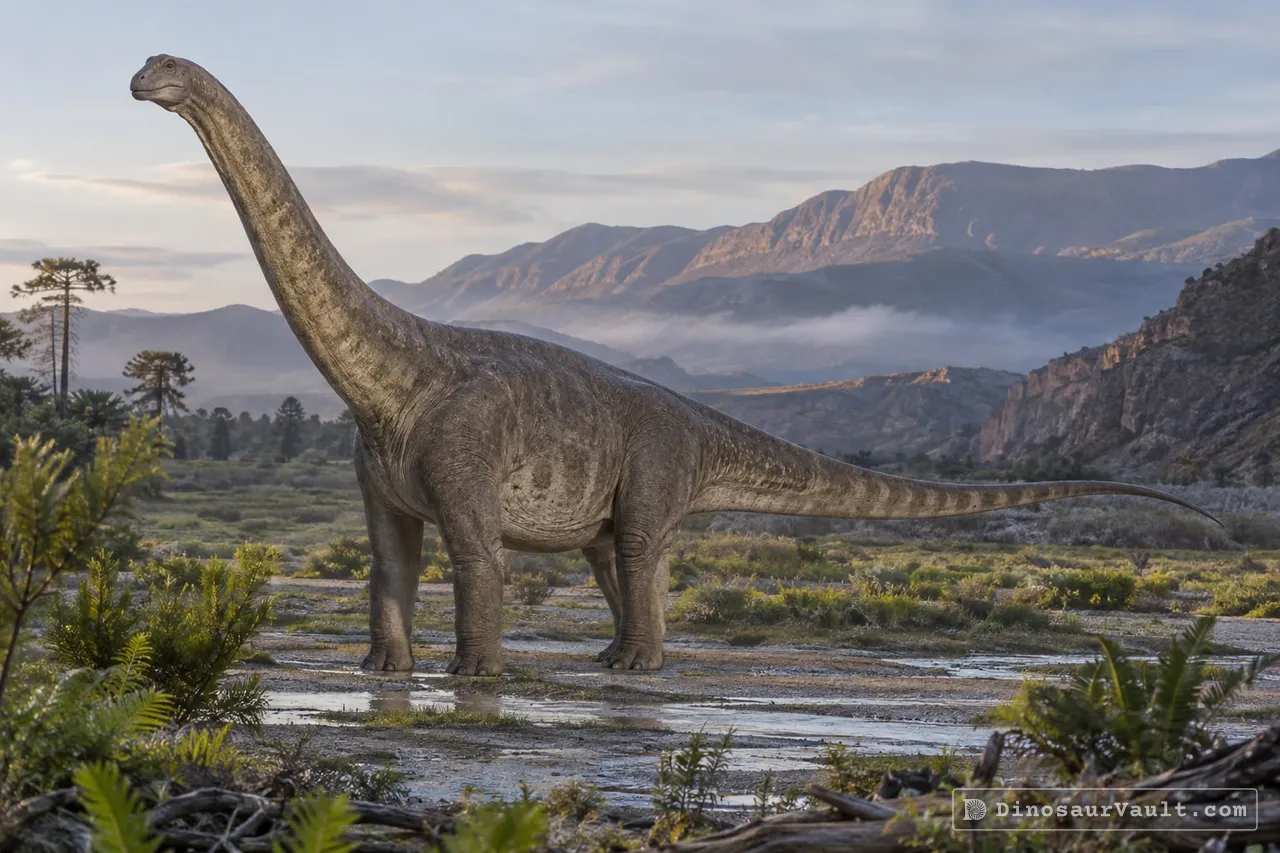
Punatitan was a titanosaur, a long-necked plant eater. It is known from part of the backbone, hips and ribs.
Its world
It lived in the Late Cretaceous, in what is now Argentina. It comes from the Ciénaga del Río Huaco Formation, where the smaller titanosaur Bravasaurus has also been found.
How it was found
Hechenleitner and colleagues named Punatitan in 2020. The type species is Punatitan coughlini.
Field gallery
More views of Punatitan
Scenes reconstructed from the available fossil evidence.
Lived alongside
Found in the same rock formations

A rock formation can hold fossils laid down millions of years apart, so not every animal here met Punatitan.
The evidence
The science behind Punatitan
Which parts of the picture come from its own bones, and which come from its relatives.
From its own fossils
- The type skeleton includes a piece of the rear neck, two back vertebrae, an incomplete sacrum, a connected row of tail vertebrae with their chevrons, hip bones and ribs.
- The back vertebrae have deep hollows crossed by bony ridges.
- The tail vertebrae have a socket at the front and a ball at the back of each joint, and their bodies and spines are tallest near the hips and shrink farther back.
Borrowed from relatives
- The missing head is restored after the titanosaur Tapuiasaurus, and the neck, body and legs after Mnyamawamtuka.
- The hands follow Camarasaurus and Apatosaurus.
- Its tail bones share features with Aeolosaurus and Arrudatitan.
Still unknown
- The shape of its head and the full length of its neck.
- Whether the titanosaur eggs at its fossil locality belonged to Punatitan.
- Its skin color and pattern.
Discovery timeline
- 2016Its worldHechenleitner et al.
- 2020Named itHechenleitner et al.
- 2022Family treeSilva Junior et al.
Key papers
The research behind what we know of Punatitan
Its world
Described another titanosaur nesting site in northwestern Argentina, where egg arrangement and surrounding sediments suggest nests dug into the ground.
A new Upper Cretaceous titanosaur nesting site from La Rioja (NW Argentina), with implications for titanosaur nesting strategies. Palaeontology 59: 433-446
Read the paper : A new Upper Cretaceous titanosaur nesting site from La Rioja (NW Argentina), with implications for titanosaur nesting strategies (opens in a new tab)Named it
Described Punatitan and Bravasaurus and linked their relatives across South America, alongside discoveries of extensive titanosaur nesting sites.
Two Late Cretaceous sauropods reveal titanosaurian dispersal across South America. Communications Biology 3
Read the paper : Two Late Cretaceous sauropods reveal titanosaurian dispersal across South America (opens in a new tab)Family tree
Renamed a Brazilian titanosaur Arrudatitan and compared its tail anatomy and relationships with Punatitan and Aeolosaurus.
Reassessment of Aeolosaurus maximus, a titanosaur dinosaur from the Late Cretaceous of Southeastern Brazil. Historical Biology 34: 403-411
Read the paper : Reassessment of Aeolosaurus maximus, a titanosaur dinosaur from the Late Cretaceous of Southeastern Brazil (opens in a new tab)
Close relatives
Other members of Rinconsauria


Sources: Wikidata