Bravasaurus
Type species Bravasaurus arrierosorum
- Lived
- 84 to 66 million years ago, Late Cretaceous
- Diet
- Herbivore
- Group
- Sauropods
- Found in
- Argentina
- Named by
- Hechenleitner et al. 2020
Where its fossils were found
The evidence
Today

75 million years ago
Habitat
It lived in what is now Argentina, where its bones were buried in red sediments. The larger sauropod Punatitan and extensive dinosaur nesting grounds are known from the same rock formation.
Field notes
About Bravasaurus
What it was like
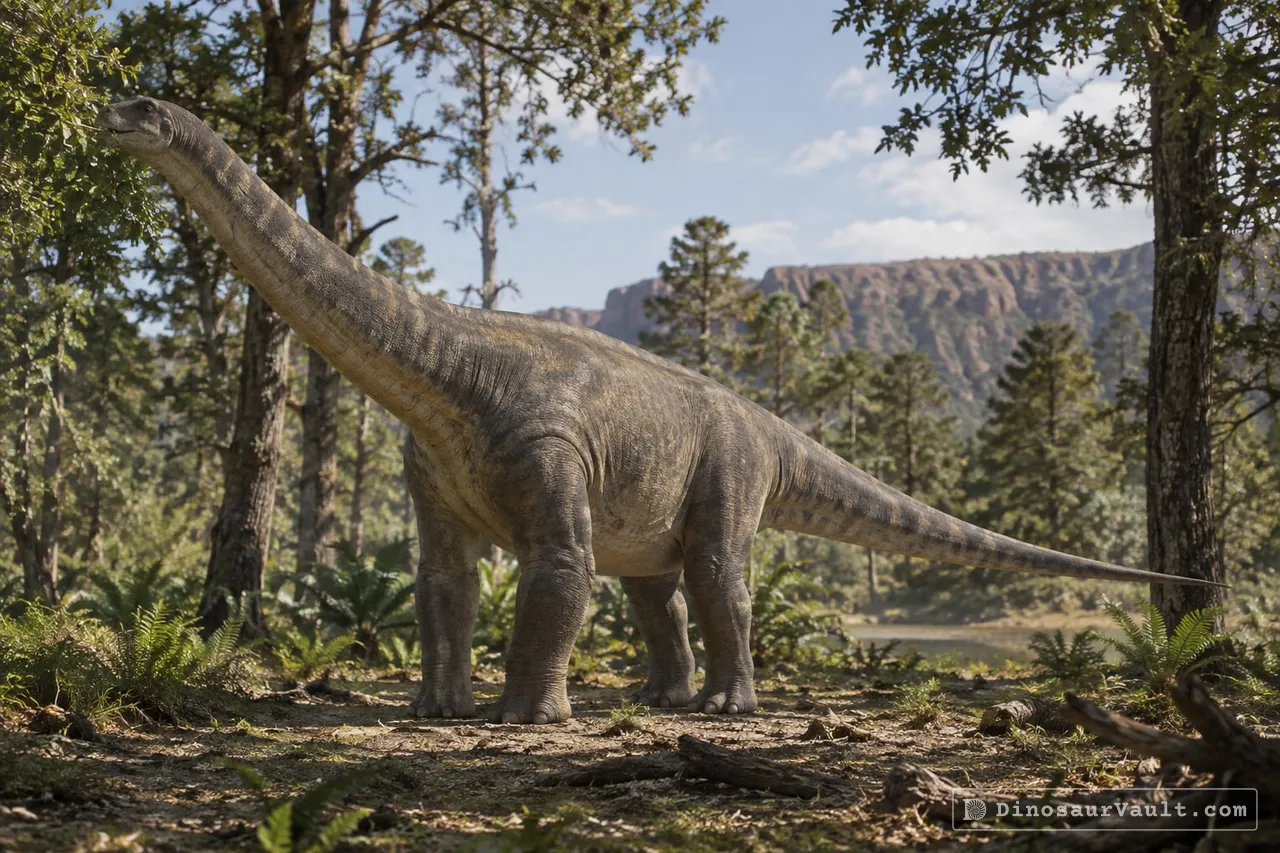
Bravasaurus was a small titanosaur, a long-necked plant eater. It is known from part of a skull and skeleton.
Its world
It lived in the Late Cretaceous, in what is now Argentina. It comes from the Ciénaga del Río Huaco Formation, where the titanosaur Punatitan and many dinosaur eggs have also been found.
How it was found
Hechenleitner and colleagues named Bravasaurus in 2020. The type species is Bravasaurus arrierosorum. Its name comes from a nearby lagoon.
Field gallery
More views of Bravasaurus
Scenes reconstructed from the available fossil evidence.
1 of 2
Lived alongside
Found in the same rock formations

A rock formation can hold fossils laid down millions of years apart, so not every animal here met Bravasaurus.
The evidence
The science behind Bravasaurus
Which parts of the picture come from its own bones, and which come from its relatives.
From its own fossils
- Its partial skeleton includes bones from the rear of the skull, neck, back, tail, hips and limbs.
- The vertebrae have fused parts, suggesting that this small sauropod had reached maturity.
Borrowed from relatives
- Missing parts of the skull and skeleton are restored by comparison with other titanosaurs, including Rinconsaurus and Overosaurus.
Still unknown
- The complete shape of its head.
- Its skin color.
- Whether any of the dinosaur eggs from the same rocks belonged to Bravasaurus.
Discovery timeline
- 2013Close relativeCORIA et al.
- 2020Named itHechenleitner et al.
- 2022Close relativeNavarro et al.
Key papers
The research behind what we know of Bravasaurus
Close relative
Described the small titanosaur Overosaurus, whose backbone provides a useful comparison with Bravasaurus.
<i>Overosaurus paradasorum</i> gen. et sp. nov. , a new sauropod dinosaur (Titanosauria: Lithostrotia) from the Late Cretaceous of Neuquén, Patagonia, Argentina. Zootaxa 3683
Read the paper : <i>Overosaurus paradasorum</i> gen. et sp. nov. , a new sauropod dinosaur (Titanosauria: Lithostrotia) from the Late Cretaceous of Neuquén, Patagonia, Argentina (opens in a new tab)Named it
Named Bravasaurus and Punatitan from partial skeletons, and reported extensive dinosaur nesting grounds in the same formation.
Two Late Cretaceous sauropods reveal titanosaurian dispersal across South America. Communications Biology 3
Read the paper : Two Late Cretaceous sauropods reveal titanosaurian dispersal across South America (opens in a new tab)Close relative
Described the small titanosaur Ibirania and examined how small body size evolved in different sauropod lineages.
A New Nanoid Titanosaur (Dinosauria: Sauropoda) from the Upper Cretaceous of Brazil. Ameghiniana 59
Read the paper : A New Nanoid Titanosaur (Dinosauria: Sauropoda) from the Upper Cretaceous of Brazil (opens in a new tab)
Close relatives
Other members of Rinconsauria


Sources: Wikidata