Pradhania
"Pradhan's"
- Lived
- 201 to 193 million years ago, Early Jurassic
- Group
- Early sauropodomorphs, Massospondylidae
- Found in
- India
- Named by
- Kutty et al. 2007
Where its fossils were found
The evidence
Today

195 million years ago
Habitat
Its bones were buried in mud deposited when rivers spilled onto their floodplains. Lamplughsaura lived in the same part of the Dharmaram Formation in India.
Field notes
About Pradhania
What it was like
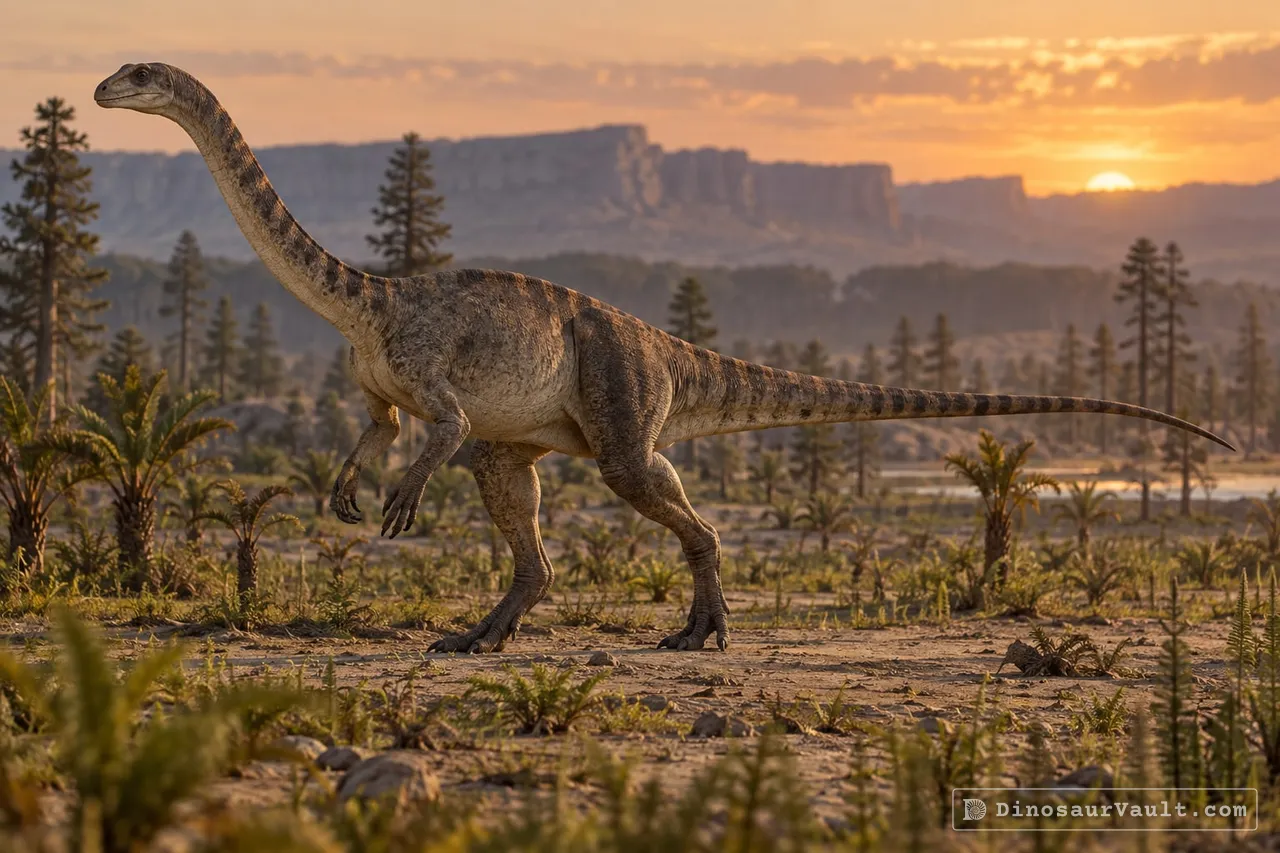
Pradhania was a small plant eater from the long-necked line that later produced the giant sauropods, a relative of Massospondylus. It is known from part of a skull and skeleton.
Its world
It lived in the Early Jurassic in what is now India. Its bones come from the Dharmaram Formation, where it shared the land with the larger Lamplughsaura.
How it was found
Kutty and colleagues named Pradhania in 2007, after a fossil collector.
Field gallery
More views of Pradhania
Scenes reconstructed from the available fossil evidence.
1 of 3
Lived alongside
Found in the same rock formations


A rock formation can hold fossils laid down millions of years apart, so not every animal here met Pradhania.
The evidence
The science behind Pradhania
Which parts of the picture come from its own bones, and which come from its relatives.
From its own fossils
- One fragmentary skeleton includes part of the upper jaw, the front of the left lower jaw, a piece from the back of the skull, two neck vertebrae, a hip vertebra and a partial left hand.
- A strong ridge runs along the inner face of the upper jaw, and the front neck vertebrae are long. The tip of the lower jaw curves gently downward.
- The claw of the first finger is strongly curved.
Borrowed from relatives
- The missing face, body, arms and hips are restored by comparison with Massospondylus, a better-known early sauropodomorph.
- The knees and shins follow Adeopapposaurus, another early sauropodomorph.
Still unknown
- The proportions of its complete body and limbs.
- Its skin covering and color.
- Exactly where it belongs in the early sauropodomorph family tree. One study linked it to Massospondylus and its relatives, but a later study found that its position shifted from one analysis to the next.
Discovery timeline
- 2007Named itKutty et al.
- 2011Family treeNovas et al.
- 2018Close relativeChapelle & Choiniere
- 2025Family treeLania, Pabst & Scheyer
Key papers
The research behind what we know of Pradhania
Named it
Described Pradhania and the larger Lamplughsaura from the same rocks, identifying a distinctive ridge inside Pradhania's upper jaw.
Basal sauropodomorphs (Dinosauria: Saurischia) from the Lower Jurassic of India: their anatomy and relationships. Journal of Paleontology 81: 1218-1240
Read the paper : Basal sauropodomorphs (Dinosauria: Saurischia) from the Lower Jurassic of India: their anatomy and relationships (opens in a new tab)Family tree
Compared early Indian dinosaurs and proposed a relationship between Pradhania and the massospondylids, based on its downturned jaw tip and long neck vertebrae.
New dinosaur species from the Upper Triassic Upper Maleri and Lower Dharmaram formations of Central India. Earth and Environmental Science Transactions of the Royal Society of Edinburgh 101: 333-349
Read the paper : New dinosaur species from the Upper Triassic Upper Maleri and Lower Dharmaram formations of Central India (opens in a new tab)Close relative
Used scans to describe the skull of Massospondylus, a comparison for restoring the missing parts of Pradhania's head.
A revised cranial description ofMassospondylus carinatusOwen (Dinosauria: Sauropodomorpha) based on computed tomographic scans and a review of cranial characters for basal Sauropodomorpha. PeerJ 6: e4224
Read the paper : A revised cranial description ofMassospondylus carinatusOwen (Dinosauria: Sauropodomorpha) based on computed tomographic scans and a review of cranial characters for basal Sauropodomorpha (opens in a new tab)Family tree
Described a new early sauropodomorph skull from Switzerland and found that Pradhania changed position from one family-tree analysis to another.
Craniomandibular osteology of a new massopodan sauropodomorph (Dinosauria: Sauropodomorpha) from the Late Triassic (latest Norian) of Canton Aargau, Switzerland. Swiss Journal of Palaeontology 144
Read the paper : Craniomandibular osteology of a new massopodan sauropodomorph (Dinosauria: Sauropodomorpha) from the Late Triassic (latest Norian) of Canton Aargau, Switzerland (opens in a new tab)
Close relatives
Other members of Massospondylidae


Sources: Wikidata