Lamplughsaura
- Lived
- 201 to 193 million years ago, Early Jurassic
- Diet
- Herbivore
- Group
- Sauropods
- Found in
- India
- Named by
- Kutty et al. 2007
Where its fossils were found
The evidence
Today

195 million years ago
Habitat
It lived in a river landscape in what is now India. Other dinosaurs recorded from the Dharmaram Formation include Pradhania and Jaklapallisaurus.
Field notes
About Lamplughsaura
What it was like
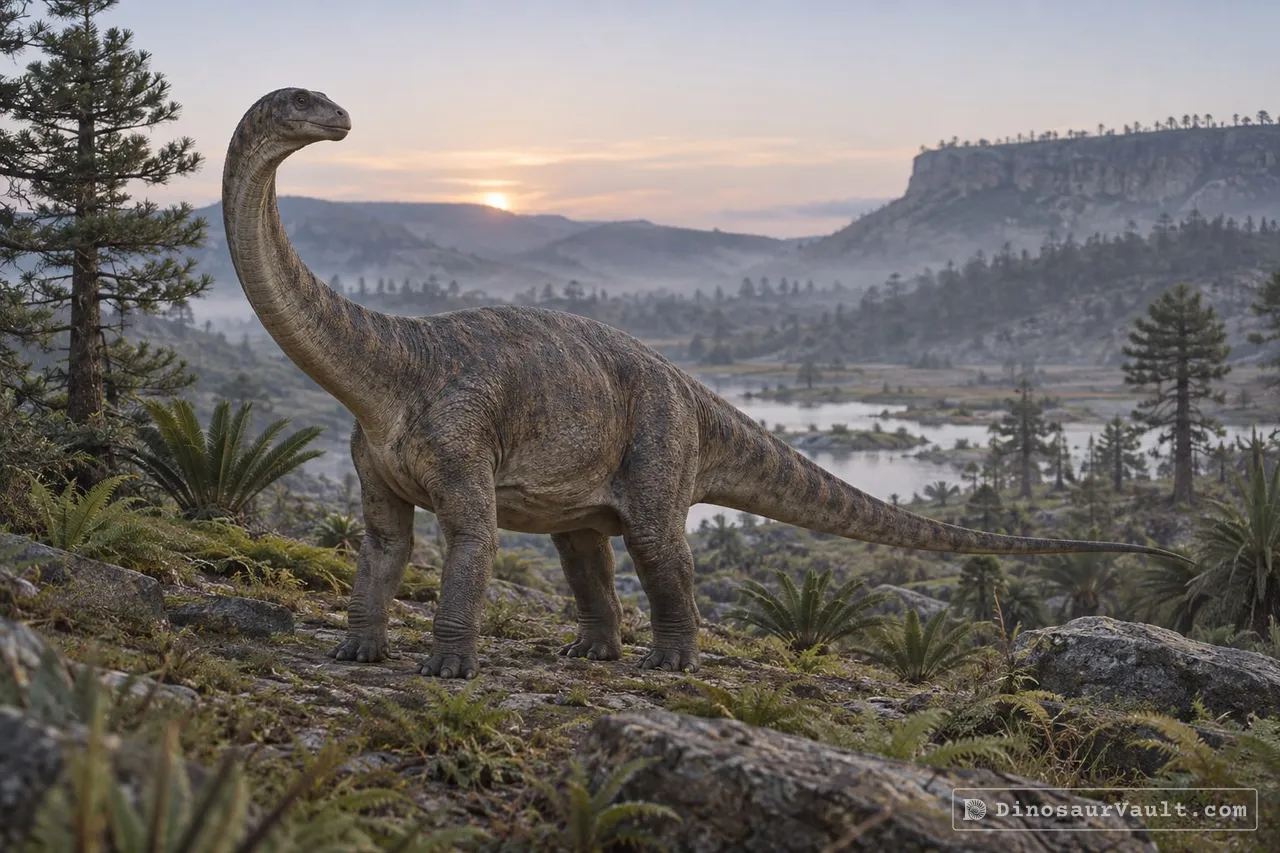
Lamplughsaura was a large, early sauropod, a long-necked plant eater. It is known from bones of several animals.
Its world
It lived in the Early Jurassic, in what is now India. It comes from the Dharmaram Formation, where the early sauropodomorph Jaklapallisaurus has also been found.
How it was found
Kutty and colleagues named Lamplughsaura in 2007. Its name honors a founder of an institute that studies India's geology.
Field gallery
More views of Lamplughsaura
Scenes reconstructed from the available fossil evidence.
1 of 3
Lived alongside
Found in the same rock formations


A rock formation can hold fossils laid down millions of years apart, so not every animal here met Lamplughsaura.
The evidence
The science behind Lamplughsaura
Which parts of the picture come from its own bones, and which come from its relatives.
From its own fossils
- Several partial skeletons preserve skull bones, much of the neck, parts of the back and tail, and strong limbs.
- Its limb proportions supported a heavy body walking on all fours.
- Its teeth had a deeply indented rear edge, a feature that helps distinguish it from other early long-necked dinosaurs.
Borrowed from relatives
- Missing skeletal parts are restored by comparison with other early long-necked dinosaurs, including Plateosaurus and Barapasaurus.
- The skin covering follows comparisons with other dinosaurs.
Still unknown
- Its skin texture and color.
- Exactly where it belongs near the beginning of the sauropod family tree.
- How its body changed from hatchling to adult.
Discovery timeline
- 2007Named itKutty et al.
- 2010Close relativeBANDYOPADHYAY et al.
- 2017Its worldMcPhee et al.
Key papers
The research behind what we know of Lamplughsaura
Named it
Described several partial skeletons of a heavy, four-legged plant eater and compared its bones with early sauropods and their relatives.
Basal sauropodomorphs (Dinosauria: Saurischia) from the Lower Jurassic of India: their anatomy and relationships. Journal of Paleontology 81: 1218-1240
Read the paper : Basal sauropodomorphs (Dinosauria: Saurischia) from the Lower Jurassic of India: their anatomy and relationships (opens in a new tab)Close relative
Described Barapasaurus in detail and compared early Indian sauropods, including Lamplughsaura, to trace changes in their skeletons.
Osteology of Barapasaurus tagorei (Dinosauria: Sauropoda) from the Early Jurassic of India. Palaeontology 53: 533-569
Read the paper : Osteology of Barapasaurus tagorei (Dinosauria: Sauropoda) from the Early Jurassic of India (opens in a new tab)Its world
Compared early long-necked dinosaur communities across continents, linking the Indian assemblage containing Lamplughsaura with a wider Jurassic radiation.
The sauropodomorph biostratigraphy of the Elliot Formation of southern Africa: Tracking the evolution of Sauropodomorpha across the Triassic–Jurassic boundary. Acta Palaeontologica Polonica 62
Read the paper : The sauropodomorph biostratigraphy of the Elliot Formation of southern Africa: Tracking the evolution of Sauropodomorpha across the Triassic–Jurassic boundary (opens in a new tab)
Close relatives
Other members of Sauropoda


Sources: Wikidata