Petrobrasaurus
"Petrobras lizard"
- Lived
- 90 to 84 million years ago, Late Cretaceous
- Diet
- Herbivore
- Group
- Sauropods
- Found in
- Argentina
- Named by
- Filippi et al. 2011
Where its fossils were found
The evidence
Today

90 million years ago
Habitat
It lived on the land that is now Argentina, where mud accumulated in the Plottier Formation. Other plant eaters from these rocks include Notocolossus, Antarctosaurus and Muyelensaurus.
Field notes
About Petrobrasaurus
What it was like
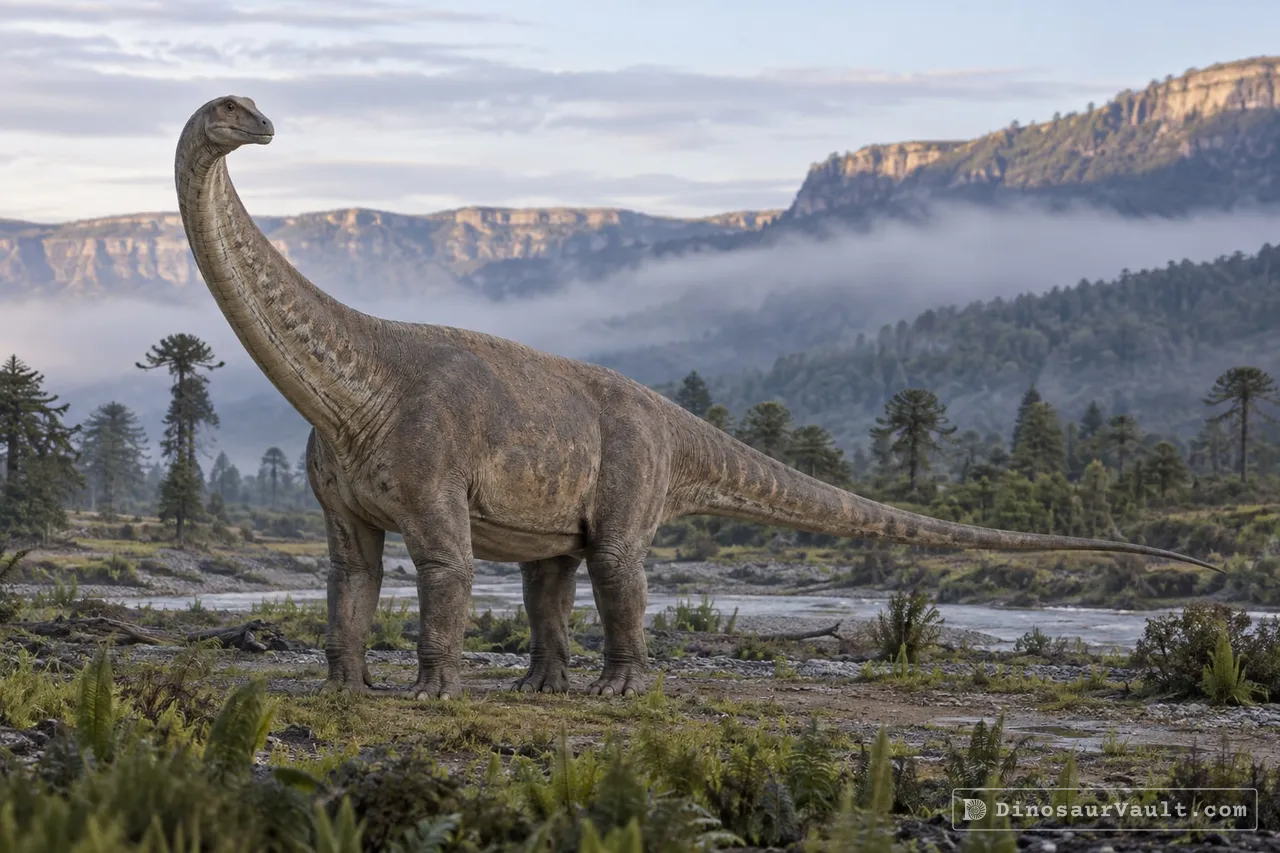
Petrobrasaurus was a titanosaur, a long-necked, four-legged plant eater, known from a partial skeleton.
Its world
It lived in the Late Cretaceous in what is now Argentina. Its bones come from the Plottier Formation, where it shared the land with the giant titanosaur Notocolossus and the smaller Muyelensaurus.
How it was found
Filippi and colleagues named Petrobrasaurus in 2011, from a single find. It was found on land belonging to an oil company, which it is named after.
Field gallery
More views of Petrobrasaurus
Scenes reconstructed from the available fossil evidence.
1 of 3
Lived alongside
Found in the same rock formations


A rock formation can hold fossils laid down millions of years apart, so not every animal here met Petrobrasaurus.
The evidence
The science behind Petrobrasaurus
Which parts of the picture come from its own bones, and which come from its relatives.
From its own fossils
- The type specimen was found scattered. It includes two incomplete replacement teeth, part of a neck vertebra, vertebrae from the rear of the back and the front of the tail, ribs, breastbone plates, a slender upper arm bone, three complete hand bones and part of a fourth, both thigh bones, parts of the shins and pieces of the hip.
- Its teeth were narrow and pencil-shaped, with rough enamel.
- Deep pockets and supporting ridges in the backbones help distinguish it from other titanosaurs.
Borrowed from relatives
- The missing face and jaws are restored by comparison with the titanosaur Tapuiasaurus.
- The rest of the neck, the trunk, forearms, tail tip and feet follow the titanosaur Mnyamawamtuka, and the wrist and the missing parts of the hand follow Camarasaurus and Apatosaurus.
Still unknown
- Its skull. No skull is known, and only two loose teeth come from the head.
- The length of its neck and tail, and its skin covering and color.
- Its closest relatives. Its describers suggested it might belong with Futalognkosaurus and Mendozasaurus, but adding it to an earlier family-tree analysis left its position unresolved.
Discovery timeline
- 2011Named itFILIPPI et al.
- 2016Same rocksCruzado-Caballero et al.
- 2016Same rocksGonzález Riga et al.
Key papers
The research behind what we know of Petrobrasaurus
Named it
Named a titanosaur from a partial skeleton with pencil-shaped teeth and distinctive pockets and ridges in its backbones.
A new sauropod titanosaur from the Plottier Formation (Upper Cretaceous) of Patagonia (Argentina). Geologica Acta 9: 1-12
Read the paper : A new sauropod titanosaur from the Plottier Formation (Upper Cretaceous) of Patagonia (Argentina) (opens in a new tab)Same rocks
Described a plant eater's backbone fragment from the same quarry as Petrobrasaurus, adding an ornithopod to the local dinosaur fauna.
New record of ornithopod dinosaur from the Plottier Formation (Upper Cretaceous), Patagonia, Argentina. Annales de Paléontologie 102: 145-150
Read the paper : New record of ornithopod dinosaur from the Plottier Formation (Upper Cretaceous), Patagonia, Argentina (opens in a new tab)Same rocks
Named Notocolossus from the same formation and described its compact hind foot, expanding the known range of titanosaur foot shapes.
A gigantic new dinosaur from Argentina and the evolution of the sauropod hind foot. Scientific Reports 6
Read the paper : A gigantic new dinosaur from Argentina and the evolution of the sauropod hind foot (opens in a new tab)
Close relatives
Other members of Titanosauria


Sources: Wikidata