Padillasaurus
"Padilla lizard"
- Lived
- 126 to 121 million years ago, Early Cretaceous
- Diet
- Herbivore
- Group
- Sauropods
- Found in
- Colombia
- Named by
- Carballido et al. 2015
Where its fossils were found
The evidence
Today

125 million years ago
Habitat
It lived on land in what is now Colombia. Its bones were buried in coastal mud on tidal salt flats that became part of the Paja Formation.
Field notes
About Padillasaurus
What it was like
Padillasaurus was a long-necked, four-legged plant eater, known from part of the backbone. It was first described as a brachiosaur, a relative of Brachiosaurus, but later studies place it elsewhere among the relatives of the titanosaurs.
Its world
It lived in the Early Cretaceous in what is now Colombia. Its bones come from the Paja Formation, rocks laid down in the sea.
How it was found
Carballido and colleagues named Padillasaurus in 2015, from a single find. It was one of the first dinosaurs named from Colombia.
Field gallery
More views of Padillasaurus
Scenes reconstructed from the available fossil evidence.
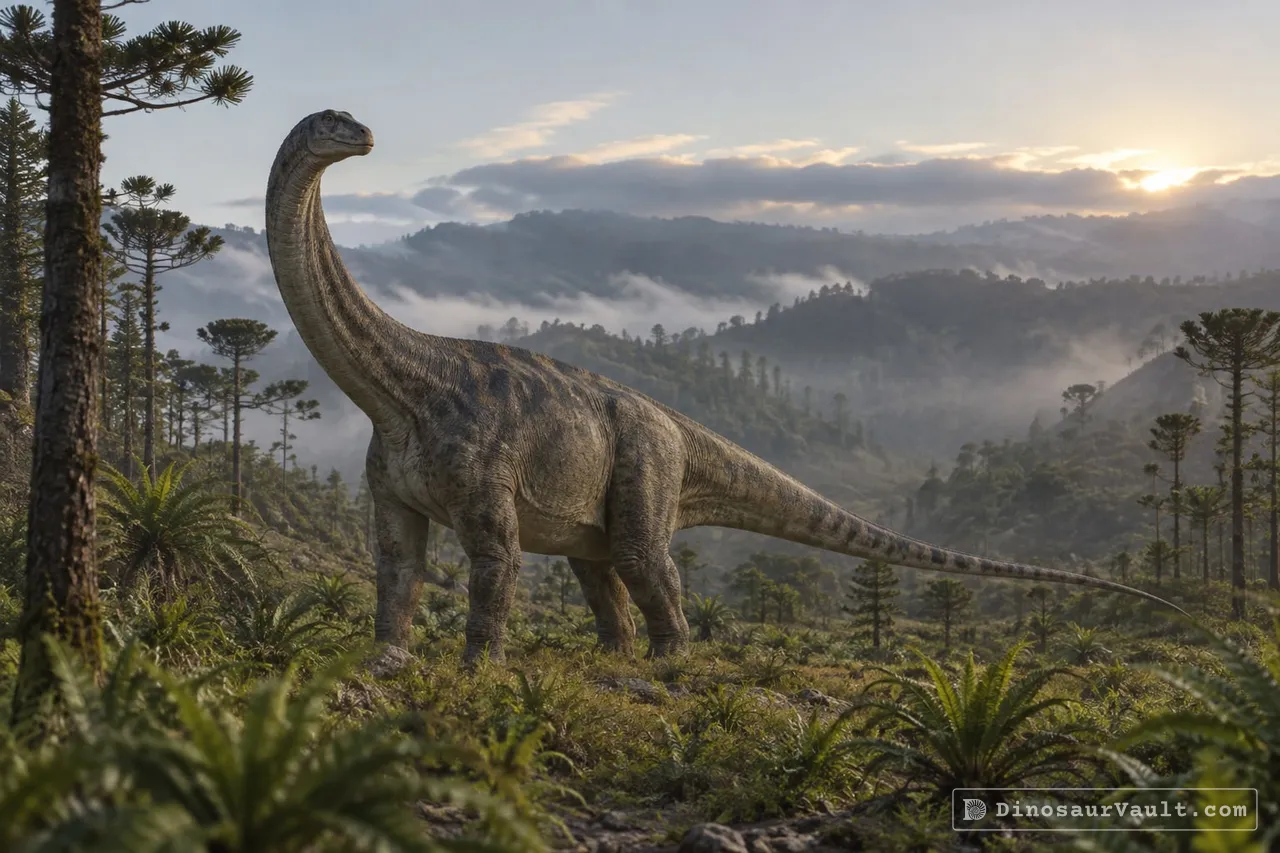
1 of 3
The evidence
The science behind Padillasaurus
Which parts of the picture come from its own bones, and which come from its relatives.
From its own fossils
- Part of a single backbone was found in three pieces: the body of a rear back vertebra; what is probably the last back vertebra, joined to the front hip vertebrae; and the rear hip vertebrae, joined to eight front tail bones.
- The front tail bones have shallow hollows on their sides and short side branches divided into upper and lower parts.
Borrowed from relatives
- The missing head is restored by comparison with Euhelopus, the neck, body and upper limbs with Mnyamawamtuka, and the hands with Camarasaurus and Apatosaurus.
- Later family-tree studies place it among the relatives of titanosaurs rather than with Brachiosaurus.
Still unknown
- The shape of its skull and the length of its neck.
- Its full size and body proportions, and the height of its tail spines, whose tops are missing.
- Its closest relatives. It was first placed with Brachiosaurus, and later studies moved it without settling its nearest kin.
Discovery timeline
- 2015Named itCarballido et al.
- 2016Close relativePoropat et al.
- 2017Family treeMannion, Allain & Moine
Key papers
The research behind what we know of Padillasaurus
Named it
Named a sauropod from back, hip and tail bones found in marine rocks, initially placing it in the brachiosaur family.
A new Early Cretaceous brachiosaurid (Dinosauria, Neosauropoda) from northwestern Gondwana (Villa de Leiva, Colombia). Journal of Vertebrate Paleontology 35
Read the paper : A new Early Cretaceous brachiosaurid (Dinosauria, Neosauropoda) from northwestern Gondwana (Villa de Leiva, Colombia) (opens in a new tab)Close relative
Described Savannasaurus, whose tail bones have side hollows like those that originally linked Padillasaurus to brachiosaurs.
New Australian sauropods shed light on Cretaceous dinosaur palaeobiogeography. Scientific Reports 6
Read the paper : New Australian sauropods shed light on Cretaceous dinosaur palaeobiogeography (opens in a new tab)Family tree
Showed that closed side hollows in the tail bones also occur outside brachiosaurs, and placed Padillasaurus among the relatives of titanosaurs instead.
The earliest known titanosauriform sauropod dinosaur and the evolution of Brachiosauridae. PeerJ 5: e3217
Read the paper : The earliest known titanosauriform sauropod dinosaur and the evolution of Brachiosauridae (opens in a new tab)
Close relatives
Other members of Somphospondyli


Sources: Wikidata