Velocipes
"quick foot"
Type species Velocipes guerichi
- Lived
- 227 to 206 million years ago, Late Triassic
- Diet
- Carnivore
- Group
- Theropods
- Found in
- Poland
- Named by
- Huene 1932
Where its fossils were found
The evidence
Today

220 million years ago
Habitat
River channels deposited the gravel that became the Lissauer Breccia in Poland. The same deposits contain fossil wood, armored aetosaurs, early turtles and lungfish.
Field notes
About Velocipes
What it was like
Velocipes is known from part of a single leg bone. It was described as a small theropod, but the bone is not complete enough to be sure.
Its world
It lived in the Late Triassic, in what is now Poland.
How it was found
Huene named Velocipes in 1932. The type species is Velocipes guerichi. Most scientists treat the name as doubtful.
Field gallery
More views of Velocipes
Scenes reconstructed from the available fossil evidence.
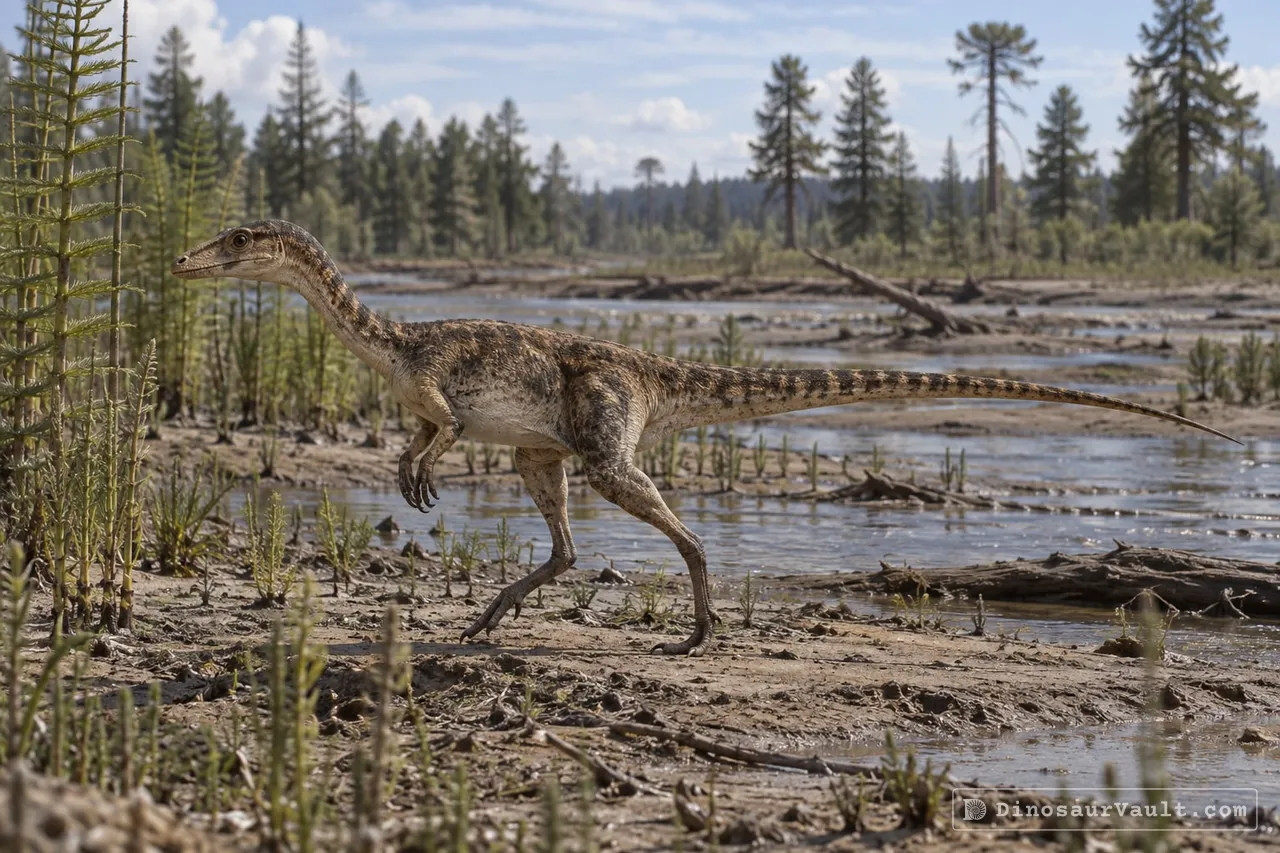
The evidence
The science behind Velocipes
Which parts of the picture come from its own bones, and which come from its relatives.
From its own fossils
- It is known from the upper part of a single fibula, the slender bone beside the shin.
- A long hollow on the inner side of the bone resembles the condition in early theropods.
Borrowed from relatives
- Any full-body restoration must borrow almost everything from early theropods such as Liliensternus and Dilophosaurus.
Still unknown
- Whether its bone is distinctive enough to separate it from other dinosaurs.
- Its exact place among early theropods.
- Its skull, arms, skin covering and color.
Discovery timeline
- 1932Named itHuene
- 2016RedescriptionSkawiński et al.
- 2021Same rocksCzepiński et al.
Key papers
The research behind what we know of Velocipes
Named it
Named Velocipes from an incomplete leg bone and identified it as a theropod.
Die fossile Reptil-Ordnung Saurischia, ihre Entwicklung und Geschichte [The fossil reptile order Saurischia, their development and history]. Monographien zur Geologie und Palaeontologie, serie 1 4: 1-361
No link available
Redescription
Restudied the original bone and identified it as part of a theropod fibula.
A re-evaluation of the historical ‘dinosaur’ remains from the Middle-Upper Triassic of Poland. Historical Biology 29: 442-472
Read the paper : A re-evaluation of the historical ‘dinosaur’ remains from the Middle-Upper Triassic of Poland (opens in a new tab)Same rocks
Described the rediscovered fossil site, its river deposits, and an assemblage including an armored reptile, turtles and lungfish.
An Upper Triassic terrestrial vertebrate assemblage from the forgotten Kocury locality (Poland) with a new aetosaur taxon. Journal of Vertebrate Paleontology 41
Read the paper : An Upper Triassic terrestrial vertebrate assemblage from the forgotten Kocury locality (Poland) with a new aetosaur taxon (opens in a new tab)
Close relatives
Other members of Neotheropoda


Sources: Wikidata