Nipponosaurus
"Japan lizard"
Type species Nipponosaurus sachalinensis
- Lived
- 86 to 72 million years ago, Late Cretaceous
- Diet
- Herbivore
- Group
- Ornithopods, Hadrosauridae
- Found in
- Russia
- Named by
- Nagao 1936
Where its fossils were found
The evidence
Today

80 million years ago
Habitat
It lived on land in what is now Russia during the Late Cretaceous. Its skeleton was buried in marine sediments, suggesting that it may have lived near the coast.
Field notes
About Nipponosaurus
What it was like
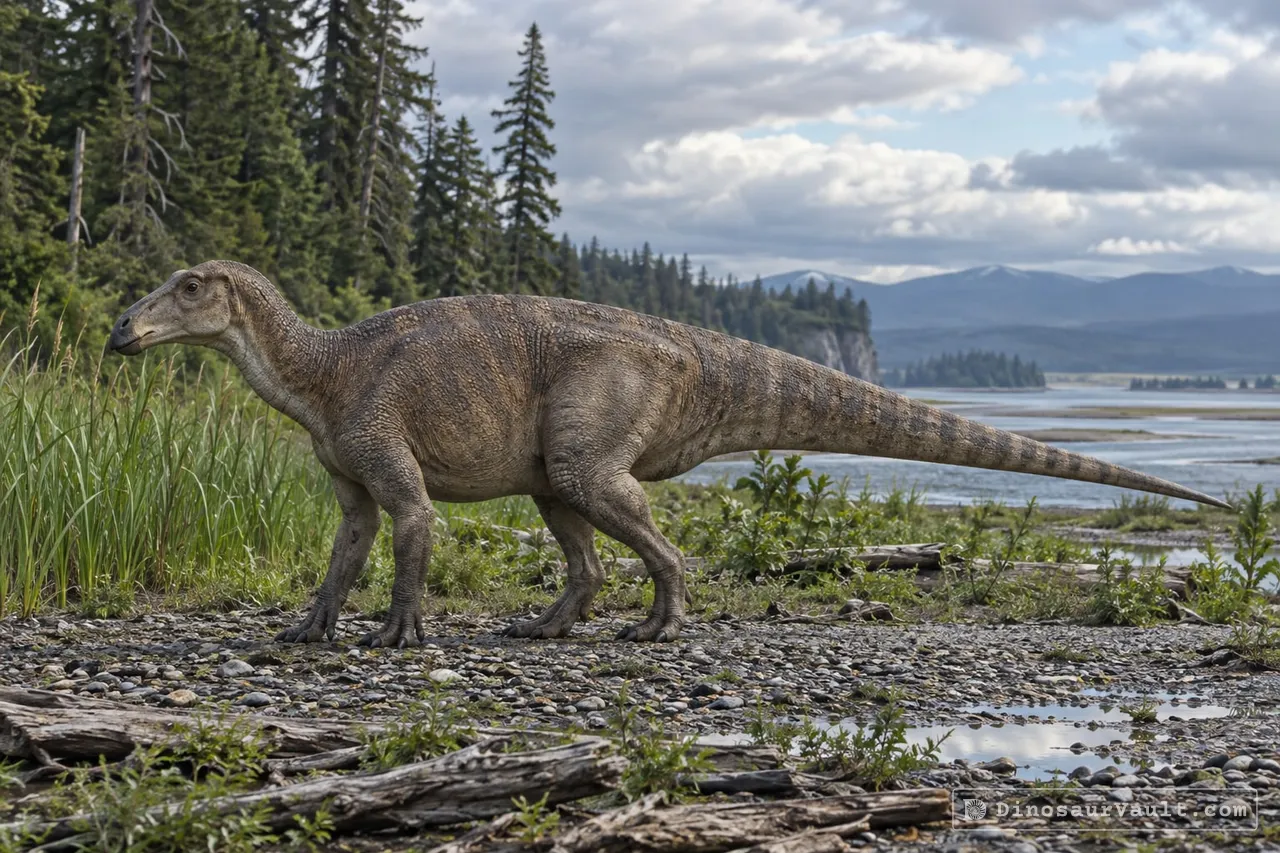
Nipponosaurus was a lambeosaurine duckbill, a plant eater that probably had a hollow crest on its head. The skeleton is of a young animal, so the crest is small.
Its world
It lived in the Late Cretaceous, on an island that is now part of Russia.
How it was found
Nagao named Nipponosaurus in 1936, when the island was ruled by Japan. The type species is Nipponosaurus sachalinensis. It was the first dinosaur named from Japanese territory.
Field gallery
More views of Nipponosaurus
Scenes reconstructed from the available fossil evidence.
1 of 3
The evidence
The science behind Nipponosaurus
Which parts of the picture come from its own bones, and which come from its relatives.
From its own fossils
- The known skeleton includes parts of the skull and jaws, the backbone, hips and limbs.
- Its lower jaw has a broad shelf beneath a tall projection where chewing muscles attached.
- The forelimbs are unusually short compared with those of other duckbills.
Borrowed from relatives
- The missing parts of the head can be compared with hollow-crested duckbills such as Corythosaurus and Hypacrosaurus.
Still unknown
- The shape of its adult crest.
- Its full adult size.
- Its skin color and markings.
Discovery timeline
- 1936Named itNagao
- 2004Full descriptionSuzuki, Weishampel & Minoura
- 2017Growing upTakasaki et al.
Key papers
The research behind what we know of Nipponosaurus
Named it
Introduced Nipponosaurus from a partial duckbill skeleton found in territory then ruled by Japan.
Nipponosaurus sachalinensis: a new genus and species of trachodont dinosaur from Japanese Saghalien. Journal of the Faculty of Science, Hokkaido Imperial University, series 4, Geology and Mineralogy 3: 185-220
No link available
Full description
Redescribed the skeleton, recognized its immature growth stage and placed it among hollow-crested duckbills near Hypacrosaurus.
Nipponosaurus sachalinensis(Dinosauria; Ornithopoda): anatomy and systematic position within Hadrosauridae. Journal of Vertebrate Paleontology 24: 145-164
Read the paper : Nipponosaurus sachalinensis(Dinosauria; Ornithopoda): anatomy and systematic position within Hadrosauridae (opens in a new tab)Growing up
Bone sections confirmed a young animal, while jaw and limb features supported recognition of Nipponosaurus as a distinct dinosaur.
Reanalysis of the phylogenetic status of Nipponosaurus sachalinensis (Ornithopoda: Dinosauria) from the Late Cretaceous of Southern Sakhalin. Historical Biology 30: 694-711
Read the paper : Reanalysis of the phylogenetic status of Nipponosaurus sachalinensis (Ornithopoda: Dinosauria) from the Late Cretaceous of Southern Sakhalin (opens in a new tab)
Close relatives
Other members of Hadrosauridae


Sources: Wikidata