Lutungutali
"high hip"
- Lived
- 247 to 227 million years ago, Middle Triassic to Late Triassic
- Diet
- Herbivore
- Group
- Early ornithischians, Silesauridae
- Found in
- Zambia
- Named by
- Peecook et al. 2013
Where its fossils were found
The evidence
Today

240 million years ago
Habitat
The Ntawere Formation records river channels, floodplains and ponds in a landscape with seasonal rainfall. Sangusaurus was a tusked plant eater in this fauna. Zambiasaurus was another tusked plant eater found in the same rocks.
Field notes
About Lutungutali
What it was like
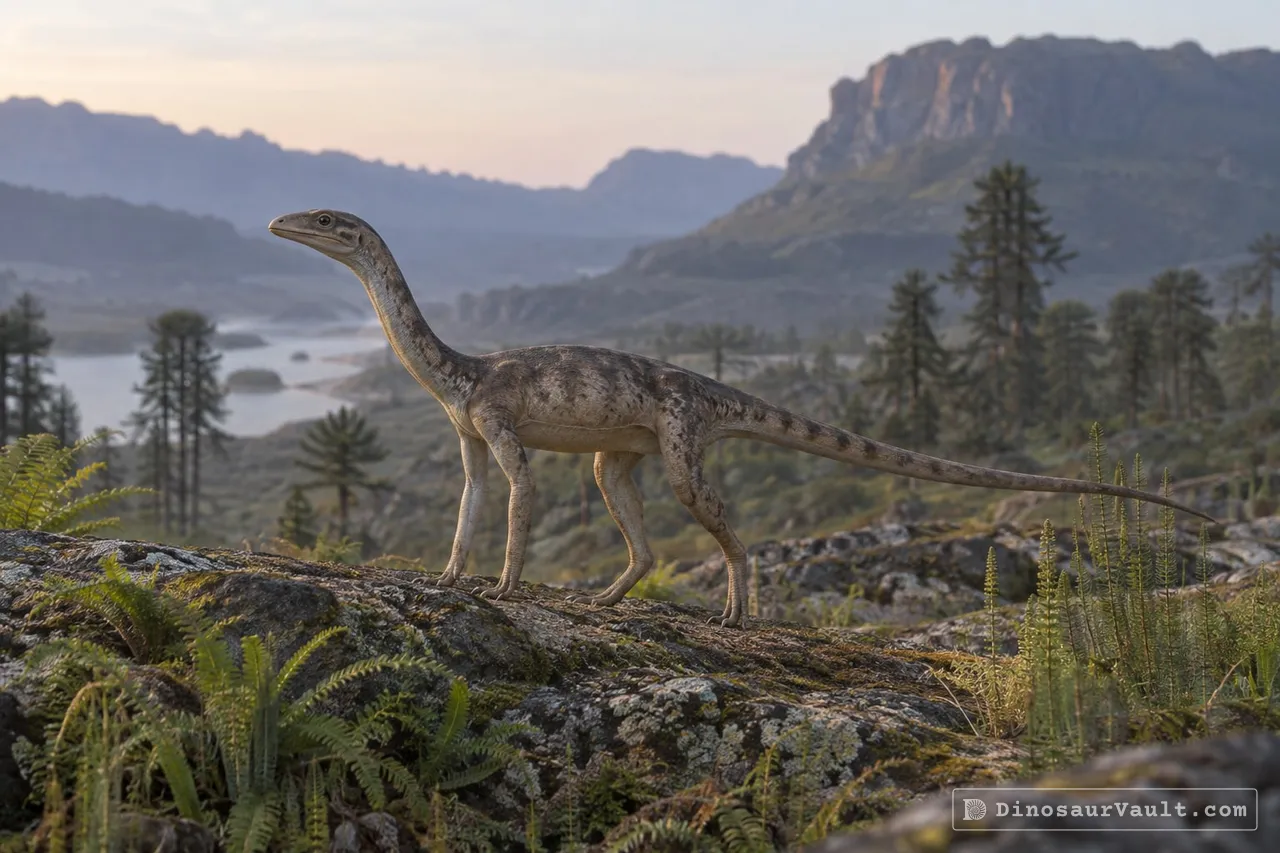
Lutungutali was a silesaurid, a small, slender animal known from hip bones and vertebrae from the base of the tail. Scientists disagree whether silesaurids were close relatives of dinosaurs or early bird-hipped dinosaurs.
Its world
It lived in the Triassic in what is now Zambia. Its bones come from the Ntawere Formation. It is one of the oldest known silesaurids.
How it was found
Peecook and colleagues named it in 2013. Its name comes from a local language.
Field gallery
More views of Lutungutali
Scenes reconstructed from the available fossil evidence.
1 of 3
The evidence
The science behind Lutungutali
Which parts of the picture come from its own bones, and which come from its relatives.
From its own fossils
- The type specimen preserves both upper hip bones, parts of both lower rear hip bones, pieces of the front hip bones, and parts of four vertebrae from the base of the tail.
- The upper blade of the hip bone is unusually tall and upright, a hollow at its rear faces outward, and the lower rear hip bone has a thin, blade-like shaft.
Borrowed from relatives
- The missing head, neck, body, arms and legs are restored by comparison with Silesaurus. The tall hip blade of Lutungutali replaces the low one of Silesaurus.
Still unknown
- Its full size and the shape of its skull.
- Whether any of the larger silesaurid thigh bones from the same rocks belong to Lutungutali. A later study found none can be assigned to it with confidence.
- Its exact place in the family tree, and whether silesaurids were early ornithischian dinosaurs or their closest relatives. One analysis placed it next to Silesaurus, but with weak support.
Discovery timeline
- 2013Named itPeecook et al.
- 2017Its worldPeecook et al.
- 2025New findLovegrove et al.
Key papers
The research behind what we know of Lutungutali
Named it
Named Lutungutali from hip and tail bones and linked it with silesaurids such as Silesaurus and Sacisaurus.
A new silesaurid from the upper Ntawere Formation of Zambia (Middle Triassic) demonstrates the rapid diversification of Silesauridae (Avemetatarsalia, Dinosauriformes). Journal of Vertebrate Paleontology 33: 1127-1137
Read the paper : A new silesaurid from the upper Ntawere Formation of Zambia (Middle Triassic) demonstrates the rapid diversification of Silesauridae (Avemetatarsalia, Dinosauriformes) (opens in a new tab)Its world
Updated the geology and animal life of the Ntawere Formation, including Lutungutali and larger silesaurid remains.
Updated geology and vertebrate paleontology of the Triassic Ntawere Formation of northeastern Zambia, with special emphasis on the archosauromorphs. Journal of Vertebrate Paleontology 37: 8-38
Read the paper : Updated geology and vertebrate paleontology of the Triassic Ntawere Formation of northeastern Zambia, with special emphasis on the archosauromorphs (opens in a new tab)New find
Described a large silesaurid thigh bone from the same formation and found that neither it nor other thigh bones there can be confidently assigned to Lutungutali.
A new large ‘silesaur’ specimen from the ?Late Triassic of Zambia; taxonomic, ecological and evolutionary implications. Royal Society Open Science 12
Read the paper : A new large ‘silesaur’ specimen from the ?Late Triassic of Zambia; taxonomic, ecological and evolutionary implications (opens in a new tab)
Close relatives
Other members of Silesauridae


Sources: Wikidata