Kansaignathus
Type species Kansaignathus sogdianus
- Lived
- 86 to 84 million years ago, Late Cretaceous
- Diet
- Carnivore
- Group
- Theropods, Dromaeosauridae
- Found in
- Tajikistan
- Named by
- Averianov and Lopatin 2021
Where its fossils were found
The evidence
Today

80 million years ago
Habitat
A low coastal plain in what is now Tajikistan. The Yalovach Formation also contains sauropods, duck-billed dinosaurs, tyrannosaurs and turtles.
Field notes
About Kansaignathus
What it was like
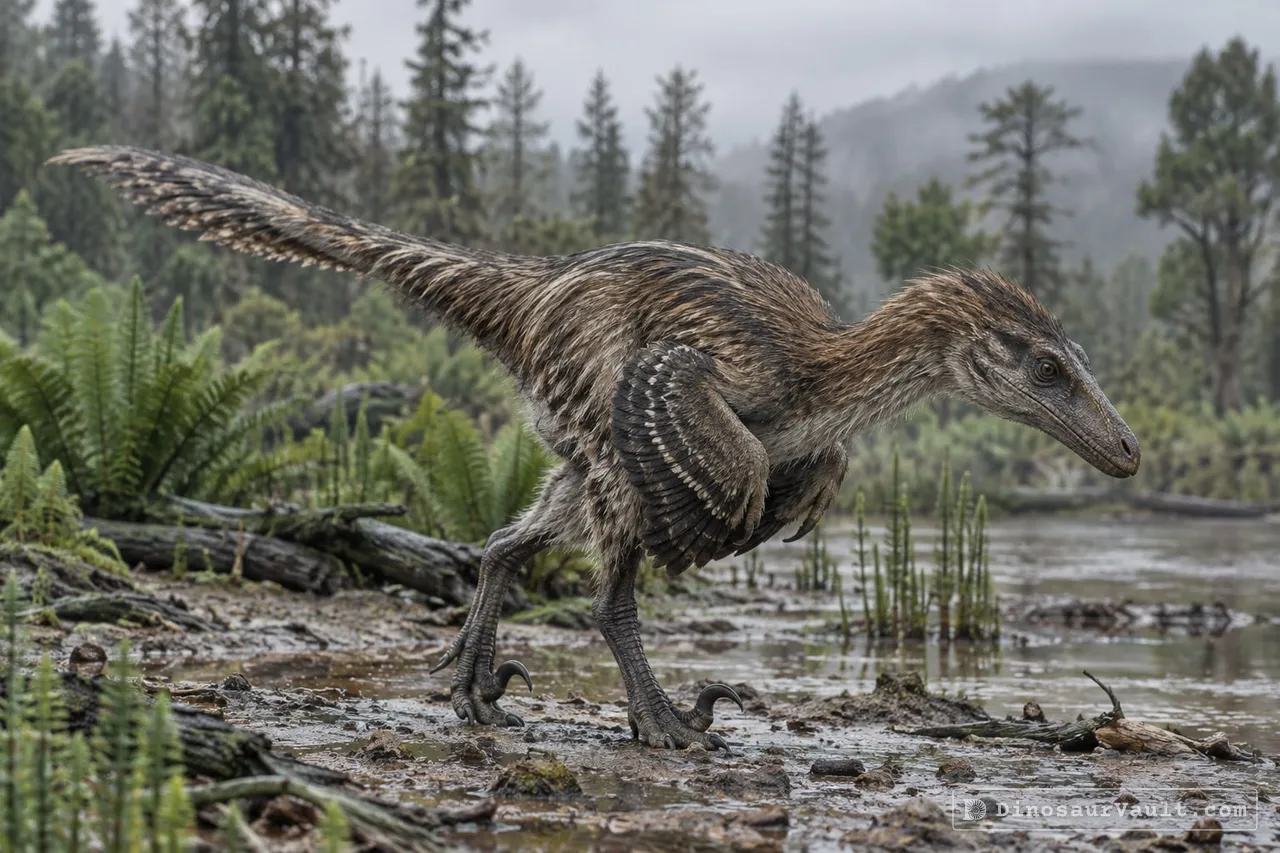
Kansaignathus was a dromaeosaur, a feathered hunter related to Velociraptor. It is known from a lower jaw and a few other bones.
Its world
It lived about 86 to 84 million years ago, in the Late Cretaceous, in what is now Tajikistan. It comes from the Yalovach Formation.
How it was found
Averianov and Lopatin named Kansaignathus in 2021. The type species is Kansaignathus sogdianus.
Field gallery
More views of Kansaignathus
Scenes reconstructed from the available fossil evidence.
1 of 2
The evidence
The science behind Kansaignathus
Which parts of the picture come from its own bones, and which come from its relatives.
From its own fossils
- The type specimen is a nearly complete right lower-jaw bone, deep and relatively thin, with a small chin and a front that does not bend downward.
- Separate sacrum fragments, hand claws and part of a foot bone from the same site have been provisionally assigned to Kansaignathus; they are not from one skeleton.
Borrowed from relatives
- Arm feathers are inferred from a feather-bearing relative provisionally assigned to Velociraptor.
- Velociraptor provides a broader comparison for the missing upper skull, neck, trunk and forequarters.
Still unknown
- The shape of its complete skull, its body proportions and its exact place among dromaeosaurs.
- Its feather colors and patterns.
- What prey it caught and whether it hunted alone.
Discovery timeline
- 2007SkinTurner, Makovicky & Norell
- 2021Named itAverianov & Lopatin
- 2023New findAverianov & Lopatin
- 2025Family treeBindellini et al.
Key papers
The research behind what we know of Kansaignathus
Skin
Found feather attachment bumps on a forearm originally assigned to Velociraptor, supporting arm feathers in a relative of Kansaignathus.
Feather quill knobs in the dinosaur Velociraptor. Science 317: 1721
Read the paper : Feather quill knobs in the dinosaur Velociraptor (opens in a new tab)Named it
Named Kansaignathus from a lower jaw; a majority-rule family tree suggested an early position on the velociraptorine branch.
A New Theropod Dinosaur (Theropoda, Dromaeosauridae) from the Late Cretaceous of Tajikistan. Doklady Earth Sciences 499: 570-574
Read the paper : A New Theropod Dinosaur (Theropoda, Dromaeosauridae) from the Late Cretaceous of Tajikistan (opens in a new tab)New find
Provisionally assigned separate sacrum fragments, hand claws and part of a foot bone to Kansaignathus, then tested its relationships.
New data on Kansaignathus sogdianus, a dromaeosaurid theropod from the Upper Cretaceous of Tajikistan. Cretaceous Research 147: 105524
Read the paper : New data on Kansaignathus sogdianus, a dromaeosaurid theropod from the Upper Cretaceous of Tajikistan (opens in a new tab)Family tree
Reviewed Velociraptor anatomy and treated the feather-bearing forearm as belonging to an unidentified velociraptorine or provisionally to Velociraptor.
Velociraptor: the state of the art 100 years after the discovery of this iconic dinosaur. Italian Journal of Geosciences 144: 460-486
Read the paper : Velociraptor: the state of the art 100 years after the discovery of this iconic dinosaur (opens in a new tab)
Close relatives
Other members of Dromaeosauridae


Sources: Wikidata