Jiangxititan
"Jiangxi titan"
Type species Jiangxititan ganzhouensis
- Lived
- 72 to 66 million years ago, Late Cretaceous
- Diet
- Herbivore
- Group
- Sauropods
- Found in
- China
- Named by
- Mo et al. 2023
Where its fossils were found
The evidence
Today

70 million years ago
Habitat
Rivers and lakes shaped the landscape in southern China. The regional dinosaur fauna included Gannansaurus, Nankangia and Banji.
Field notes
About Jiangxititan
What it was like
Jiangxititan was a long-necked, four-legged plant eater, known from several backbones with ribs.
It was first described as a titanosaur, but later studies suggest it was a close relative of the titanosaurs instead.
Its world
It lived about 72 to 66 million years ago, at the end of the Late Cretaceous, in what is now southern China.
How it was found
Mo and colleagues named Jiangxititan in 2023, from a single find.
Field gallery
More views of Jiangxititan
Scenes reconstructed from the available fossil evidence.
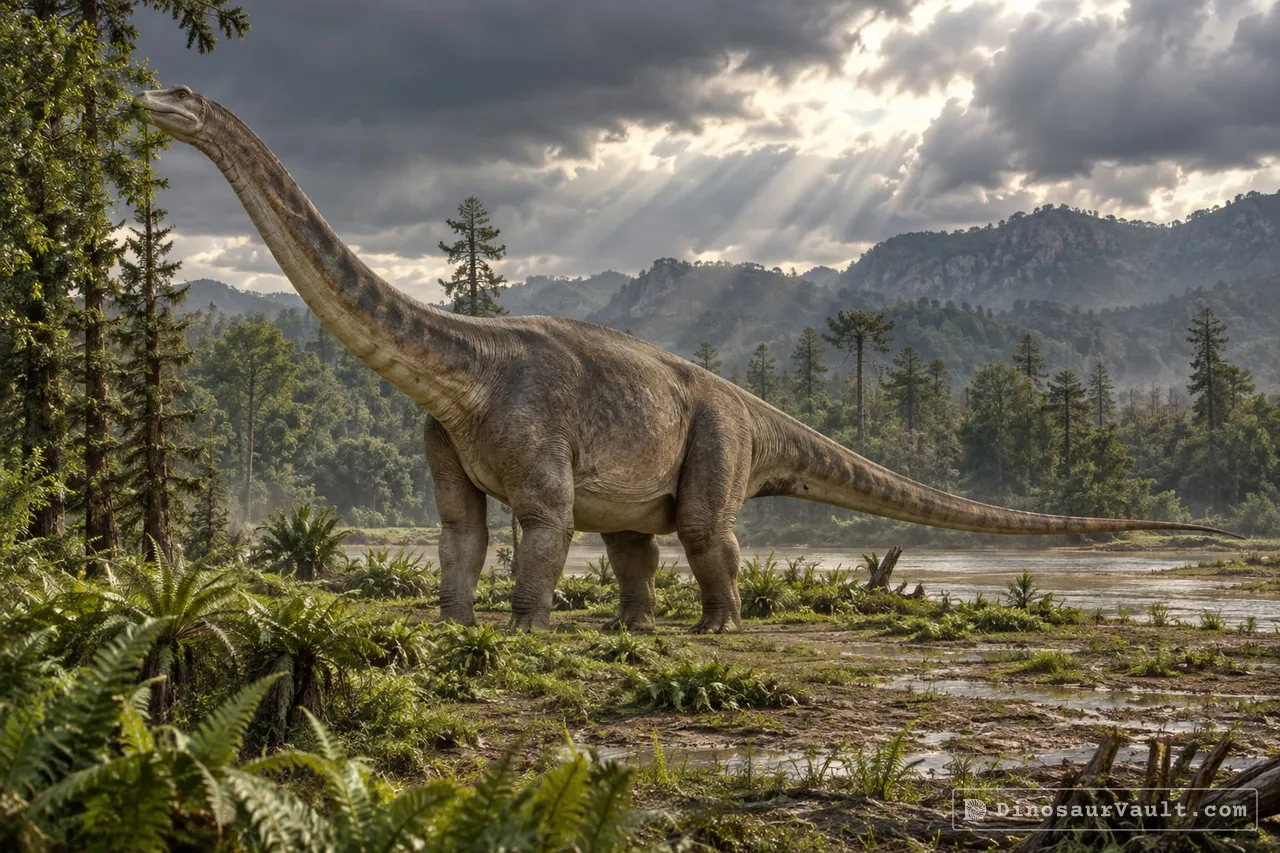
The evidence
The science behind Jiangxititan
Which parts of the picture come from its own bones, and which come from its relatives.
From its own fossils
- The type skeleton preserves a connected stretch of the rear neck and front of the back, with incomplete ribs.
- The vertebrae are unusually low and broad, with deeply split bony spines whose branches, on the better-preserved side, spread sideways.
Borrowed from relatives
- Euhelopus provides a broader comparison for the missing skull and lower jaw.
Still unknown
- Its full size and body proportions.
- Its exact position in the sauropod family tree.
- Its skin covering and color.
Discovery timeline
- 2013Same rocksLü et al.
- 2013SkullsPoropat & Kear
- 2023Named itMo et al.
Key papers
The research behind what we know of Jiangxititan
Same rocks
Named Nankangia and proposed that different jaw shapes helped the region's beaked dinosaurs divide food resources.
A New Oviraptorosaur (Dinosauria: Oviraptorosauria) from the Late Cretaceous of Southern China and Its Paleoecological Implications. PLoS ONE 8: e80557
Read the paper : A New Oviraptorosaur (Dinosauria: Oviraptorosauria) from the Late Cretaceous of Southern China and Its Paleoecological Implications (opens in a new tab)Skulls
Described and reconstructed the skull and lower jaw of Euhelopus, providing a comparison for the missing head of Jiangxititan.
Photographic Atlas and Three-Dimensional Reconstruction of the Holotype Skull of Euhelopus zdanskyi with Description of Additional Cranial Elements. PLoS ONE 8: e79932
Read the paper : Photographic Atlas and Three-Dimensional Reconstruction of the Holotype Skull of Euhelopus zdanskyi with Description of Additional Cranial Elements (opens in a new tab)Named it
Named a sauropod with unusually flattened vertebrae and deeply split bony spines, adding another long-necked dinosaur to the fauna of southern China.
A New Titanosaurian Sauropod from the Upper Cretaceous of Jiangxi Province, Southern China. Historical Biology 36: 2443-2457
Read the paper : A New Titanosaurian Sauropod from the Upper Cretaceous of Jiangxi Province, Southern China (opens in a new tab)
Close relatives
Other members of Somphospondyli


Sources: Wikidata