Jiangshanosaurus
"Jiangshan lizard"
- Lived
- 101 to 90 million years ago, Late Cretaceous
- Diet
- Herbivore
- Group
- Sauropods
- Found in
- China
- Named by
- Tang et al. 2001
Where its fossils were found
The evidence
Today

95 million years ago
Habitat
Lake basins in eastern China formed the rocks of the Jinhua Formation. The sauropod Dongyangosaurus also lived in this region.
Field notes
About Jiangshanosaurus
What it was like
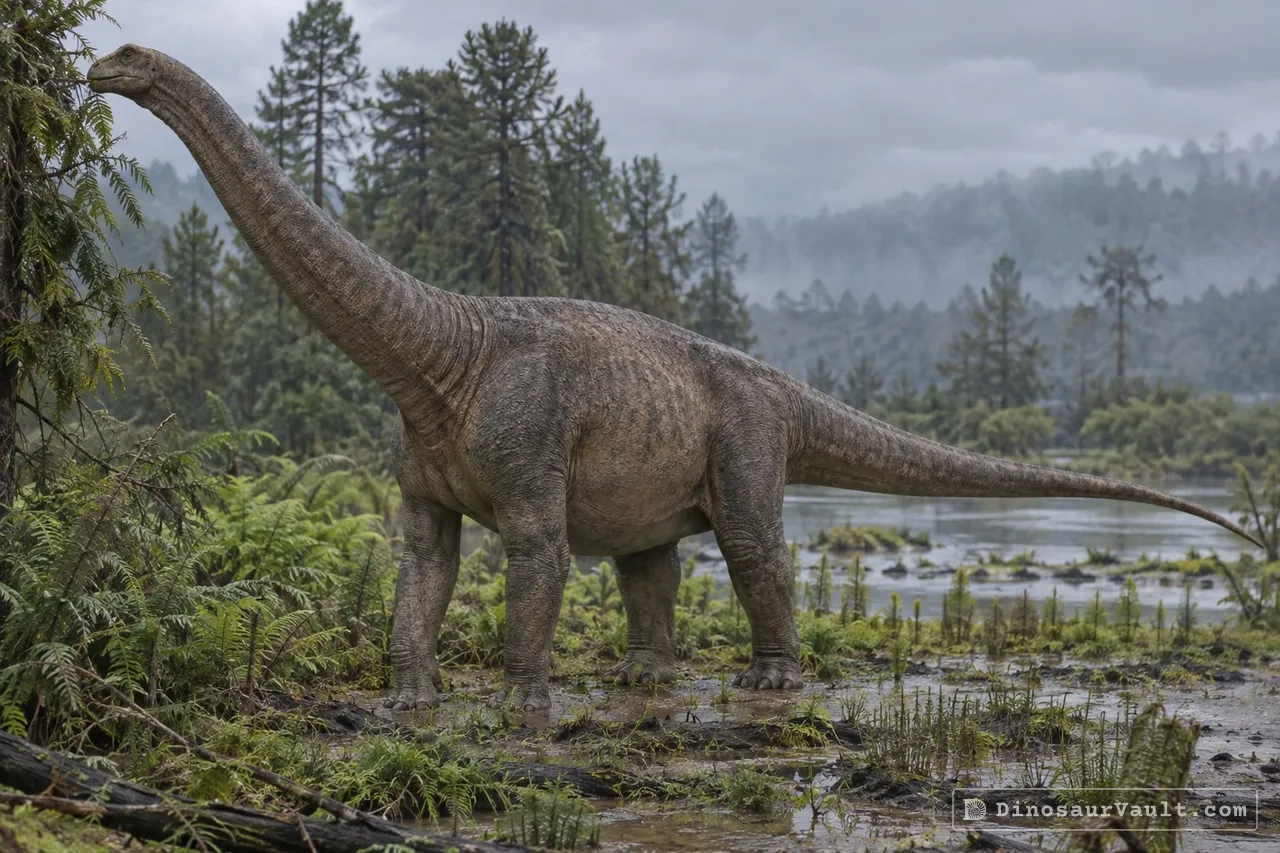
Jiangshanosaurus was a long-necked sauropod, a relative of the titanosaurs. It is known from parts of the back, hips, shoulder and leg.
Its world
It lived in the Late Cretaceous in what is now eastern China. Its bones come from the Jinhua Formation, where the sauropod Dongyangosaurus also lived.
How it was found
Tang and colleagues named it in 2001.
Field gallery
More views of Jiangshanosaurus
Scenes reconstructed from the available fossil evidence.
Lived alongside
Found in the same rock formations

A rock formation can hold fossils laid down millions of years apart, so not every animal here met Jiangshanosaurus.
The evidence
The science behind Jiangshanosaurus
Which parts of the picture come from its own bones, and which come from its relatives.
From its own fossils
- The type specimen includes back vertebrae, three tail vertebrae, the left shoulder blade, parts of the hip bones and the shaft of the left thigh bone. Parts of the mounted skeleton, including some back vertebrae, are restorations.
- A hip bone ends in a small hook, one of the features that distinguishes it from other sauropods.
- The preserved tail vertebrae have hollowed ends on both sides.
Borrowed from relatives
- The missing head is restored by comparison with Euhelopus, and the neck, body, legs and tail with Mnyamawamtuka.
- The hands follow those of other sauropods such as Apatosaurus.
Still unknown
- The shape of its skull and the length of its neck.
- Its skin texture and color.
- Its precise place among the relatives of titanosaurs. A recent study found it among the euhelopodids under one method of weighting features, and among titanosaurs under another.
Discovery timeline
- 2001Named itTang et al.
- 2017Family treeAverianov & Sues
- 2019RedescriptionMannion et al.
- 2026Family treeSethapanichsakul et al.
Key papers
The research behind what we know of Jiangshanosaurus
Named it
Named Jiangshanosaurus from a partial skeleton and compared its shoulder and vertebrae with those of titanosaurs.
A new sauropod dinosaur of Cretaceous from Jingshan, Zhejiang province. Vertebrata PalAsiatica 39: 272-281
No link available
Family tree
Reviewed Asian sauropods and compared Dongyangosaurus with relatives sharing air-filled tail bones.
Review of Cretaceous sauropod dinosaurs from Central Asia. Cretaceous Research 69: 184-197
Read the paper : Review of Cretaceous sauropod dinosaurs from Central Asia (opens in a new tab)Redescription
Restudied Jiangshanosaurus and Dongyangosaurus, corrected the interpretation of the tail joints, and found that their family-tree positions varied between analyses.
New information on the Cretaceous sauropod dinosaurs of Zhejiang Province, China: impact on Laurasian titanosauriform phylogeny and biogeography. Royal Society Open Science 6: 191057
Read the paper : New information on the Cretaceous sauropod dinosaurs of Zhejiang Province, China: impact on Laurasian titanosauriform phylogeny and biogeography (opens in a new tab)Family tree
Named a new sauropod from Thailand; its family-tree analyses placed Jiangshanosaurus among the euhelopodids or among titanosaurs, depending on the method.
The first sauropod dinosaur from the Lower Cretaceous Khok Kruat Formation of Thailand enriches the diversity of somphospondylan titanosauriforms in southeast Asia. Scientific Reports 16
Read the paper : The first sauropod dinosaur from the Lower Cretaceous Khok Kruat Formation of Thailand enriches the diversity of somphospondylan titanosauriforms in southeast Asia (opens in a new tab)
Close relatives
Other members of Somphospondyli


Sources: Wikidata