Hypselospinus
"high spine"
Type species Hypselospinus fittoni
- Lived
- 137 to 133 million years ago, Early Cretaceous
- Diet
- Herbivore
- Group
- Ornithopods
- Found in
- United Kingdom
- Named by
- Norman 2010
Where its fossils were found
The evidence
Today

135 million years ago
Habitat
Low plains and shallow lagoons covered parts of southern England. Ferns and conifers grew in the region, alongside dinosaurs such as Barilium and Hylaeosaurus.
Field notes
About Hypselospinus
What it was like
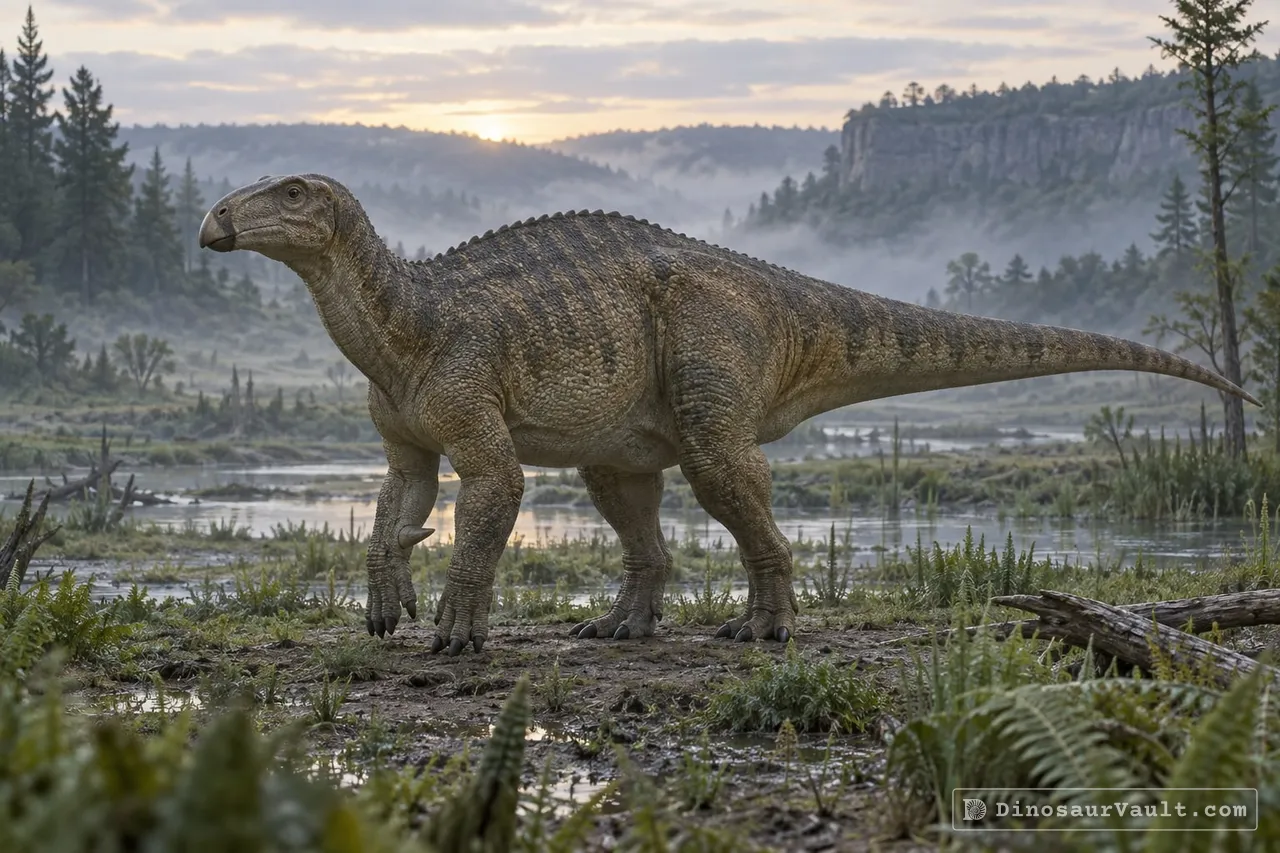
Hypselospinus was a large plant eater related to Iguanodon, with tall spines on its backbones and a long, low skull. It had a thumb spike, a beak and grinding teeth.
Its world
It lived in the Early Cretaceous in what is now southern England. Its bones come from the Wadhurst Clay, where it shared the land with the armored Hylaeosaurus and the plant eater Barilium.
How it was found
Its bones were first described as a species of Iguanodon. Norman gave it its own genus in 2010. Seven finds are known.
Field gallery
More views of Hypselospinus
Scenes reconstructed from the available fossil evidence.
1 of 3
Lived alongside
Found in the same rock formations


A rock formation can hold fossils laid down millions of years apart, so not every animal here met Hypselospinus.
The evidence
The science behind Hypselospinus
Which parts of the picture come from its own bones, and which come from its relatives.
From its own fossils
- Several partial skeletons preserve jaw, backbone, hip and limb bones.
- The back and front of the tail carried tall, narrow spines that leaned backward.
- Its thumb ended in a large, flattened spike with a slight curve.
Borrowed from relatives
- Missing portions of the skeleton are restored by comparison with Iguanodon and other closely related plant eaters.
Still unknown
- The outer shape of the ridge along its back.
- Its skin texture and color.
- Whether it lived in herds.
Discovery timeline
- 2010Named itNORMAN
- 2012Family treeMcDonald
- 2014Full descriptionNorman
- 2024Same rocksBarker et al.
Key papers
The research behind what we know of Hypselospinus
Named it
Separated Hypselospinus and Barilium from Iguanodon by comparing the older plant-eating dinosaurs of southern England.
A taxonomy of iguanodontians (Dinosauria: Ornithopoda) from the lower Wealden Group (Cretaceous: Valanginian) of southern England. Zootaxa 2489
Read the paper : A taxonomy of iguanodontians (Dinosauria: Ornithopoda) from the lower Wealden Group (Cretaceous: Valanginian) of southern England (opens in a new tab)Family tree
Compared early iguanodontians, including Hypselospinus, and found that many relationships within this group remained difficult to resolve.
Phylogeny of Basal Iguanodonts (Dinosauria: Ornithischia): An Update. PLoS ONE 7: e36745
Read the paper : Phylogeny of Basal Iguanodonts (Dinosauria: Ornithischia): An Update (opens in a new tab)Full description
Described the partial skeletons in detail, clarified which bones belong to Hypselospinus, and reassessed its place among duckbill relatives.
On the history, osteology, and systematic position of the Wealden (Hastings group) dinosaurHypselospinus fittoni(Iguanodontia: Styracosterna). Zoological Journal of the Linnean Society 173: 92-189
Read the paper : On the history, osteology, and systematic position of the Wealden (Hastings group) dinosaurHypselospinus fittoni(Iguanodontia: Styracosterna) (opens in a new tab)Same rocks
Identified several kinds of meat-eating dinosaurs from teeth in the Wadhurst Clay Formation, revealing a richer predator community than previously recognized.
Theropod dinosaur diversity of the lower English Wealden: analysis of a tooth‐based fauna from the Wadhurst Clay Formation (Lower Cretaceous: Valanginian) via phylogenetic, discriminant and machine learning methods. Papers in Palaeontology 10
Read the paper : Theropod dinosaur diversity of the lower English Wealden: analysis of a tooth‐based fauna from the Wadhurst Clay Formation (Lower Cretaceous: Valanginian) via phylogenetic, discriminant and machine learning methods (opens in a new tab)
Close relatives
Other members of Neoiguanodontia


Sources: Wikidata