Huallasaurus
"duck lizard"
- Lived
- 72 to 66 million years ago, Late Cretaceous
- Diet
- Herbivore
- Group
- Ornithopods, Hadrosauridae
- Found in
- Argentina
- Named by
- Rozadilla et al. 2021
Where its fossils were found
The evidence
Today

70 million years ago
Habitat
Lakes and coastal lowlands in Argentina, where turtles, snakes and small mammals also lived.
Field notes
About Huallasaurus
What it was like
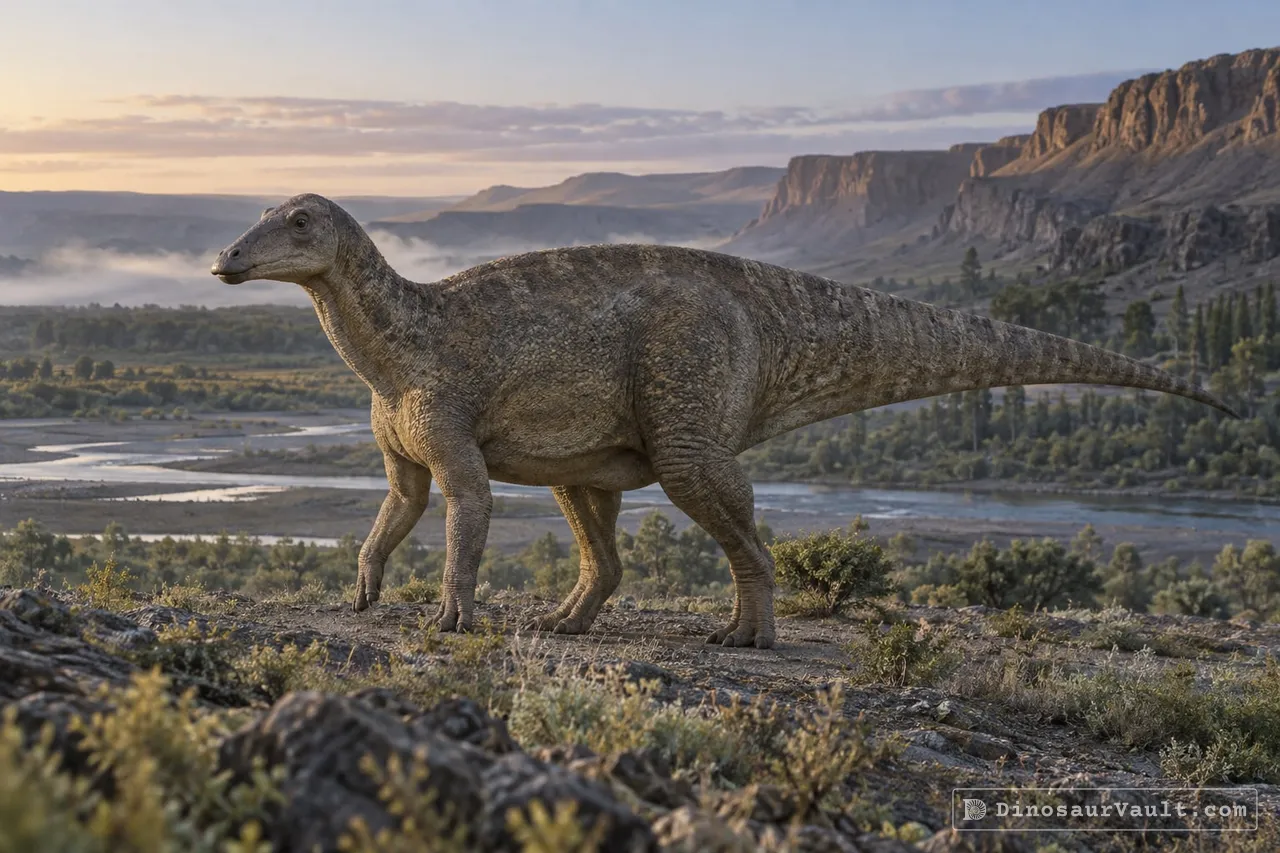
Huallasaurus was a duckbill, a plant eater related to Kritosaurus. It is known from part of a skeleton.
Its world
It lived about 72 to 66 million years ago, near the end of the Cretaceous, in what is now Argentina. It comes from the Los Alamitos Formation.
How it was found
Rozadilla and colleagues named Huallasaurus in 2021, for bones first placed in Kritosaurus.
Field gallery
More views of Huallasaurus
Scenes reconstructed from the available fossil evidence.
1 of 2
The evidence
The science behind Huallasaurus
Which parts of the picture come from its own bones, and which come from its relatives.
From its own fossils
- Partial skulls and skeletons preserve the jaws, hips and backbone of this duckbill.
- Its vertebrae contain a dense network of bony struts rather than large chambers invaded by air sacs.
Borrowed from relatives
- The missing parts of its body are restored by comparison with other duckbills, including Kritosaurus and Secernosaurus.
Still unknown
- Its skin color and markings.
- Whether it cared for its young.
- Exactly which plants it ate.
Discovery timeline
- 2010Full descriptionPrieto-Marquez & Salinas
- 2021Named itRozadilla et al.
- 2025Full descriptionAureliano et al.
Key papers
The research behind what we know of Huallasaurus
Full description
Described the bones under their earlier names and proposed that Kritosaurus australis belonged to Secernosaurus, a classification later revised.
A re-evaluation ofSecernosaurus koerneriandKritosaurus australis(Dinosauria, Hadrosauridae) from the Late Cretaceous of Argentina. Journal of Vertebrate Paleontology 30: 813-837
Read the paper : A re-evaluation ofSecernosaurus koerneriandKritosaurus australis(Dinosauria, Hadrosauridae) from the Late Cretaceous of Argentina (opens in a new tab)Named it
Separated Huallasaurus from other duckbills while describing Kelumapusaura and examining the relationships of South American hadrosaurs.
A new hadrosaurid (Dinosauria: Ornithischia) from the Late Cretaceous of northern Patagonia and the radiation of South American hadrosaurids. Journal of Systematic Palaeontology 19: 1207-1235
Read the paper : A new hadrosaurid (Dinosauria: Ornithischia) from the Late Cretaceous of northern Patagonia and the radiation of South American hadrosaurids (opens in a new tab)Full description
Scans revealed dense bony struts inside the vertebrae, without the air-sac chambers found in many long-necked and meat-eating dinosaurs.
Inside a duck‐billed dinosaur: Vertebral bone microstructure of Huallasaurus (Hadrosauridae), Upper Cretaceous of Patagonia. The Anatomical Record 309: 1702-1712
Read the paper : Inside a duck‐billed dinosaur: Vertebral bone microstructure of Huallasaurus (Hadrosauridae), Upper Cretaceous of Patagonia (opens in a new tab)
Close relatives
Other members of Hadrosauridae


Sources: Wikidata