Gongshuilong
"Gong River dragon"
Type species Gongshuilong fanwei
- Lived
- 72 to 66 million years ago, Late Cretaceous
- Diet
- Herbivore
- Group
- Ornithopods, Hadrosauridae
- Found in
- China
- Named by
- Yao et al. 2026
Where its fossils were found
The evidence
Today

70 million years ago
Habitat
It lived on land in southern China during the Late Cretaceous, in the region preserved by the Lianhe Formation.
Field notes
About Gongshuilong
What it was like
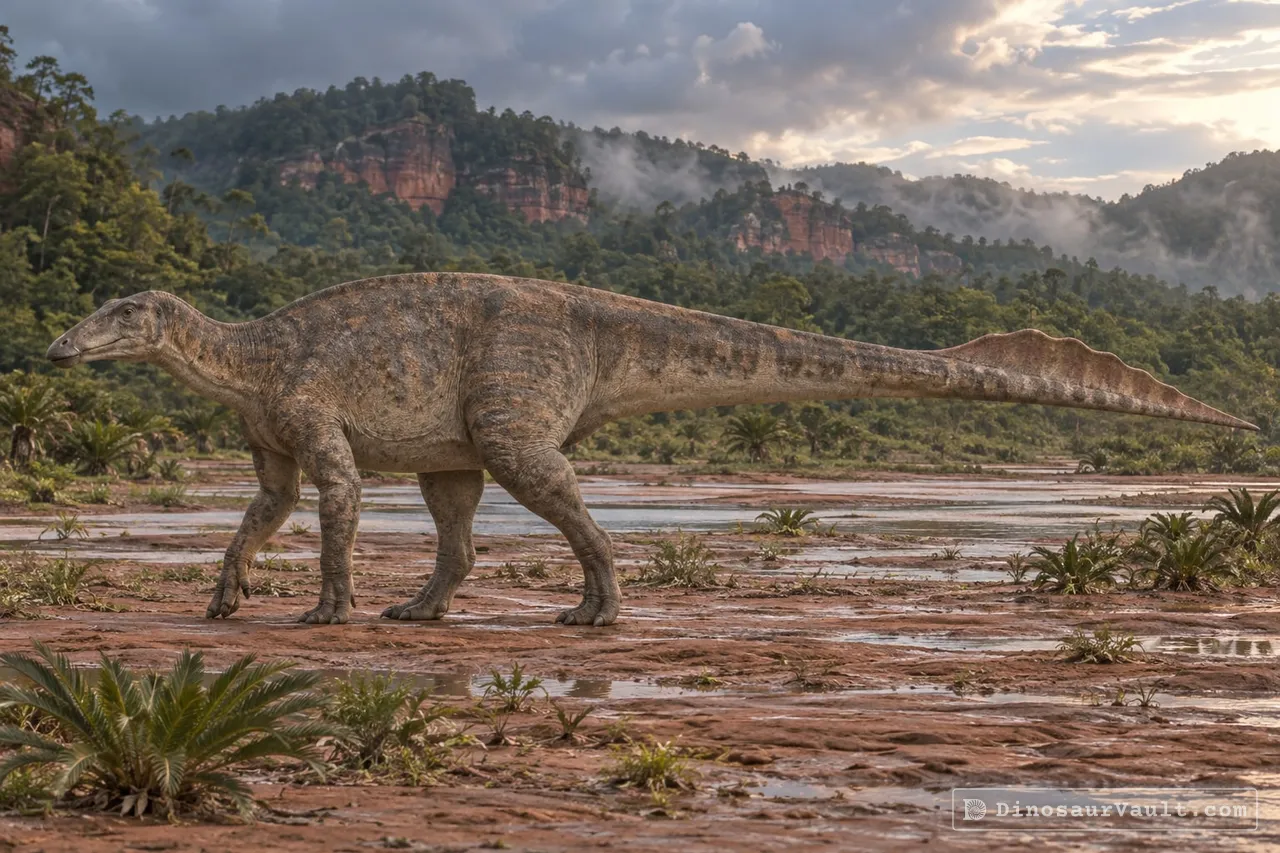
Gongshuilong was a duck-billed plant eater without a hollow crest. It is known from scattered bones of at least two animals found together.
Its world
It lived about 72 to 66 million years ago, at the end of the Late Cretaceous, in what is now southern China. Its bones come from the Lianhe Formation.
How it was found
Yao and colleagues named Gongshuilong in 2026.
Field gallery
More views of Gongshuilong
Scenes reconstructed from the available fossil evidence.
The evidence
The science behind Gongshuilong
Which parts of the picture come from its own bones, and which come from its relatives.
From its own fossils
- Scattered skull, jaw, shoulder and backbone bones preserve parts of its head and body.
- The teeth in its lower jaw have a central ridge and small serrations along their edges.
- Tall, backward-curving spines on the rear tail bones supported a raised outline near the end of the tail.
Borrowed from relatives
- Missing parts of the body are restored by comparison with duckbills such as Acristavus and Brachylophosaurus.
Still unknown
- The complete outline of its head.
- What the raised end of its tail was used for.
- Its skin texture and color.
Discovery timeline
- 2011Close relativeGates et al.
- 2015Close relativeFreedman Fowler & Horner
- 2026Named itYao et al.
Key papers
The research behind what we know of Gongshuilong
Close relative
Named Acristavus and defined the duckbill group that later studies placed Gongshuilong within.
New unadorned hadrosaurine hadrosaurid (Dinosauria, Ornithopoda) from the Campanian of North America. Journal of Vertebrate Paleontology 31: 798-811
Read the paper : New unadorned hadrosaurine hadrosaurid (Dinosauria, Ornithopoda) from the Campanian of North America (opens in a new tab)Close relative
Compared Probrachylophosaurus with Acristavus and Brachylophosaurus, showing how skull crests differed among relatives of Gongshuilong.
A New Brachylophosaurin Hadrosaur (Dinosauria: Ornithischia) with an Intermediate Nasal Crest from the Campanian Judith River Formation of Northcentral Montana. PLOS ONE 10: e0141304
Read the paper : A New Brachylophosaurin Hadrosaur (Dinosauria: Ornithischia) with an Intermediate Nasal Crest from the Campanian Judith River Formation of Northcentral Montana (opens in a new tab)Named it
Named a duckbill from scattered bones, including teeth with small serrations and unusually tall, curved spines near the end of the tail.
A new saurolophine hadrosaurid (Dinosauria: Ornithopoda) from the Upper Cretaceous of South China, providing further support for the possible Asian origin of Brachylophosaurini. Journal of Systematic Palaeontology 24
Read the paper : A new saurolophine hadrosaurid (Dinosauria: Ornithopoda) from the Upper Cretaceous of South China, providing further support for the possible Asian origin of Brachylophosaurini (opens in a new tab)
Close relatives
Other members of Hadrosauridae


Sources: Wikidata