Saltriovenator
"Saltrio hunter"
Type species Saltriovenator zanellai
- Lived
- 200 to 193 million years ago, Early Jurassic
- Diet
- Carnivore
- Group
- Theropods
- Found in
- Italy
- Named by
- Dal Sasso et al. 2018
Where its fossils were found
The evidence
Today

195 million years ago
Habitat
It probably lived on land near a tropical coast in what is now Italy. Its carcass reached a shallow sea, where marine animals fed on the bones.
Field notes
About Saltriovenator
What it was like
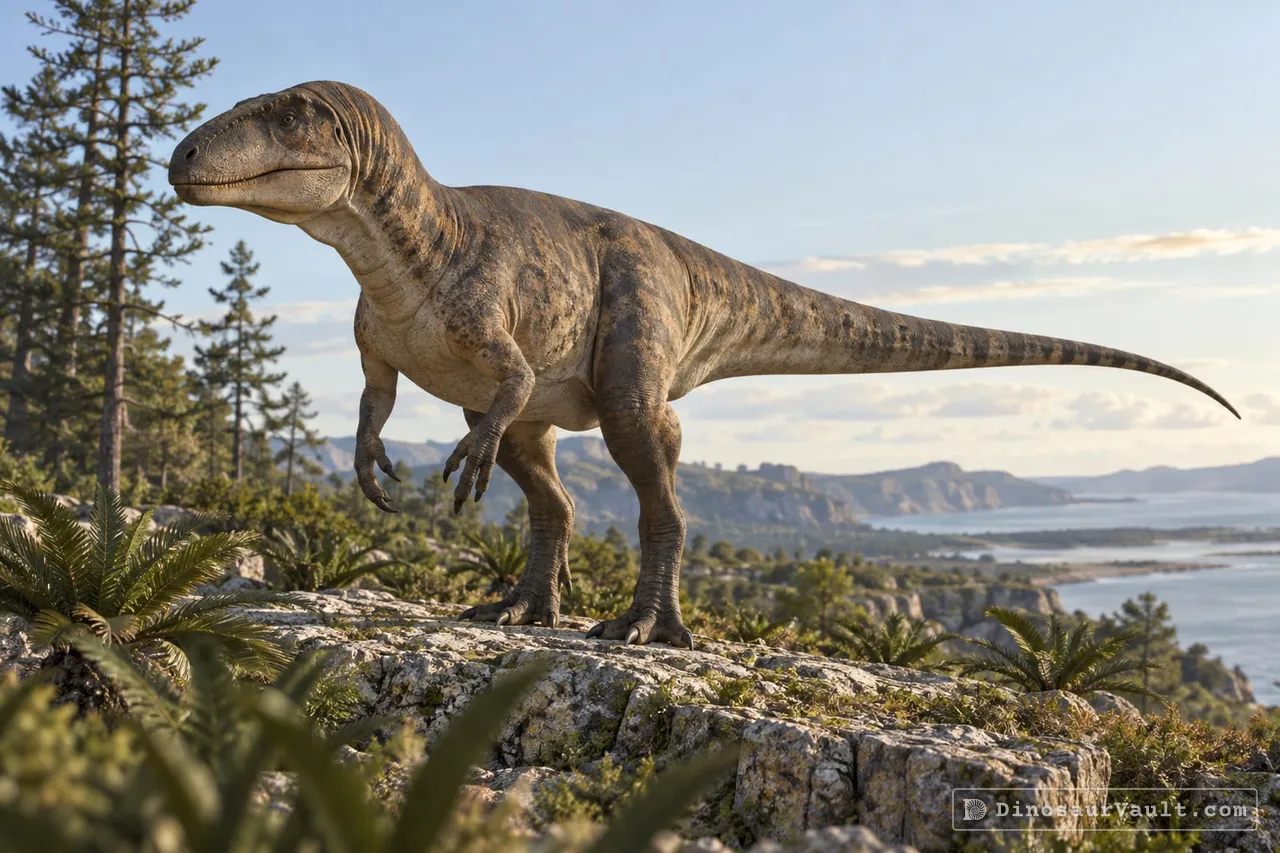
Saltriovenator was a large meat eater from the Early Jurassic, one of the biggest theropods known from that time. It is known only from scattered bones, among them parts of the arm and hand, which suggest a large, powerful two-legged hunter.
It belongs to the ceratosaurs, the group that later included Ceratosaurus.
Its world
It lived about 200 to 193 million years ago, in the Early Jurassic, in what is now Italy. Its bones were found in marine limestone of the Saltrio Formation, which means its body was washed out to sea before it became a fossil.
How it was found
Dal Sasso and colleagues named Saltriovenator zanellai in 2018. The bones had been found in a quarry many years earlier, and several show bite marks from sea creatures that fed on the carcass.
Field gallery
More views of Saltriovenator
Scenes reconstructed from the available fossil evidence.
1 of 3
The evidence
The science behind Saltriovenator
Which parts of the picture come from its own bones, and which come from its relatives.
From its own fossils
- The partial skeleton preserves lower-jaw fragments, ribs, shoulder bones, strong upper arms and parts of the hands and feet.
- Preserved fingers show a functional grasping hand with curved claws.
- Marine invertebrates left feeding traces on bones after the carcass reached the sea.
Borrowed from relatives
- Ceratosaurus provides a model for the missing skull, neck, legs and tail.
- Restorations combine that body model with the strong arms and grasping fingers preserved in Saltriovenator itself.
Still unknown
- The full shape of its face and whether it had skull crests.
- Its complete finger and toe arrangement.
- Its skin covering and color.
Often drawn wrong
- Tiny arms copied from later abelisaurs replace its strong, functional forelimbs.
- A large nose horn copied from Ceratosaurus has no support in its preserved skull fragments.
Discovery timeline
- 2003Fossil sitesDal Sasso
- 2007Close relativeAllain et al.
- 2018Named itDal Sasso, Maganuco & Cau
Key papers
The research behind what we know of Saltriovenator
Fossil sites
Reviewed dinosaur finds in Italy, including the bones later named Saltriovenator, and argued for substantial land areas along the ancient coast.
Dinosaurs of Italy. Comptes Rendus Palevol 2: 45-66
Read the paper : Dinosaurs of Italy (opens in a new tab)Close relative
Described Berberosaurus from Morocco, an early ceratosaur later recovered as a close relative of Saltriovenator.
An abelisauroid (Dinosauria: Theropoda) from the Early Jurassic of the High Atlas Mountains, Morocco, and the radiation of ceratosaurs. Journal of Vertebrate Paleontology 27: 610-624
Read the paper : An abelisauroid (Dinosauria: Theropoda) from the Early Jurassic of the High Atlas Mountains, Morocco, and the radiation of ceratosaurs (opens in a new tab)Named it
Named a large early ceratosaur with strong grasping hands and bones bearing feeding traces from marine invertebrates.
The oldest ceratosaurian (Dinosauria: Theropoda), from the Lower Jurassic of Italy, sheds light on the evolution of the three-fingered hand of birds. PeerJ 6: e5976
Read the paper : The oldest ceratosaurian (Dinosauria: Theropoda), from the Lower Jurassic of Italy, sheds light on the evolution of the three-fingered hand of birds (opens in a new tab)
Close relatives
Other members of Ceratosauria


Sources: Wikidata