Spinostropheus
- Lived
- Jurassic
- Diet
- Carnivore
- Group
- Theropods
- Found in
- Niger
- Named by
- Sereno et al. 2004
Where its fossils were found
The evidence
Fossil record
Niger, Tiourarén Formation
Jurassic, exact age uncertain
Published material comes from the Tiourarén Formation. Its age has been revised, but the exact dating remains uncertain. A historical referral from a different formation is withheld pending review, and whether all referred skeletons belong to this genus is also disputed.
Today

Habitat
It lived in a landscape crossed by rivers in what is now Niger. Jobaria and Afrovenator also come from the same Jurassic rocks.
Field notes
About Spinostropheus
What it was like
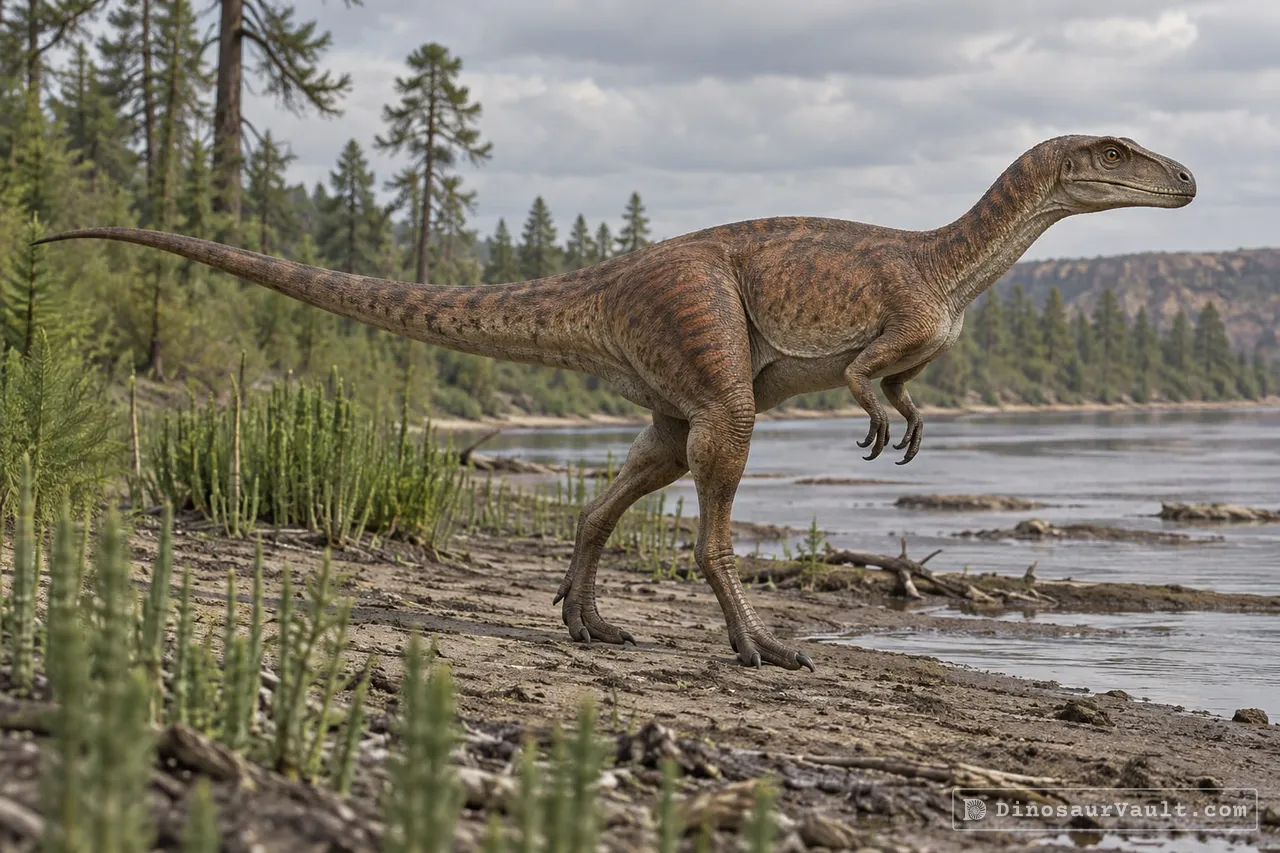
Spinostropheus was a lightly built, two-legged predator known from parts of the backbone and limbs. It was first thought to be a species of Elaphrosaurus. Later studies placed it among the early ceratosaurs.
Its world
It lived in the Jurassic in what is now Niger. Its bones come from the Tiourarén Formation, a land of rivers shared with the long-necked Jobaria and the predator Afrovenator.
How it was found
Sereno and colleagues gave it its own genus in 2004.
Field gallery
More views of Spinostropheus
Scenes reconstructed from the available fossil evidence.
1 of 3
The evidence
The science behind Spinostropheus
Which parts of the picture come from its own bones, and which come from its relatives.
From its own fossils
- A neck vertebra has a deeply hollowed rear joint surface and a short ridge along its underside.
- Its neck bones differ from those of Elaphrosaurus, the genus to which it was first assigned.
Borrowed from relatives
- Dilophosaurus offers a broad comparison for the missing skull, arms, feet and tail.
Still unknown
- Which bones in the original collection belonged to the same animal.
- Whether it belongs among ceratosaurs or another branch of theropods.
- Its complete skull shape and body proportions.
Often drawn wrong
- The projections on its neck vertebrae were internal bones, not exposed skin spikes.
Discovery timeline
- 2004Named itSereno, Wilson & Conrad
- 2008Family treeCarrano & Sampson
Key papers
The research behind what we know of Spinostropheus
Named it
Separated Spinostropheus from Elaphrosaurus on the shape of its neck vertebrae.
New dinosaurs link southern landmasses in the Mid–Cretaceous. Proceedings of the Royal Society of London. Series B: Biological Sciences 271: 1325-1330
Read the paper : New dinosaurs link southern landmasses in the Mid–Cretaceous (opens in a new tab)Family tree
Compared its neck vertebrae with Elaphrosaurus and questioned whether the original collection represented a single animal.
The Phylogeny of Ceratosauria (Dinosauria: Theropoda). Journal of Systematic Palaeontology 6: 183-236
Read the paper : The Phylogeny of Ceratosauria (Dinosauria: Theropoda) (opens in a new tab)
Close relatives
Other members of Ceratosauria


Sources: Wikidata