Erythrovenator
"red hunter"
- Lived
- 237 to 227 million years ago, Late Triassic
- Diet
- Carnivore
- Group
- Theropods
- Found in
- Brazil
- Named by
- Müller 2020
Where its fossils were found
The evidence
Today

230 million years ago
Habitat
Muddy ground in Late Triassic Brazil preserved its remains in red rock. Siriusgnathus was a plant-eating mammal relative from the same area. Agudotherium was a smaller mammal relative with teeth adapted for eating meat.
Field notes
About Erythrovenator
What it was like
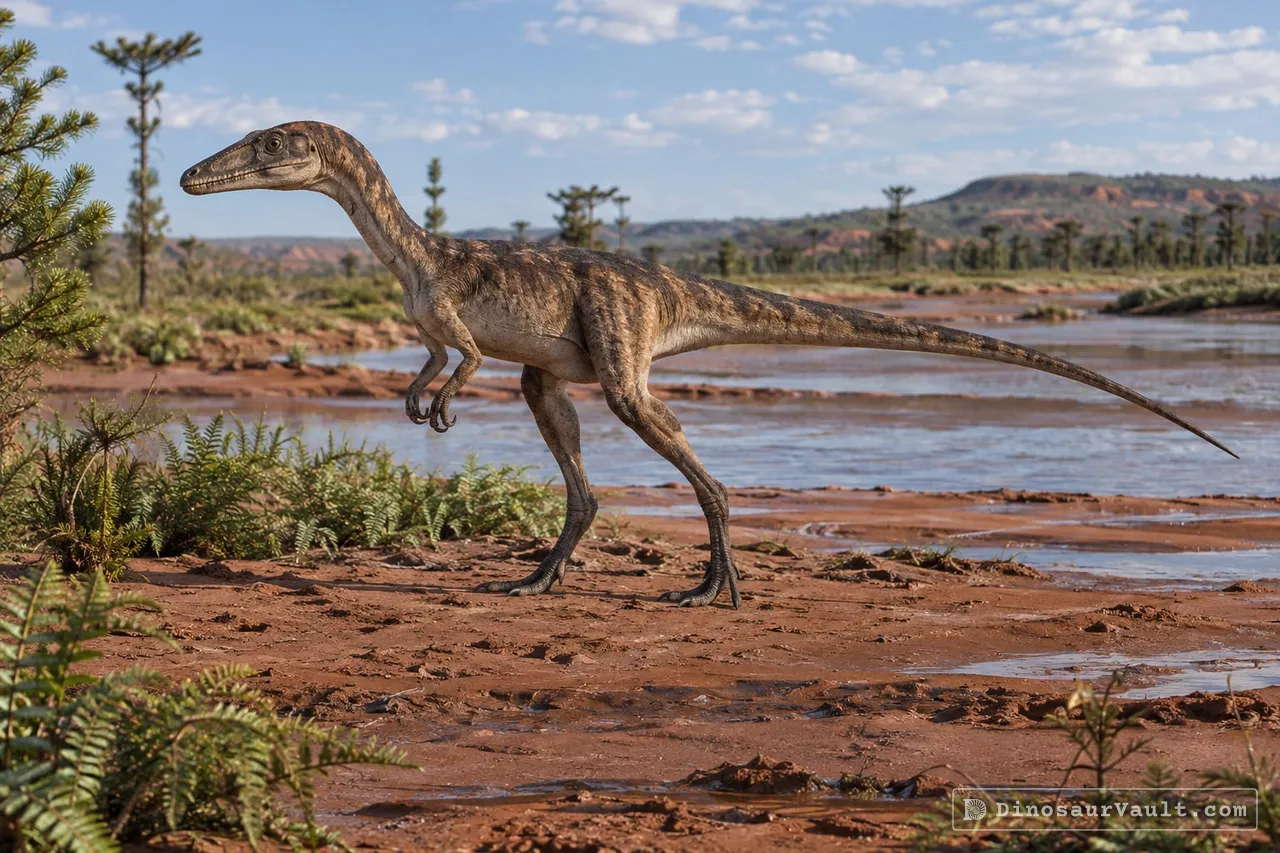
Erythrovenator was an early two-legged predator known only from a thigh bone. It is one of the oldest theropods known.
Its world
It lived in the Late Triassic in what is now Brazil. Its bone comes from the Candelária Formation, a red rock layer that also holds other early dinosaurs.
How it was found
Müller named it in 2020 from one find.
Field gallery
More views of Erythrovenator
Scenes reconstructed from the available fossil evidence.
The evidence
The science behind Erythrovenator
Which parts of the picture come from its own bones, and which come from its relatives.
From its own fossils
- Only the upper part of a left thigh bone is known, preserved in red mudstone.
- A ridge for muscle attachment near the top of the bone helped identify it as an early theropod.
Borrowed from relatives
- Its missing body can only be sketched by comparison with early theropods such as Coelophysis.
Still unknown
- The shape of its skull, limbs and tail.
- Its skin covering, color and full body size.
- Its closest relatives and the precise age of its fossil bed.
Discovery timeline
- 2018Fossil sitesPavanatto et al.
- 2020Named itMüller
- 2024Same rocksDoering et al.
Key papers
The research behind what we know of Erythrovenator
Fossil sites
Named a plant-eating mammal relative and described the unusual fossil site that also yielded Erythrovenator.
A new Upper Triassic cynodont-bearing fossiliferous site from southern Brazil, with taphonomic remarks and description of a new traversodontid taxon. Journal of South American Earth Sciences 88: 179-196
Read the paper : A new Upper Triassic cynodont-bearing fossiliferous site from southern Brazil, with taphonomic remarks and description of a new traversodontid taxon (opens in a new tab)Named it
Named an early theropod from part of a thigh bone, adding a carnivorous dinosaur to a fauna rich in mammal relatives.
A new theropod dinosaur from a peculiar Late Triassic assemblage of southern Brazil. Journal of South American Earth Sciences.
No link available
Same rocks
Described a rhynchosaur and additional dinosaur-line reptiles from the fossil complex, helping narrow the age of its unusual fauna.
New archosauromorph remains provide data on the age of a unique Late Triassic assemblage from southern Brazil. Journal of South American Earth Sciences 145: 105046
Read the paper : New archosauromorph remains provide data on the age of a unique Late Triassic assemblage from southern Brazil (opens in a new tab)
Close relatives
Other members of Theropoda


Sources: Wikidata