Where its fossils were found
The evidence
No finds with map coordinates are recorded yet.
Habitat
It may have lived on river plains in southern England.
Field notes
About Altispinax
What it was like
Altispinax is known only from a small amount of fossil material, mainly backbone pieces with unusually tall spines rising from them, the feature its name refers to. Because so little has been found, its full body size, proportions, and appearance are not well known. It was a carnivorous theropod, but beyond that, little can be said with confidence.
Its world
The exact place and time Altispinax lived are not well established from the fossils that survive. It is generally placed among the theropods, the meat-eating dinosaurs, but its scattered remains make it hard to say much more about its life or surroundings.
How it was found
Huene named Altispinax in 1923. Since then, the genus has remained one of the more uncertain names in dinosaur science: many paleontologists consider its remains too incomplete to say for certain how it relates to other theropods, and its classification is still debated today.
Field gallery
More views of Altispinax
Scenes reconstructed from the available fossil evidence.
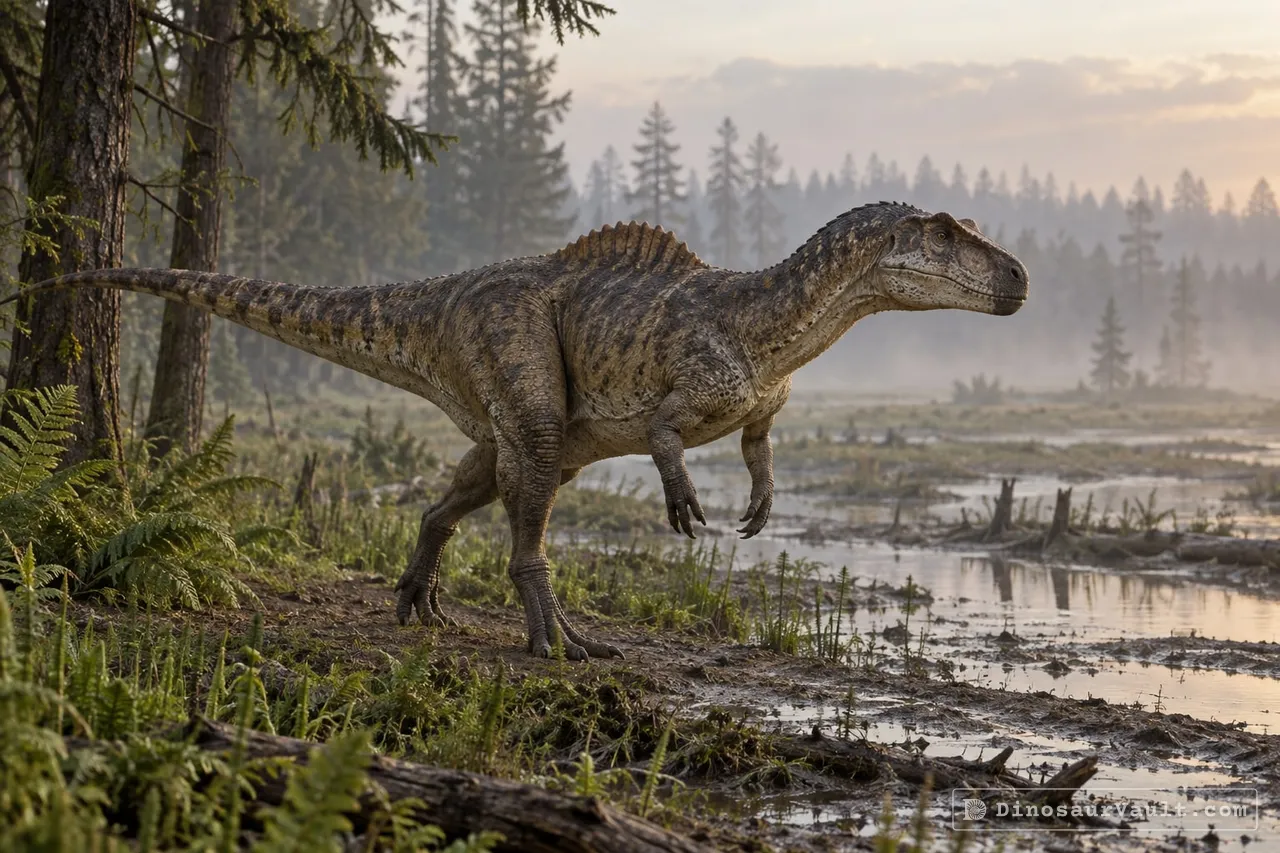
The evidence
The science behind Altispinax
Which parts of the picture come from its own bones, and which come from its relatives.
From its own fossils
- A short section of backbone preserves unusually tall spines above the vertebrae.
- The vertebrae remain joined together, preserving the shape of part of the raised back.
Borrowed from relatives
- The head, limbs and tail are modeled on better-known large theropods such as Allosaurus.
Still unknown
- Its body size, skull shape and closest relatives.
- How far the raised back extended, and whether it formed a sail or a fleshy hump.
- The exact fossil horizon and the landscape where it lived.
Often drawn wrong
- A complete sail running along the back goes beyond the short backbone section that survives.
Discovery timeline
- 1923Named itVON HUENE
- 2007Fossil sitesNaish & Martill
- 2016RedescriptionMaisch
Key papers
The research behind what we know of Altispinax
Named it
Introduced Altispinax while discussing European meat-eating dinosaurs and their tall-spined vertebrae.
Carnivorous Saurischia in Europe Since the Triassic. Geological Society of America Bulletin 34: 449-458
Read the paper : Carnivorous Saurischia in Europe Since the Triassic (opens in a new tab)Fossil sites
Reviewed the high-spined vertebrae under the name Becklespinax and separated them from the tooth historically linked to Altispinax.
Dinosaurs of Great Britain and the role of the Geological Society of London in their discovery: basal Dinosauria and Saurischia. Journal of the Geological Society 164: 493-510
Read the paper : Dinosaurs of Great Britain and the role of the Geological Society of London in their discovery: basal Dinosauria and Saurischia (opens in a new tab)Redescription
Argued that Altispinax was originally based on the high-spined vertebrae, making Becklespinax a later name for the same animal.
The nomenclatural status of the carnivorous dinosaur genus Altispinax v. Huene, 1923 (Saurischia, Theropoda) from the Lower Cretaceous of England. Neues Jahrbuch für Geologie und Paläontologie - Abhandlungen 280: 215-219
Read the paper : The nomenclatural status of the carnivorous dinosaur genus Altispinax v. Huene, 1923 (Saurischia, Theropoda) from the Lower Cretaceous of England (opens in a new tab)
Close relatives
Other members of Theropoda


Sources: Wikidata