Elaltitan
- Lived
- 90 to 86 million years ago, Late Cretaceous
- Diet
- Herbivore
- Group
- Sauropods
- Found in
- Argentina
- Named by
- Mannion and Otero 2012
Where its fossils were found
The evidence
Today

90 million years ago
Habitat
River channels and floodplains formed its landscape in Argentina. The Lago Colhué Huapi Formation also preserves Argyrosaurus, Aeolosaurus and Sektensaurus.
Field notes
About Elaltitan
What it was like
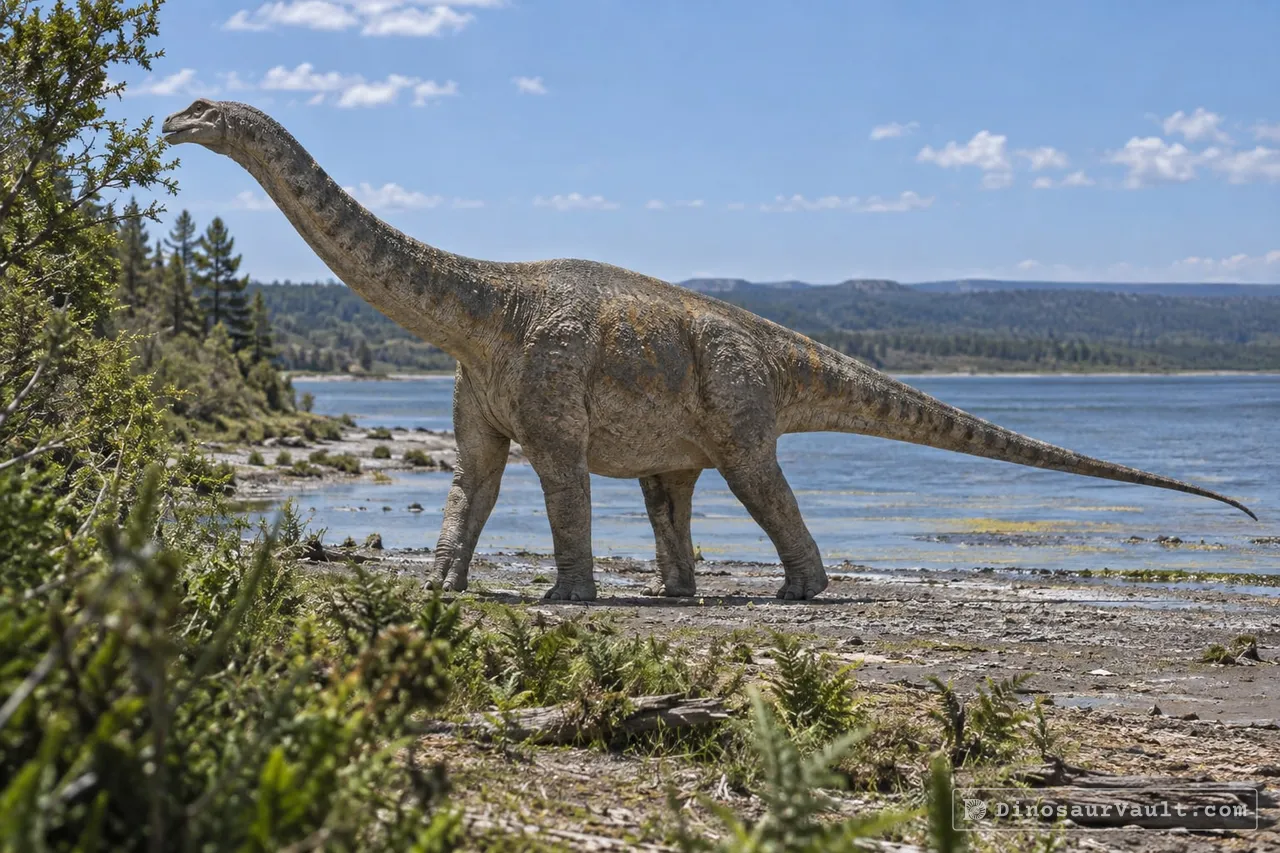
Elaltitan was a large titanosaur, a long-necked plant eater. It is known from bones of the back, tail and limbs.
Its world
It lived in the Late Cretaceous in what is now Argentina.
How it was found
Its bones were long thought to belong to Argyrosaurus. Mannion and Otero gave it its own name in 2012.
Field gallery
More views of Elaltitan
Scenes reconstructed from the available fossil evidence.
1 of 3
The evidence
The science behind Elaltitan
Which parts of the picture come from its own bones, and which come from its relatives.
From its own fossils
- A partial skeleton includes back and tail vertebrae, a shoulder blade, arm bones, part of the hip, hindlimb bones and an ankle bone. A bone first identified as a heel bone was later shown to be the end of the shin bone stuck to the fibula.
- Its forearm bones are stout, with a strong elbow process on the ulna, and its upper arm bore a crest for muscle attachment.
- A vertebra near the base of the tail has a ball-and-socket joint and a tall arch over its front half.
Borrowed from relatives
- The skull of Tapuiasaurus, another titanosaur, guides restorations of the missing head.
- The titanosaur Mnyamawamtuka guides the missing neck, body and tail, while the stout arms follow Elaltitan's own bones.
- Its hands and feet are unknown, so restorations follow other sauropods: a compact, column-like hand and feet based on articulated feet of Camarasaurus.
Still unknown
- The shape of its skull and the length of its neck.
- Its closest relatives. A recent family-tree study paired it with Bonatitan, but where that pair sits among other titanosaurs changed with the method used.
- Its skin texture and color.
Discovery timeline
- 2012Named itMannion & Otero
- 2017RedescriptionMannion, Allain & Moine
- 2017Same rocksIbiricu et al.
- 2019Same rocksIbiricu et al.
- 2025Family treeDíaz et al.
Key papers
The research behind what we know of Elaltitan
Named it
Separated a partial skeleton from Argyrosaurus and named Elaltitan from distinctive features of its backbone and limbs.
A reappraisal of the Late Cretaceous Argentinean sauropod dinosaurArgyrosaurus superbus, with a description of a new titanosaur genus. Journal of Vertebrate Paleontology 32: 614-638
Read the paper : A reappraisal of the Late Cretaceous Argentinean sauropod dinosaurArgyrosaurus superbus, with a description of a new titanosaur genus (opens in a new tab)Redescription
While describing an early relative, the authors re-examined the ankle of Elaltitan and showed that its supposed heel bone is a fragment of shin bone.
The earliest known titanosauriform sauropod dinosaur and the evolution of Brachiosauridae. PeerJ 5: e3217
Read the paper : The earliest known titanosauriform sauropod dinosaur and the evolution of Brachiosauridae (opens in a new tab)Same rocks
Described additional titanosaurs from the formation that also contains Elaltitan, expanding the picture of its regional dinosaur fauna.
New materials of lithostrotian titanosaurs (Dinosauria: Sauropoda) from the Upper Cretaceous of central Patagonia. Cretaceous Research 73: 25-39
Read the paper : New materials of lithostrotian titanosaurs (Dinosauria: Sauropoda) from the Upper Cretaceous of central Patagonia (opens in a new tab)Same rocks
Named Sektensaurus, a plant eater from the same formation as Elaltitan, Argyrosaurus and Aeolosaurus.
A new ornithopod dinosaur (Dinosauria: Ornithischia) from the Late Cretaceous of central Patagonia. Cretaceous Research 98: 276-291
Read the paper : A new ornithopod dinosaur (Dinosauria: Ornithischia) from the Late Cretaceous of central Patagonia (opens in a new tab)Family tree
A large titanosaur family tree included Elaltitan and grouped it with Bonatitan, though wider relationships shifted between analyses.
Revision of Romanian sauropod dinosaurs reveals high titanosaur diversity and body-size disparity on the latest Cretaceous Haţeg Island, with implications for titanosaurian biogeography. Journal of Systematic Palaeontology 23
Read the paper : Revision of Romanian sauropod dinosaurs reveals high titanosaur diversity and body-size disparity on the latest Cretaceous Haţeg Island, with implications for titanosaurian biogeography (opens in a new tab)
Close relatives
Other members of Lithostrotia


Sources: Wikidata