Diodorus
- Lived
- 237 to 206 million years ago, Late Triassic
- Diet
- Herbivore
- Group
- Early ornithischians, Silesauridae
- Found in
- Morocco
- Named by
- Kammerer et al. 2012
Where its fossils were found
The evidence
Today

220 million years ago
Habitat
It lived in Late Triassic Morocco, where its bones were buried in mud. The same fossil layer contains fish, crocodile-like phytosaurs and large amphibians.
Field notes
About Diodorus
What it was like
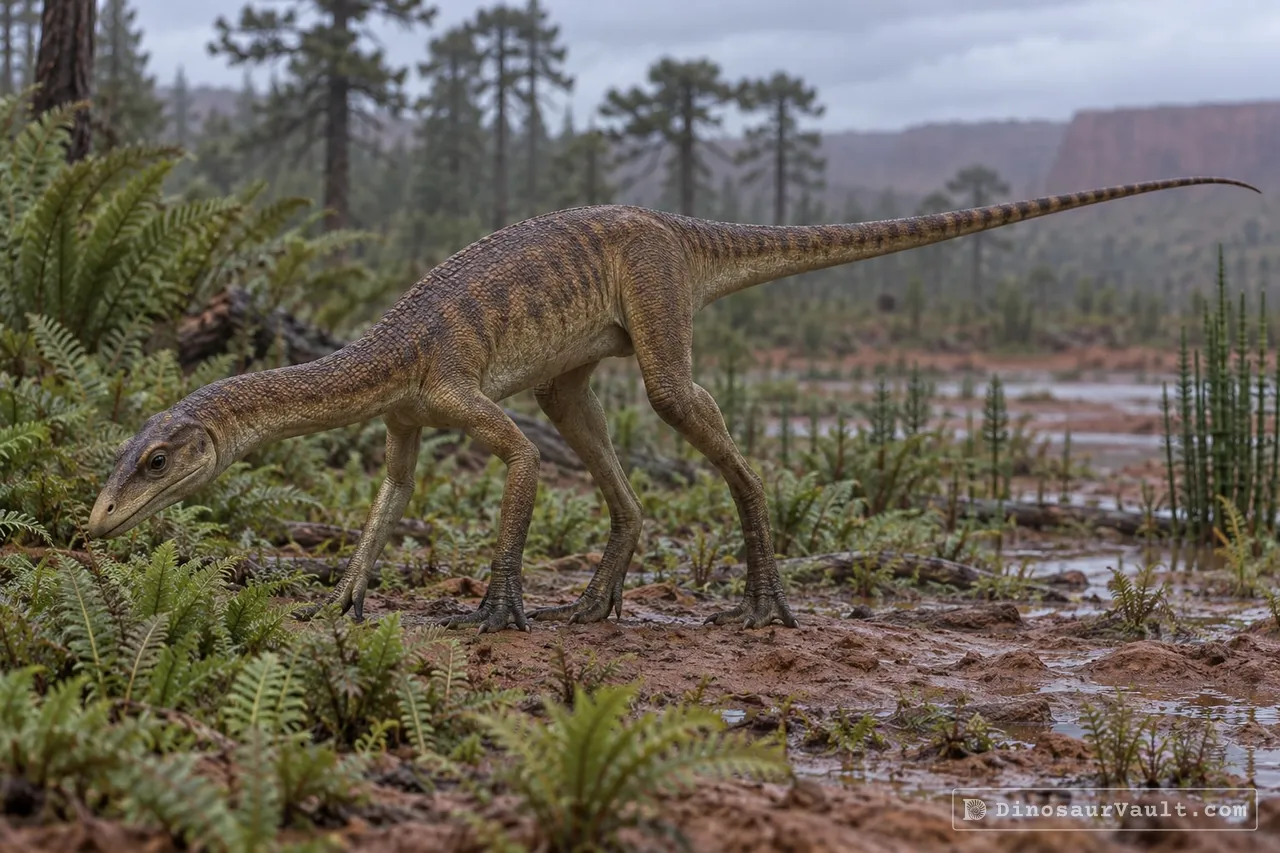
Diodorus was a silesaur, a plant-eating member of that group. It is known from part of a lower jaw and teeth. Separate limb bones have also been tentatively assigned to it.
Scientists still debate whether silesaurs were early dinosaurs or their close cousins.
Its world
It lived in the Late Triassic in what is now Morocco. Its bones come from the Timezgadiouine Formation.
How it was found
Kammerer and colleagues named Diodorus in 2012. Its type specimen is part of a lower jaw; the other assigned bones were found apart and probably come from different animals.
Field gallery
More views of Diodorus
Scenes reconstructed from the available fossil evidence.
1 of 3
The evidence
The science behind Diodorus
Which parts of the picture come from its own bones, and which come from its relatives.
From its own fossils
- The type specimen is the front part of a right lower jaw, missing its very tip. The jaw bows downward and holds triangular teeth with serrated edges that lean forward and become smaller toward the front.
- A raised ridge runs along the outer side of the jaw below the teeth and fades toward the front, and a groove on the inner side widens toward the back.
- Matching isolated teeth were assigned to it from the same site. Long, nearly straight upper arm bones, a crushed thigh bone and a tentatively identified foot bone were also assigned to it, but they probably come from different individuals.
Borrowed from relatives
- The missing face, neck, body, hips and upper parts of the limbs are restored by comparison with Silesaurus, which is known from several skeletons.
- Its teeth resemble those of Sacisaurus, which also has smaller, forward-leaning teeth at the front of the lower jaw.
Still unknown
- The shape of its complete skull, its hands and its tail.
- Its skin covering and color.
- Whether silesaurs were early ornithischian dinosaurs or close relatives outside Dinosauria. Recent studies still disagree.
Discovery timeline
- 2003Close relativeDzik
- 2012Named itKammerer, Nesbitt & Shubin
- 2013Family treeLanger et al.
- 2020Family treeMüller & Garcia
Key papers
The research behind what we know of Diodorus
Close relative
Named Silesaurus, a beaked plant eater close to the dinosaurs, from several skeletons that include skull bones, necks, limbs and hips.
A beaked herbivorous archosaur with dinosaur affinities from the early Late Triassic of Poland. Journal of Vertebrate Paleontology 23: 556-574
Read the paper : A beaked herbivorous archosaur with dinosaur affinities from the early Late Triassic of Poland (opens in a new tab)Named it
Named Diodorus from a partial jaw and assigned other teeth and limb bones to it, identifying a close relationship with Sacisaurus.
The First Silesaurid Dinosauriform from the Late Triassic of Morocco. Acta Palaeontologica Polonica 57: 277-284
Read the paper : The First Silesaurid Dinosauriform from the Late Triassic of Morocco (opens in a new tab)Family tree
Reviewed early dinosaur relatives, including Diodorus, and compared their feeding, movement and geographic spread.
Non-dinosaurian Dinosauromorpha. Geological Society, London, Special Publications 379: 157-186
Read the paper : Non-dinosaurian Dinosauromorpha (opens in a new tab)Family tree
Proposed that silesaurs belonged along the early branches of Ornithischia rather than outside the dinosaur family tree.
A paraphyletic ‘Silesauridae' as an alternative hypothesis for the initial radiation of ornithischian dinosaurs. Biology Letters 16: 20200417
Read the paper : A paraphyletic ‘Silesauridae' as an alternative hypothesis for the initial radiation of ornithischian dinosaurs (opens in a new tab)
Close relatives
Other members of Silesauridae


Sources: Wikidata