Daxiatitan
"Daxia titan"
- Lived
- 126 to 113 million years ago, Early Cretaceous
- Diet
- Herbivore
- Group
- Sauropods, Euhelopodidae
- Found in
- China
- Named by
- You et al. 2008
Where its fossils were found
The evidence
Fossil record
Hekou Group, Gansu, China
Early Cretaceous
The skeleton comes from the Hekou Group. The source record does not establish a formally named formation.
Today

120 million years ago
Habitat
It lived in a landscape of rivers and lakes in China. Huanghetitan and Yongjinglong are known from the same rocks.
Field notes
About Daxiatitan
What it was like
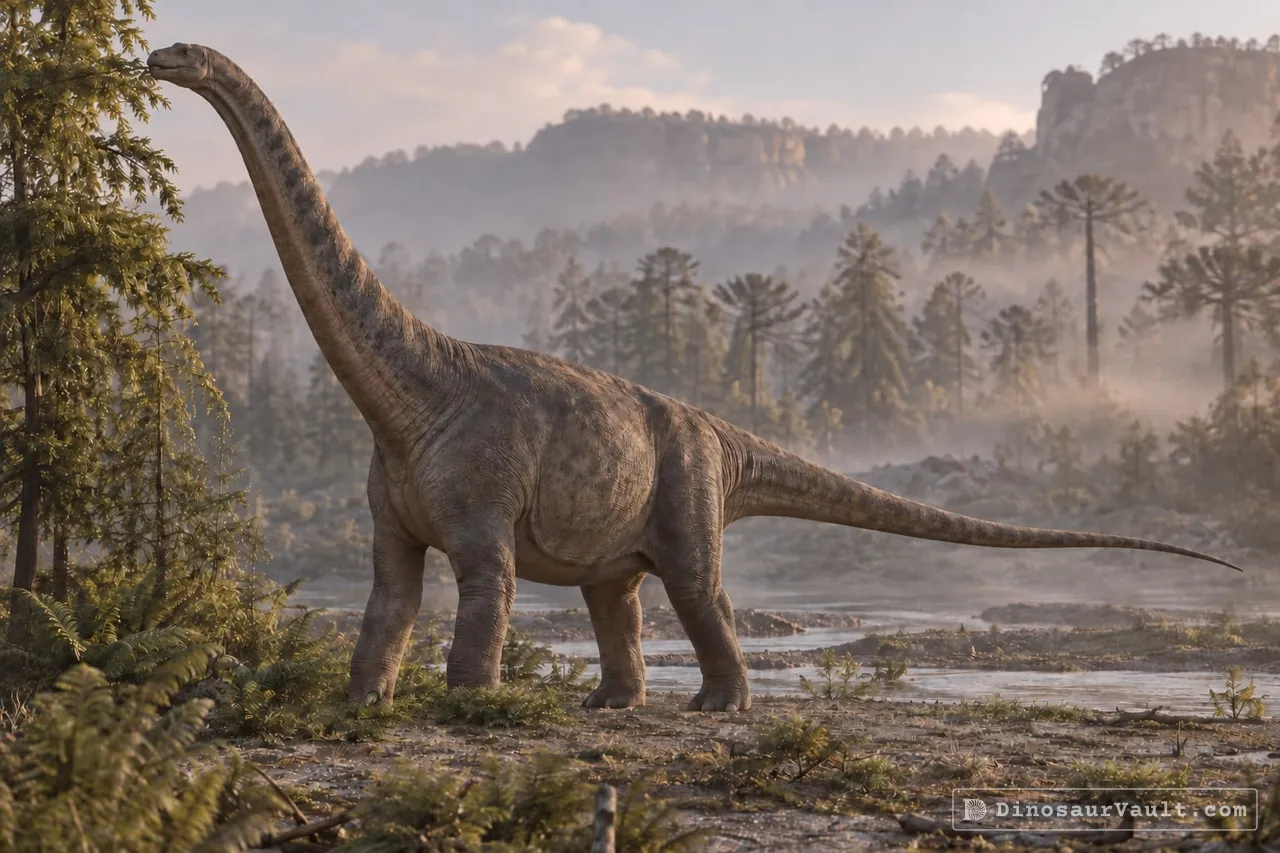
Daxiatitan was a large sauropod with a very long neck. It is known from much of the neck, part of the back and a thigh bone.
Its world
It lived in the Early Cretaceous, in what is now China. It shared its world with the giant sauropod Huanghetitan.
How it was found
You and colleagues named Daxiatitan in 2008.
Field gallery
More views of Daxiatitan
Scenes reconstructed from the available fossil evidence.
1 of 3
The evidence
The science behind Daxiatitan
Which parts of the picture come from its own bones, and which come from its relatives.
From its own fossils
- Its neck and back bones come from an incomplete skeleton, with part of the backbone still joined together.
- Its neck vertebrae are much longer than those of Yongjinglong, and its neck ribs are long.
- A large shoulder blade has a prominent bump where an arm muscle attached.
Borrowed from relatives
- The missing head can be restored by comparison with other sauropods such as the titanosaur Tapuiasaurus, and the feet with better-known sauropods such as Euhelopus.
- The muscles supporting its neck can be reconstructed by comparing the bones with those of living birds.
Still unknown
- The shape of its skull.
- Its full body length and skin color.
- Its place in the family tree. One analysis grouped it with Euhelopus, while a newer one puts it among titanosaurs, close to Xianshanosaurus.
Discovery timeline
- 2008Named itYou et al.
- 2012Family treeD'EMIC
- 2014Same rocksLi et al.
- 2025Family treeShan
Key papers
The research behind what we know of Daxiatitan
Named it
Introduced a giant sauropod from China with exceptionally large neck bones and an unusual thigh bone.
Daxiatitan binglingi: a giant sauropod dinosaur from the Early Cretaceous of China. Gansu Geology 17: 1-10
No link available
Family tree
Grouped Daxiatitan with Euhelopus and other Asian sauropods in an analysis of the early titanosauriform family tree.
The early evolution of titanosauriform sauropod dinosaurs. Zoological Journal of the Linnean Society 166: 624-671
Read the paper : The early evolution of titanosauriform sauropod dinosaurs (opens in a new tab)Same rocks
Named Yongjinglong from the same rocks and compared its neck and shoulder bones with Daxiatitan.
A New Titanosaurian Sauropod from the Hekou Group (Lower Cretaceous) of the Lanzhou-Minhe Basin, Gansu Province, China. PLoS ONE 9: e85979
Read the paper : A New Titanosaurian Sauropod from the Hekou Group (Lower Cretaceous) of the Lanzhou-Minhe Basin, Gansu Province, China (opens in a new tab)Family tree
A family tree built while redescribing Liaoningotitan placed Daxiatitan among titanosaurs beside Xianshanosaurus.
The re-description of Liaoningotitan sinensis Zhou et al., 2018. PeerJ 13: e19154
Read the paper : The re-description of Liaoningotitan sinensis Zhou et al., 2018 (opens in a new tab)
Close relatives
Other members of Euhelopodidae


Sources: Wikidata